We use Google Analytics to understand how visitors use this site. Analytics cookies are only activated with your consent. For details, read our Privacy Policy.
Profile lensThe same player, read from a different angle.
Athletic82
Acceleration
80
Pace
77
Agility
77
Strength
84
Balance
79
Jumping
85
Stamina
89
Fitness
86
Technical80
Dribbling
77
Short Passing
77
Long Passing
79
Finishing
76
Shot Accuracy
78
Shot Power
87
Shooting Technique
69
Heading
84
Tackling
84
Crossing
72
Free Kick
68
Penalties
69
First Touch
77
Mental89
Composure
85
Aggression
77
Consistency
93
Creativity
66
Leadership
87
Work Rate
95
Tactical84
Vision
75
Off the Ball
75
Defensive Positioning
85
Teamwork
90
Anticipation
85
Marking
86
Attacking77
Crossing
72
Finishing
76
Heading Accuracy
84
Shot Accuracy
78
Off the Ball
75
Technique75
Dribbling
77
Free Kick
68
Short Passing
77
Long Passing
79
First Touch
77
Shot Technique
69
Movement78
Acceleration
80
Pace
77
Agility
77
Balance
79
Physicality86
Shot Power
87
Jumping
85
Stamina
89
Strength
84
Fitness
86
Defending85
Marking
86
Tackling
84
Def. Positioning
85
Mentality & Game Reading82
Aggression
77
Composure
85
Penalties
69
Vision
75
Leadership
87
Work Rate
95
Teamwork
90
Anticipation
85
Consistency
93
Creativity
66
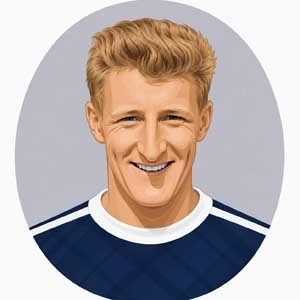
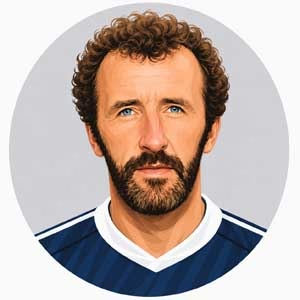
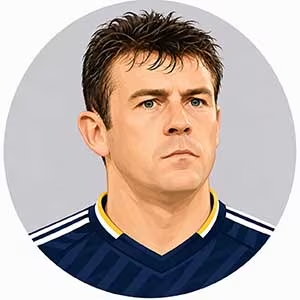
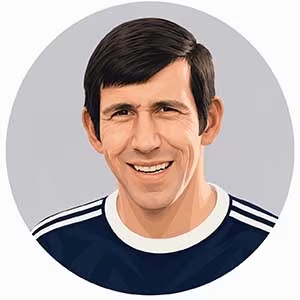
Scotland - Centre-backGreig, John
Rangers built a bronze statue outside Ibrox in 2001, and the man they chose to depict, in a deliberately reflective pose, was not their greatest goalscorer or their most gifted individual talent. It was John Greig — captain of the club on the day in 1971 when a crowd crush killed sixty-six of the club's own supporters inside the stadium he had spent his career representing. The statue was raised as part of the memorial to that disaster, and the choice of Greig as its figure said as much about what the club valued in him as any of his trophies did.
Born in Edinburgh in 1942, Greig grew up a Hearts supporter, and signed for Rangers only reluctantly, at his father's insistence, before a 6–1 thrashing of Hibernian convinced the teenager the move had been the right one after all. He began as a forward, was moved back through midfield — initially playing alongside Jim Baxter — and finally settled at left-back, a positional journey that reflected a player never regarded as technically outstanding but who, by universal consensus among teammates, opponents and generations of Rangers supporters, made himself indispensable through sheer determination and force of will. He made 755 official appearances across seventeen seasons, scored 120 goals — mostly during his early years further forward — and won five league titles, six Scottish Cups, four League Cups and three domestic Trebles, a treble record no other player in the club's history has matched. He captained the side to its greatest single triumph, the 1972 European Cup Winners' Cup final victory over Dynamo Moscow in Barcelona, having earlier come agonizingly close in a 1967 final defeat to a Bayern Munich side built around a young Franz Beckenbauer, played in conditions close to a home fixture for the Germans. For Scotland he won 44 caps, captaining the side 15 times, scoring the country's most celebrated goal of that era — a late winner against Italy in a 1965 World Cup qualifier watched by over 100,000 at Hampden, finished off a one-two with Baxter — and later captaining Scotland to a famous 3–2 win over England at Wembley in 1967, the reigning World Champions' first defeat since winning the trophy.
His limitations were the honest ones his own admirers describe openly: Greig was never among the most technically gifted players of his generation, and his career unfolded largely in the shadow of Jock Stein's dominant Celtic side, which won nine consecutive league titles through much of his own captaincy. Against opponents with superior individual quality, his contribution depended more on organization, physical commitment and sheer refusal to be beaten than on any technical solution he could produce alone.
Temperamentally he was defined, with total consistency across every account of his career, by an inspirational, example-setting leadership that extended well beyond his own performance. He made a habit of being available to younger teammates, offering guidance and support as a matter of course rather than obligation, and his captaincy through the club's most harrowing chapter — the 1971 Ibrox disaster — became the defining measure of his character precisely because football had nothing to do with what was required of him that day. When manager Jock Wallace resigned in 1978, Rangers turned to Greig within twenty-four hours, ending his playing career abruptly to make him manager instead, a transition that reflected the institutional trust built over more than a decade of captaincy. He led the club to a cup double in his first season in charge before resigning in 1983, returned to Ibrox in a public relations role in 1990, later joined the board of directors, and was named honorary life president and ambassador in 2015 — a nearly unbroken institutional relationship spanning more than six decades. Fans voted him the Greatest Ever Ranger in 1999, a judgment the club has never seriously revisited since. Determined rather than gifted, dignified in the club's darkest moment as much as in its greatest one, and permanently identified with a single institution across every role football offered him, Greig built a legacy less on any individual moment than on being, for the better part of his life, simply what Rangers meant.


 All Time ScotlandNT