We use Google Analytics to understand how visitors use this site. Analytics cookies are only activated with your consent. For details, read our Privacy Policy.
Profile lensThe same player, read from a different angle.
Athletic81
Acceleration
74
Pace
78
Agility
76
Strength
86
Balance
82
Jumping
85
Stamina
84
Fitness
85
Technical82
Dribbling
81
Short Passing
82
Long Passing
80
Finishing
60
Shot Accuracy
58
Shot Power
77
Shooting Technique
70
Heading
87
Tackling
90
Crossing
75
Free Kick
60
Penalties
60
First Touch
80
Mental89
Composure
88
Aggression
77
Consistency
90
Creativity
71
Leadership
89
Work Rate
91
Tactical86
Vision
74
Off the Ball
67
Defensive Positioning
90
Teamwork
91
Anticipation
91
Marking
89
Player Traits
Attacking69
Crossing
75
Finishing
60
Heading Accuracy
87
Shot Accuracy
58
Off the Ball
67
Technique76
Dribbling
81
Free Kick
60
Short Passing
82
Long Passing
80
First Touch
80
Shot Technique
70
Movement78
Acceleration
74
Pace
78
Agility
76
Balance
82
Physicality83
Shot Power
77
Jumping
85
Stamina
84
Strength
86
Fitness
85
Defending90
Marking
89
Tackling
90
Def. Positioning
90
Mentality & Game Reading82
Aggression
77
Composure
88
Penalties
60
Vision
74
Leadership
89
Work Rate
91
Teamwork
91
Anticipation
91
Consistency
90
Creativity
71
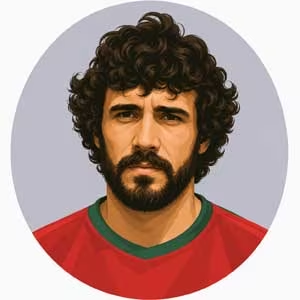
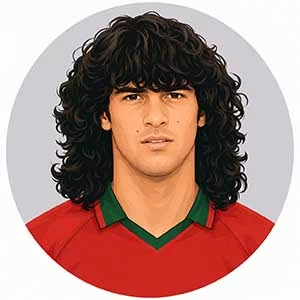
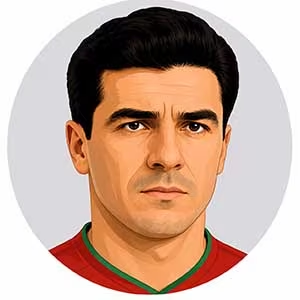
Portugal - Centre-backGermano
On 27 May 1965, Benfica were chasing an equaliser against Inter in the European Cup final at San Siro when goalkeeper Costa Pereira could no longer continue. Substitutions were not available. Germano de Figueiredo, already carrying the responsibility of organising Benfica’s defence, took the gloves and went into goal for the final half-hour. Inter were protecting a 1–0 lead in their own stadium, yet Germano conceded nothing further and dealt with several dangerous situations before the final whistle. Benfica still lost, but the episode distilled his footballing identity: when structure collapsed around him, Germano did not dramatise the emergency. He identified what the team required, changed function and carried on.
Germano was primarily a centre-back, although his understanding of space and comfort with the ball allowed him to perform across several defensive and midfield positions during his career. At around 1.83 metres, he possessed enough strength for direct contests but was distinguished less by physical intimidation than by positioning, anticipation and the speed with which he converted recovery into possession. Benfica’s own accounts emphasise how frequently he reorganised teammates from the centre of defence, stepped forward to intercept and then delivered the ball rapidly and accurately into midfield or attack. He could follow an opponent away from the defensive line when necessary, but his strongest defending came from reading where danger would develop rather than pursuing collisions for their own sake. That intelligence made him particularly important to an adventurous Benfica side whose attacking ambition frequently demanded defensive judgement behind it. Germano developed at Atlético Clube de Portugal and spent most of the 1950s there before joining Benfica in 1960 at 27, relatively late for a player who would become central to one of Europe’s dominant teams. During seven seasons with Benfica he won four Portuguese league titles, two Portuguese Cups and consecutive European Cups in 1961 and 1962, starting both finals. He also appeared in the losing European Cup finals of 1963 and 1965. For Portugal he won 24 caps between 1953 and 1966 and captained the national team during the qualification campaign for the 1966 World Cup. He appeared once at the tournament as Portugal eventually finished third, bringing his international career to an end.
Germano’s authority could obscure the limits produced by his style. Because he trusted anticipation and positional control, opponents capable of accelerating suddenly beyond the line could punish an incorrect step more severely than they would a defender who remained permanently deep. He was strong in the tackle but not built around repeated recovery sprints, and his value decreased when defensive situations became permanently chaotic rather than readable. His willingness to move forward with an opponent or begin possession from defence also created space if teammates failed to cover behind him. Age amplified those risks: much of his greatest European football came around thirty, when accumulated experience compensated for declining physical margins, but that balance could not remain indefinitely. His 1966 World Cup appearance against Bulgaria was also his last international match, and contemporary accounts differ over whether his subsequent absence was principally caused by physical problems or by dissatisfaction with that performance. Either way, by then Portugal possessed alternatives better suited to the demands of the remaining tournament.
Psychologically, Germano’s strongest signal is controlled authority rather than emotional detachment. Benfica’s historical material describes him as the voice directing the defence in the 1961 European Cup campaign, repositioning teammates during matches and simplifying dangerous situations through instruction. Leadership therefore was not merely symbolic captaincy: teammates could hear and follow it in real time. Yet recollections away from competition describe a markedly reserved man. Former Benfica players remembered him arriving before training, sitting beside the goal and reading while others joked around him; teammates later spoke of him as unusually well read, interested in books, cinema and music. That combination matters. Germano did not appear to need constant social performance in order to exercise authority once the match began. Responsibility activated a different register. The 1965 final provides the clearest example: when Costa Pereira could no longer remain in goal, Germano accepted an unfamiliar position in the most important club match available rather than disputing the risk or protecting his own reputation. The emergency changed his task but not visibly his composure. His behaviour in Benfica’s earlier European triumphs points in the same direction. Match reports repeatedly describe interventions made through positioning, instructions and uncomplicated clearances rather than increasingly aggressive reactions as pressure rose. There is little reliable evidence of habitual confrontation with referees, retaliation after fouls or emotional escalation against hostile crowds, so assigning him a volatile disciplinary profile would be unsupported. Physical confrontation belonged to his work, but the surviving accounts emphasise precision and control more than intimidation. His relationship with teammates also seems to have combined hierarchy with instruction rather than humiliation: younger players later remembered him as someone from whom they learned both football and conduct, not simply someone who demanded obedience. Major occasions clearly did not reduce his functionality. He started four European Cup finals in five seasons and, even in defeat, repeatedly remained central to Benfica’s defensive organisation. Germano therefore offers a form of leadership different from visible emotional mobilisation. His influence came from making the surrounding structure clearer. Under pressure he did not appear to become louder because he was frightened or more reckless because the stakes increased; he became useful by assigning positions, choosing the simplest defensive solution and accepting responsibilities that the situation imposed.


 All Time PortugalNT