We use Google Analytics to understand how visitors use this site. Analytics cookies are only activated with your consent. For details, read our Privacy Policy.
Profile lensThe same player, read from a different angle.
Athletic80
Acceleration
74
Pace
78
Agility
68
Strength
87
Balance
82
Jumping
87
Stamina
83
Fitness
80
Technical77
Dribbling
72
Short Passing
75
Long Passing
75
Finishing
68
Shot Accuracy
66
Shot Power
87
Shooting Technique
66
Heading
87
Tackling
85
Crossing
67
Free Kick
72
Penalties
66
First Touch
73
Mental77
Composure
70
Aggression
88
Consistency
80
Creativity
64
Leadership
84
Work Rate
81
Tactical80
Vision
70
Off the Ball
66
Defensive Positioning
84
Teamwork
74
Anticipation
84
Marking
88
Player Traits
Attacking71
Crossing
67
Finishing
68
Heading Accuracy
87
Shot Accuracy
66
Off the Ball
66
Technique72
Dribbling
72
Free Kick
72
Short Passing
75
Long Passing
75
First Touch
73
Shot Technique
66
Movement76
Acceleration
74
Pace
78
Agility
68
Balance
82
Physicality85
Shot Power
87
Jumping
87
Stamina
83
Strength
87
Fitness
80
Defending86
Marking
88
Tackling
85
Def. Positioning
84
Mentality & Game Reading76
Aggression
88
Composure
70
Penalties
66
Vision
70
Leadership
84
Work Rate
81
Teamwork
74
Anticipation
84
Consistency
80
Creativity
64
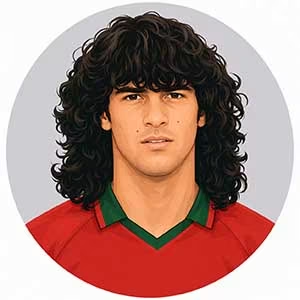
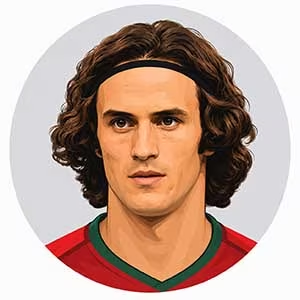
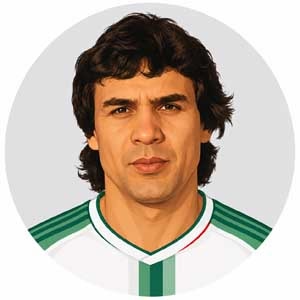
Portugal - Centre-backCouto, Fernando
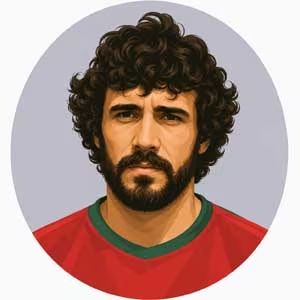
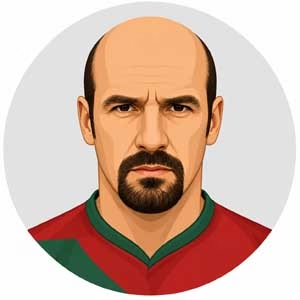
A wild, streaming mane of dark hair, an unyielding glare in the tunnel, and an uncompromising, bone-jarring leap into an aerial duel established a warrior from Espinho as the definitive defensive enforcer of Portuguese football’s golden era. Fernando Manuel Silva Couto was a ferocious, gladiatorial center-back who paired intense physical intimidation, dark-arts aerial supremacy, and aggressive man-marking with surprising technical composure and leadership authority.
Standing six feet tall with an exceptional vertical spring and textbook tackling mechanics, Couto turned penalty boxes into combat zones. He excelled at pinning opposing target-men, contesting high crosses with fearless commitment, and organizing the backline through vocal command. Rising through FC Porto, he made 158 appearances under Artur Jorge and Bobby Robson, lifting three Primeira Liga titles and three Taças de Portugal. He then embarked on a glittering European odyssey across Italy and Spain: anchoring Zdeněk Zeman’s Parma to the 1994–95 UEFA Cup, winning the 1996–97 Cup Winners' Cup, 1997–98 Copa del Rey, and 1997–98 La Liga title with Barcelona, and becoming an untouchable icon at Sven-Göran Eriksson’s SS Lazio. In Rome, he swept the 1999–2000 Scudetto, two Coppe Italia, the 1998–99 Cup Winners' Cup, and the 1999 UEFA Super Cup. For Portugal, across 110 caps and eight goals, he captained the celebrated Geração de Ouro, starring at Euro '96, Euro 2000, the 2002 World Cup, and Euro 2004, after winning the 1989 FIFA World Youth Championship in Riyadh.
That combative, high-friction style, however, constantly skirted the absolute boundaries of refereeing tolerance. Couto was an unapologetic practitioner of defensive deterrence—accumulating a heavy collection of yellow and red cards throughout his career due to reckless lunges, physical confrontations, and aerial elbowing. When drawn into isolated footraces against nimble, low-gravity forwards in wide-open forty-yard channels, his heavy turning radius and aggressive front-foot instincts could be exploited if his initial challenge failed to win the ball. Furthermore, his career was interrupted in 2001 by a high-profile, controversial doping ban that sidelined him for several months during his prime at Lazio.
Fierce, immensely passionate, and carrying an unshakeable code of protective loyalty toward his teammates, Couto was a natural-born dressing-room general. He relished high-voltage derby hostility, treating every clearance as a personal statement and thriving under the whistle of hostile away crowds. On the pitch, his body language was all kinetic menace: pounding his chest after vital blocks, staring down opposing strikers, and rising highest above clusters of bodies to power headers clear. Inside the Porto, Barcelona, Lazio, and Portuguese dressing rooms, his moral authority was absolute—an adored, fearless patriarch whose physical bravery, competitive fury, and tactical reliability made him one of the most decorated and feared defenders in European history.