We use Google Analytics to understand how visitors use this site. Analytics cookies are only activated with your consent. For details, read our Privacy Policy.
Profile lensThe same player, read from a different angle.
Athletic82
Acceleration
87
Pace
85
Agility
88
Strength
73
Balance
76
Jumping
86
Stamina
79
Fitness
79
Technical85
Dribbling
91
Short Passing
81
Long Passing
77
Finishing
86
Shot Accuracy
88
Shot Power
84
Shooting Technique
84
Heading
81
Tackling
44
Crossing
73
Free Kick
77
Penalties
76
First Touch
88
Mental76
Composure
78
Aggression
75
Consistency
73
Creativity
89
Leadership
73
Work Rate
76
Tactical81
Vision
80
Off the Ball
87
Defensive Positioning
44
Teamwork
77
Anticipation
85
Marking
42
Attacking83
Crossing
73
Finishing
86
Heading Accuracy
81
Shot Accuracy
88
Off the Ball
87
Technique83
Dribbling
91
Free Kick
77
Short Passing
81
Long Passing
77
First Touch
88
Shot Technique
84
Movement84
Acceleration
87
Pace
85
Agility
88
Balance
76
Physicality80
Shot Power
84
Jumping
86
Stamina
79
Strength
73
Fitness
79
Defending43
Marking
42
Tackling
44
Def. Positioning
44
Mentality & Game Reading78
Aggression
75
Composure
78
Penalties
76
Vision
80
Leadership
73
Work Rate
76
Teamwork
77
Anticipation
85
Consistency
73
Creativity
89
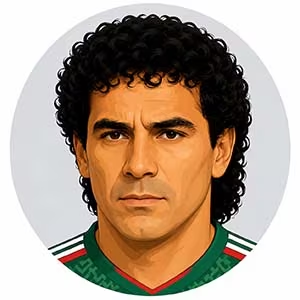
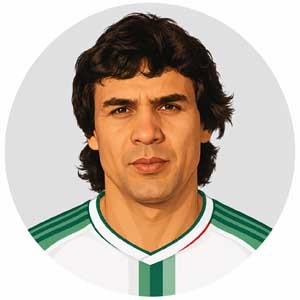
Algeria - ForwardMadjer, Rabah
In Vienna on 27 May 1987, Porto were trailing Bayern Munich 1–0 with eleven minutes remaining when Juary’s low ball reached Rabah Madjer near the six-yard box. Madjer was moving across goal, slightly unbalanced and facing away from the target. A conventional finish was almost unavailable. He used his heel instead, redirecting the ball behind him and past Jean-Marie Pfaff. Minutes later, after briefly leaving the field with cramp, he asked to return, demanded the ball on the left, attacked the full-back and crossed precisely for Juary to score the winner. Madjer later admitted that the night before the final he had been genuinely afraid; Bayern were experienced, Porto were playing their first European Cup final, and the scale of the occasion affected him. Yet the emotional reaction did not become behavioural caution. On the contrary, when the decisive moment arrived he selected the least orthodox available solution and then, still physically compromised, immediately sought another attacking responsibility. His 1987 final therefore offers unusually clean evidence that fear and performance degradation were separate variables in his competitive psychology.
Madjer was a mobile, technically expressive forward who could play as a central striker, second forward or drifting attacking reference. He was not primarily a fixed penalty-box finisher. His game depended on movement, receiving in unstable positions, carrying into defenders and creating actions that opponents had difficulty predicting. He later described himself as someone who always searched for an additional dribble or an additional gesture rather than simply completing the obvious action. That instinct was not decorative in isolation: it could produce goals, assists and destabilisation. At Porto he became decisive in the club’s greatest season, scoring in the European Cup final and then again in the Intercontinental Cup, where his lob in the snow against Peñarol helped secure another trophy. He had already been a central figure for Algeria, notably in the 1982 World Cup victory over West Germany, and remained one of the most recognisable African attackers of his generation. His physical profile supported the technique: agile, quick over short distances and comfortable changing direction while carrying the ball. Madjer was most dangerous when given enough freedom to interpret the final third rather than being reduced to rigid occupation of one channel.
The same appetite for invention created his limitations. Madjer himself acknowledged that he sometimes sought one gesture or one dribble more than necessary. That tendency could increase attacking unpredictability, but it could also reduce efficiency when the simpler continuation was already available. He was not a controlling playmaker who could guarantee rhythm through repeated secure possession, nor a physically dominant centre-forward capable of solving every match through aerial occupation or hold-up strength. His game needed technical freedom, access to combinations and enough confidence to act instinctively. Remove those conditions and his contribution could become less stable. Injury also changed the trajectory of his peak. A serious thigh problem during his period with Valencia disrupted a proposed move to Inter and contributed to an interrupted late-1980s sequence at precisely the moment his European reputation was highest. His limitations therefore should not be reduced to inconsistency. The more specific degradation conditions were physical restriction, tactical environments that demanded repeated low-risk execution and situations in which improvisation ceased to be functionally useful.
Psychologically, Madjer is best defined by **pressure-amplified inventiveness under trusted autonomy**. His own retrospective account of the 1987 final is unusually valuable because he does not rewrite himself as fearless: he explicitly remembered strong anxiety before the match, then described the heel finish as an instinctive act executed because there was no time to calculate. That is not general composure. It is a specific sequence in which emotional arousal remained high while decision-making stayed expansive rather than defensive. His relationship with coaches shows a second layer. Madjer later said that Tomislav Ivić gave him enormous trust, effectively telling him to play as he wished, and he remembered that period as highly productive. With Artur Jorge, by contrast, he recalled a misunderstanding that created a serious problem between player and coach, although he continued to speak of Jorge with respect. The evidence therefore does not support either passive obedience or habitual rebellion. Madjer could operate extremely well under strong authority when that authority granted him interpretative freedom; conflict emerged when understanding and trust broke down. His training behaviour also complicates the image of carefree artistry: he later emphasised how hard he worked after arriving at Porto and how much he sacrificed to earn a place. Evidence for persistent referee conflict, teammate-directed blame or provocation-driven retaliation is insufficient and should remain unknown. What is documented is more useful: **fear did not force him toward safety, and trust did not make him passive; both could coexist with an unusually high willingness to attempt difficult solutions at decisive moments**.


 All-Time AfricaAfrica