We use Google Analytics to understand how visitors use this site. Analytics cookies are only activated with your consent. For details, read our Privacy Policy.
Profile lensThe same player, read from a different angle.
Athletic79
Acceleration
82
Pace
81
Agility
77
Strength
80
Balance
80
Jumping
72
Stamina
85
Fitness
78
Technical80
Dribbling
82
Short Passing
77
Long Passing
84
Finishing
75
Shot Accuracy
72
Shot Power
95
Shooting Technique
76
Heading
72
Tackling
73
Crossing
81
Free Kick
86
Penalties
87
First Touch
82
Mental79
Composure
84
Aggression
82
Consistency
77
Creativity
78
Leadership
77
Work Rate
77
Tactical74
Vision
79
Off the Ball
76
Defensive Positioning
69
Teamwork
78
Anticipation
74
Marking
67
Player Traits
Attacking75
Crossing
81
Finishing
75
Heading Accuracy
72
Shot Accuracy
72
Off the Ball
76
Technique81
Dribbling
82
Free Kick
86
Short Passing
77
Long Passing
84
First Touch
82
Shot Technique
76
Movement80
Acceleration
82
Pace
81
Agility
77
Balance
80
Physicality82
Shot Power
95
Jumping
72
Stamina
85
Strength
80
Fitness
78
Defending70
Marking
67
Tackling
73
Def. Positioning
69
Mentality & Game Reading79
Aggression
82
Composure
84
Penalties
87
Vision
79
Leadership
77
Work Rate
77
Teamwork
78
Anticipation
74
Consistency
77
Creativity
78
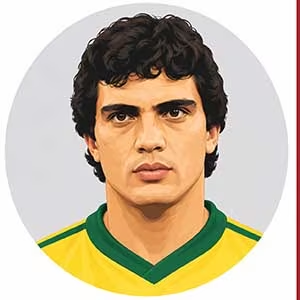
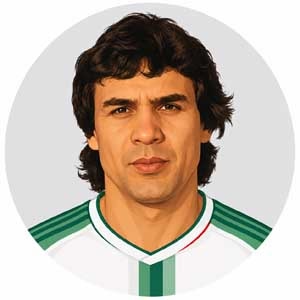
Brazil - Left BackBranco
Unforgiving ballistic trajectory, relentless overlapping stamina, and an imposing physical frame turned Cláudio Ibrahim Vaz Leal—universally known as Branco—into the archetypal Brazilian power full-back of the late 1980s and 1990s. Starting his career with Internacional and Fluminense—where he won three consecutive Campeonato Carioca titles and the 1984 Campeonato Brasileiro—Branco was the direct tactical bridge between the classical attacking full-backs of the 1970s and the explosive athleticism of Roberto Carlos. Operating down the entire left flank, he relied on long-striding acceleration and broad upper-body strength to shrug off wingers in physical duels, while his signature weapon was a terrifying left-footed strike that produced violent swerve and dip from distance. In Europe, he brought defensive solidity and set-piece danger to Brescia, Porto, Genoa—where his ferocious derby winner against Sampdoria became local folklore—and Middlesbrough. Across 72 caps and nine goals for the Seleção spanning three consecutive World Cups (1986, 1990, and 1994), his defining moment arrived at USA '94: stepping in for the suspended Leonardo in the quarter-final against the Netherlands in Dallas, he won a contested foul and struck an unforgettable, 35-yard swerving free-kick into the bottom corner to send Brazil to the semi-finals and eventual fourth world title.
A resilient, cheerful warrior who carried deep professional pride behind a relaxed, toothy smile, Branco proved his mental fortitude through some of the most surreal controversies in international football. His psychological balance was famously tested during the 1990 World Cup against Argentina in the infamous "água bendita" (holy water) incident, where he drank from a spiked Argentine bottle; rather than allowing the episode or subsequent physical decline from chronic back issues to break his spirit, he returned four years later in elite tournament shape. On the pitch, he radiated a fearless, rugged optimism, providing an essential vocal lift to a Brazilian squad weighed down by twenty-four years of championship drought. Inside the locker room, he was a unifying patriarch—warm, unpretentious, and fiercely protective of younger players, serving as an emotional cornerstone for Carlos Alberto Parreira's disciplined setup. When facing cynical wingers or aggressive double-teams designed to stop his overlapping runs, he leaned into contact, using his heavy frame to absorb challenges without breaking stride. Toward referees and opponents, Branco was tough, combative, but fundamentally respectful: avoiding cheap theatrical simulation, celebrating his goals with unrestrained, collective joy, and cementing an immortal legacy as one of the most explosive, clutch, and beloved left-backs in Brazilian history.