We use Google Analytics to understand how visitors use this site. Analytics cookies are only activated with your consent. For details, read our Privacy Policy.
Profile lensThe same player, read from a different angle.
Athletic77
Acceleration
71
Pace
68
Agility
77
Strength
84
Balance
80
Jumping
82
Stamina
68
Fitness
85
Technical48
Dribbling
63
Short Passing
65
Long Passing
66
Shot Accuracy
49
Shot Power
77
Shooting Technique
49
Heading
53
Free Kick
49
Penalties
50
First Touch
57
Mental83
Composure
85
Consistency
85
Leadership
70
Goalkeeping89
Reflexes
93
Positioning
92
Handling
82
Kicking
89
Goalkeeping89
Reflexes
93
Positioning
92
Handling
82
Kicking
89
Attacking51
Heading Accuracy
53
Shot Accuracy
49
Technique58
Dribbling
63
Free Kick
49
Short Passing
65
Long Passing
66
First Touch
57
Shot Technique
49
Physicality79
Shot Power
77
Jumping
82
Stamina
68
Strength
84
Fitness
85
Movement74
Acceleration
71
Pace
68
Agility
77
Balance
80
Mentality & Game Reading73
Composure
85
Penalties
50
Leadership
70
Consistency
85
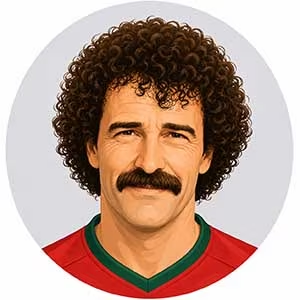
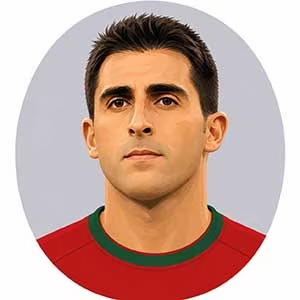
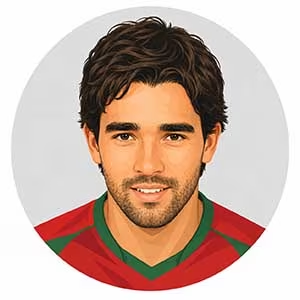
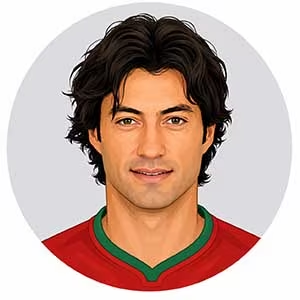
Portugal - GoalkeeperBaía, Vítor
Vítor Manuel Martins Baía stands as one of the most decorated footballers in the history of the sport, collecting an astonishing 31 major trophies across an iconic career anchored at FC Porto and FC Barcelona. Standing six-foot-one with razor-sharp reflexes on the goal line, extraordinary agility on low diving recoveries, and aggressive sweeping instincts outside his six-yard box, Baía was a master of closing down angles in one-on-one isolations. Under Sir Bobby Robson and later José Mourinho at Porto, he captured ten Primeira Liga titles, five Taças de Portugal, the 2002–03 UEFA Cup, the 2003–04 UEFA Champions League, and the 2004 Intercontinental Cup, conceding just 9 goals across the entire 34-game 1991–92 league campaign. His spell at Barcelona yielded the 1996–97 European Cup Winners' Cup, the 1997–98 La Liga title, and two Copas del Rey. For Portugal, across 80 caps between 1990 and 2002, he captained the golden generation at Euro '96, Euro 2000, and the 2002 World Cup.
His commanding presence, however, was repeatedly tested by physical vulnerability. Severe, recurring knee injuries—culminating in extensive surgical operations that sidelined him for nearly two years in the late 1990s—permanently stripped him of a fraction of his explosive lateral spring. Furthermore, his early years in Catalonia exposed an occasional weakness on high, swirling crosses into a congested six-yard box, where heavy physical contact from aggressive forwards could challenge his handling.
Serene, articulate, and carrying the natural gravitas of a born leader, Baía governed his defensive line through quiet authority and moral courage. He never engaged in chaotic, theatrical screams, commanding his penalty box with measured instructions and steady hand gestures that settled younger defenders like Ricardo Carvalho. On the pitch, his presence radiated unshakeable reliability, staying focused under intense European pressure and rising instantly from heavy collisions. Inside the Estádio das Antas, Camp Nou, and Portuguese national team dressing rooms, he was an untouchable patriarch and cultural bridge whose immense medal haul and consummate professionalism commanded absolute respect, leaving behind an immortal legacy as the greatest goalkeeper Portugal has ever produced.


 All Time PortugalNT