We use Google Analytics to understand how visitors use this site. Analytics cookies are only activated with your consent. For details, read our Privacy Policy.
Profile lensThe same player, read from a different angle.
Athletic76
Acceleration
78
Pace
73
Agility
83
Strength
77
Balance
74
Jumping
81
Stamina
65
Fitness
74
Technical51
Dribbling
68
Short Passing
65
Long Passing
72
Shot Accuracy
50
Shot Power
78
Shooting Technique
50
Heading
55
Free Kick
51
Penalties
50
First Touch
68
Mental80
Composure
82
Consistency
74
Leadership
86
Goalkeeping89
Reflexes
93
Positioning
88
Handling
85
Kicking
89
Goalkeeping89
Reflexes
93
Positioning
88
Handling
85
Kicking
89
Attacking53
Heading Accuracy
55
Shot Accuracy
50
Technique62
Dribbling
68
Free Kick
51
Short Passing
65
Long Passing
72
First Touch
68
Shot Technique
50
Physicality75
Shot Power
78
Jumping
81
Stamina
65
Strength
77
Fitness
74
Movement77
Acceleration
78
Pace
73
Agility
83
Balance
74
Mentality & Game Reading73
Composure
82
Penalties
50
Leadership
86
Consistency
74
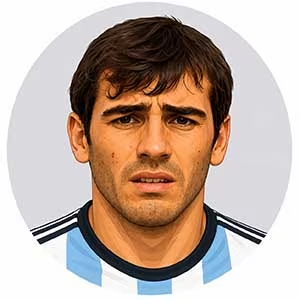
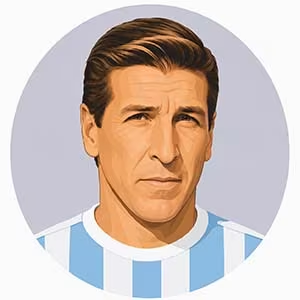
Argentina - GoalkeeperGatti, Hugo
Bandana wrapped around long brown locks, bermuda shorts pulled over his knees, and the audacious habit of chesting loose balls or executing sweeping slide-tackles thirty yards outside his box earned an Argentine maverick the immortal moniker El Loco (The Crazy One). Hugo Orlando Gatti completely dismantled the traditional, conservative dogma of Argentine goalkeeping, turning the eighteen-yard box into an open-air laboratory of high-risk entertainment. Directly influenced by Amadeo Carrizo, Gatti was a pioneer of the sweeper-keeper archetype: utilizing rapid anticipation to cut off through-balls, handling crosses with casual one-handed catches, and inventing the Diosque—a technique where he feigned diving one way before effortlessly picking the ball off a forward’s toe. Across a staggering 765 Argentine Primera División matches spanning River Plate, Gimnasia La Plata, and most notably Boca Juniors (where he made 417 appearances between 1976 and 1988), he captured three league championships, two Copas Libertadores (1977, 1978), and the 1977 Intercontinental Cup against Borussia Mönchengladbach, stopping a historic, decisive penalty from Cruzeiro’s Vanderley in the 1977 Libertadores final. For Argentina, across 18 caps, he featured in the 1966 World Cup squad before a political and stylistic falling-out with César Luis Menotti ended his international career prior to 1978.
Gatti’s theatrical, edge-of-the-abyss style naturally invited spectacular catastrophic blunders (gatadas). When his timing outside the penalty area was off by a fraction of a second, opposing strikers routinely punished him with embarrassing long-range lobs into an empty net. His refusal to play safe, orthodox percentages and his aversion to rigid tactical discipline created constant heart palpitations for his managers and central defenders alike.
Unapologetic, bohemian, and driven by an insatiable need to turn football into theatrical performance art, Gatti viewed the sport purely as a stage for his personal exhibition. He was entirely immune to stadium intimidation: blowing kisses to hostile rival crowds, bantering with opposing forwards during match play, and approaching high-stakes penalty shootouts with casual nonchalance. On the pitch, his body language was all swagger and flair, taking immense pride in demoralizing strikers through psychological superiority and unpredictable positioning. Inside the Boca Juniors locker room, he was an untouchable, magnetic presence alongside Diego Maradona and Silvio Marzolini, whose sheer charisma and clutch penalty-saving genius earned the absolute devotion of the La Doce faithful, leaving behind an immortal legacy as the most audacious, revolutionary, and unforgettable showman in South American goalkeeping history.