We use Google Analytics to understand how visitors use this site. Analytics cookies are only activated with your consent. For details, read our Privacy Policy.
Profile lensThe same player, read from a different angle.
Athletic75
Acceleration
73
Pace
73
Agility
72
Strength
76
Balance
90
Jumping
64
Stamina
77
Fitness
78
Technical92
Dribbling
93
Short Passing
97
Long Passing
92
Finishing
77
Shot Accuracy
82
Shot Power
84
Shooting Technique
92
Heading
63
Tackling
38
Crossing
89
Free Kick
92
Penalties
90
First Touch
96
Mental80
Composure
92
Aggression
63
Consistency
76
Creativity
95
Leadership
70
Work Rate
72
Tactical81
Vision
88
Off the Ball
84
Defensive Positioning
40
Teamwork
76
Anticipation
75
Marking
38
Player Traits
Attacking79
Crossing
89
Finishing
77
Heading Accuracy
63
Shot Accuracy
82
Off the Ball
84
Technique94
Dribbling
93
Free Kick
92
Short Passing
97
Long Passing
92
First Touch
96
Shot Technique
92
Movement77
Acceleration
73
Pace
73
Agility
72
Balance
90
Physicality76
Shot Power
84
Jumping
64
Stamina
77
Strength
76
Fitness
78
Defending39
Marking
38
Tackling
38
Def. Positioning
40
Mentality & Game Reading80
Aggression
63
Composure
92
Penalties
90
Vision
88
Leadership
70
Work Rate
72
Teamwork
76
Anticipation
75
Consistency
76
Creativity
95
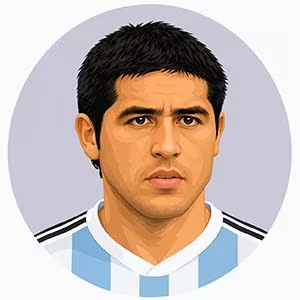
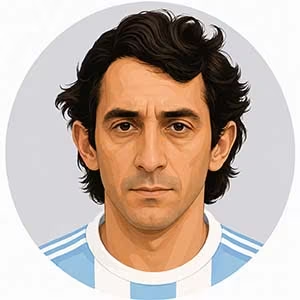
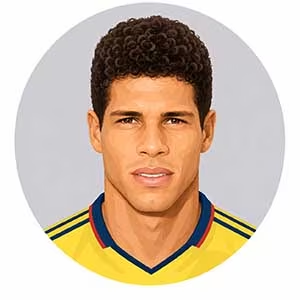
Argentina - Attacking MidfielderRiquelme, Juan Román
La Bombonera on November 28, 2000, and the International Stadium in Yokohama stood in collective awe as a slow-moving, sullen conductor shielded the ball with his broad hips, humiliating Claude Makélélé and Fernando Hierro to lead Boca Juniors to an improbable Intercontinental Cup triumph over the Galácticos of Real Madrid. Juan Román Riquelme was the ultimate classic diez—a pure, unhurried orchestrator who treated a football pitch like a chess board. Stationed in the hole behind the forwards, Riquelme manipulated time through sublime close control, disguise passes, and an extraordinary vision that unlocked backlines with a single reverse flick. Across multiple spells at Boca Juniors, he won three Copas Libertadores (2000, 2001, 2007—the latter being one of the most dominant individual tournament runs in South American history) and five Argentine league titles, before dragging Villarreal to the 2005–06 Champions League semi-finals. For Argentina, across 51 caps and 17 goals, he featured at the 2006 World Cup, won the 2008 Olympic Gold Medal as an overage captain, and claimed the 1997 FIFA World Youth Championship.
Yet Riquelme’s absolute commitment to his personal tempo made him a polarizing figure in the fast-paced modern European game. He contributed virtually nothing to defensive pressing, refused to track back into his own half, and required the entire tactical system to orbit around his feet. If a coach refused to grant him total structural freedom—as occurred under Louis van Gaal at Barcelona—his productivity plummeted. Furthermore, his international legacy carried the heartbreak of his 2006 Champions League semi-final penalty miss against Arsenal and a subsequent high-profile falling-out with Diego Maradona that ended his national team career in 2009.
Enigmatic, fiercely proud, and driven by an uncompromising aesthetic stubbornness, Riquelme played the game entirely on his own terms. He was immune to crowd hostility, famously celebrating a Superclásico goal against River Plate by standing motionless in front of the directors' box with hands cupped behind his ears in the iconic Topo Gigio gesture. On the pitch, his demeanor was languid, almost melancholic, walking between the lines before exploding into a devastating through-ball. Inside the Boca and Villarreal dressing rooms, his influence was absolute; he was a brooding leader whose supreme technical standard commanded total deference, leaving an eternal legacy as the romantic, unapologetic final maestro of the classic South American number ten.