We use Google Analytics to understand how visitors use this site. Analytics cookies are only activated with your consent. For details, read our Privacy Policy.
Profile lensThe same player, read from a different angle.
Athletic77
Acceleration
67
Pace
71
Agility
66
Strength
90
Balance
78
Jumping
75
Stamina
86
Fitness
80
Technical80
Dribbling
76
Short Passing
84
Long Passing
77
Finishing
72
Shot Accuracy
70
Shot Power
84
Shooting Technique
76
Heading
84
Tackling
86
Crossing
71
Free Kick
68
Penalties
66
First Touch
80
Mental88
Composure
87
Aggression
80
Consistency
85
Creativity
75
Leadership
92
Work Rate
95
Tactical80
Vision
83
Off the Ball
68
Defensive Positioning
82
Teamwork
86
Anticipation
76
Marking
75
Attacking73
Crossing
71
Finishing
72
Heading Accuracy
84
Shot Accuracy
70
Off the Ball
68
Technique77
Dribbling
76
Free Kick
68
Short Passing
84
Long Passing
77
First Touch
80
Shot Technique
76
Movement71
Acceleration
67
Pace
71
Agility
66
Balance
78
Physicality83
Shot Power
84
Jumping
75
Stamina
86
Strength
90
Fitness
80
Defending81
Marking
75
Tackling
86
Def. Positioning
82
Mentality & Game Reading83
Aggression
80
Composure
87
Penalties
66
Vision
83
Leadership
92
Work Rate
95
Teamwork
86
Anticipation
76
Consistency
85
Creativity
75
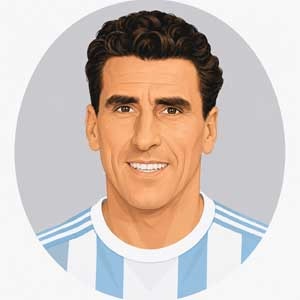
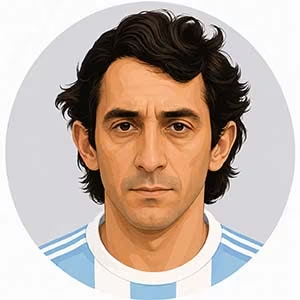
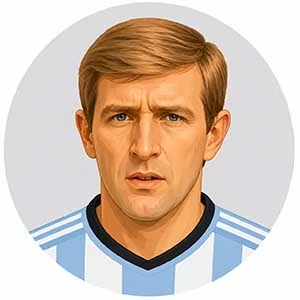
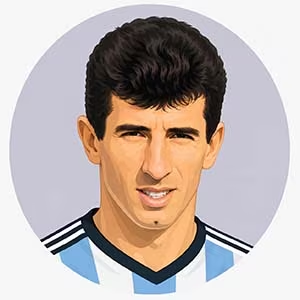
Argentina - Defensive MidfielderRattín, Antonio
Towering over the center circle of La Bombonera with the broad-chested majesty of an ancient gladiator, Antonio Ubaldo Rattín was the definitive, archetypal Argentine caudillo and the greatest single-club patriarch in the rich history of Boca Juniors. Standing nearly six feet three inches tall, El Rata redefined the classic South American número cinco (central defensive pivot) role across the 1960s, transforming it into a commanding watchtower that dictated both territorial boundaries and match tempo. Stripped of superficial acrobatics, his technical game was built on ruthless positional economy: immense aerial dominance that choked off long direct clearances, exceptional upper-body shielding that allowed him to absorb heavy contact before distributing, and a clean, laser-focused short-passing game into the inside-forwards. Across 382 official appearances for the Xeneize between 1956 and 1970—never donning another club jersey—he anchored the club to four Primera División titles (1962, 1964, 1965, 1969 Nacional) and reached the 1963 Copa Libertadores final against Pelé’s Santos. On the international stage, he captained the Albiceleste across two World Cups in 1962 and 1966, earning iconic status as the beating, uncompromising heart of Argentine defensive fortitude.
Mentally and emotionally, Rattín was a figure of volcanic pride, ferocious territorial authority, and an absolute refusal to bow before any perceived injustice. He treated the pitch not merely as a playing surface, but as sacred ground where his club and country's honor had to be defended at all costs. His leadership was monumental and hypnotic; he did not simply wear the captain's armband, he commanded his teammates like a field general, demanding total physical commitment and setting an intimidating, fearless psychological baseline that unnerved visiting teams before they even stepped onto the pitch. Inside the locker room, he was the undisputed moral patriarch—revered with near-religious devotion by younger players and standing up with unbending courage to club executives whenever squad interests were challenged. The ultimate crucible of his unyielding temperament arrived in the infamous 1966 World Cup quarter-final against England at Wembley: sent off by German referee Rudolf Kreitlein for alleged "violence of the tongue"—despite neither speaking the other's language—Rattín staged an immortal, defiant protest, refusing to leave the pitch without an official translator, famously sitting down on Queen Elizabeth II's royal red carpet, and squeezing the British corner flag in full view of the stunned London crowd. Toward opponents, Rattín was an immovable, abrasive storm who used his imposing physical mass and psychological aura to dictate terms, leaving an eternal legacy as the ultimate symbol of Argentine defiance, passion, and unvarnished footballing majesty.


 All-Time 1960s1960s