We use Google Analytics to understand how visitors use this site. Analytics cookies are only activated with your consent. For details, read our Privacy Policy.
Profile lensThe same player, read from a different angle.
Athletic80
Acceleration
74
Pace
73
Agility
72
Strength
88
Balance
88
Jumping
76
Stamina
81
Fitness
85
Technical82
Dribbling
82
Short Passing
87
Long Passing
82
Finishing
64
Shot Accuracy
64
Shot Power
80
Shooting Technique
65
Heading
82
Tackling
85
Crossing
66
Free Kick
65
Penalties
65
First Touch
84
Mental85
Composure
82
Aggression
86
Consistency
80
Creativity
66
Leadership
94
Work Rate
89
Tactical80
Vision
86
Off the Ball
69
Defensive Positioning
80
Teamwork
88
Anticipation
75
Marking
74
Player Traits
Attacking69
Crossing
66
Finishing
64
Heading Accuracy
82
Shot Accuracy
64
Off the Ball
69
Technique78
Dribbling
82
Free Kick
65
Short Passing
87
Long Passing
82
First Touch
84
Shot Technique
65
Movement77
Acceleration
74
Pace
73
Agility
72
Balance
88
Physicality82
Shot Power
80
Jumping
76
Stamina
81
Strength
88
Fitness
85
Defending80
Marking
74
Tackling
85
Def. Positioning
80
Mentality & Game Reading81
Aggression
86
Composure
82
Penalties
65
Vision
86
Leadership
94
Work Rate
89
Teamwork
88
Anticipation
75
Consistency
80
Creativity
66
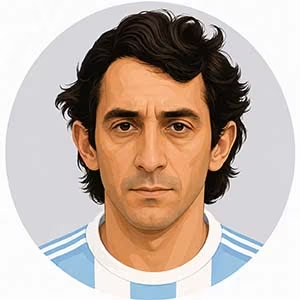
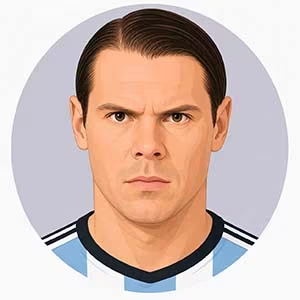
Argentina - Defensive MidfielderRossi, Néstor
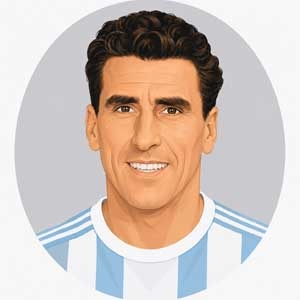
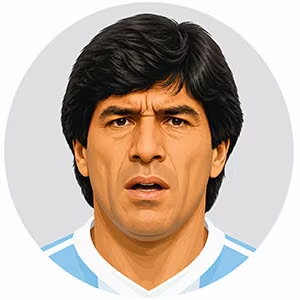
Standing with his chest puffed out on the center circle of the Monumental, hands on his hips while orchestrating the passing tempo of four legendary forwards with a booming voice that could be heard over eighty thousand screaming supporters, defined the monumental presence of an enforcer from Parque Patricios. Néstor Raúl Rossi—canonized across South America simply as Pipo or La Voz (The Voice)—was the legendary patriarch of the volante central (central pivot) role: a towering, commanding midfield general who combined bruising physical power, unyielding tactical discipline, and a cultured, panoramic passing range that laid the structural foundation for the greatest attacking machine in history.
Operating at the base of the midfield, Rossi was the absolute anchor of positional balance. He possessed immaculate aerial timing, ferocious tackling mechanics, and a pristine spatial vision that allowed him to win the ball cleanly on the edge of his box and immediately launch forty-yard diagonal balls to the wings with millimeter accuracy. As the undisputed defensive fulcrum and tactical brain of River Plate's immortal La Máquina and subsequent La Maquinita eras across two spells (1945–1949 and 1955–1958), he made 245 appearances, lifting five Argentine Primera División championships. During the legendary Colombian El Dorado era, he moved to Millonarios of Bogotá alongside Alfredo Di Stéfano and Adolfo Pedernera, orchestrating the famous Ballet Azul across four Colombian league titles (1949, 1951, 1952, 1953) and the 1953 Small Club World Cup in Caracas. For Argentina, across 26 caps, he was the feared, commanding general of two Copa América-winning sides (1947 in Ecuador and 1957 in Peru, leading the famous Caras Sucias), before captaining the national team at the 1958 World Cup in Sweden.
Rossi’s imposing, authoritative game, however, belonged to the classical era of central pivots. He was not a dynamic, mobile runner who sprinted forty yards to press high up the pitch or arrive in the opposing six-yard box to finish moves; his role was strictly central containment, distribution, and tactical organization from the midfield circle. When confronted by high-tempo, fluid European transition systems that bypassed the central midfield battle—most brutally exposed during Argentina's infamous 6–1 collapse against Czechoslovakia in Helsingborg in 1958—his lack of linear mobility and speed in open-field recovery could be brutally punished.
Tyrannical, fiercely demanding, and possessed of a booming, natural authority, Rossi was the undisputed commander-in-chief of every pitch he stepped on. He had zero tolerance for vanity, lazy tracking, or tactical indiscipline, famously berating even mythical figures like Di Stéfano, Labruna, and Sívori if they drifted out of position or held onto the ball a fraction of a second too long. On the pitch, his body language was all imperious, chest-out authority: directing passing lanes with commanding arm sweeps, stepping into challenges with bone-shaking force, and demanding the ball under any circumstance. Inside the River Plate, Millonarios, and Argentine locker rooms, his word was absolute, unshakeable law—an untouchable patriarch whose tactical brain, leadership gravitas, and legendary voice permanently defined the philosophy of the Argentine central midfield pivot.