We use Google Analytics to understand how visitors use this site. Analytics cookies are only activated with your consent. For details, read our Privacy Policy.
Profile lensThe same player, read from a different angle.
Athletic81
Acceleration
74
Pace
77
Agility
73
Strength
88
Balance
86
Jumping
78
Stamina
88
Fitness
82
Technical82
Dribbling
79
Short Passing
84
Long Passing
85
Finishing
74
Shot Accuracy
75
Shot Power
90
Shooting Technique
72
Heading
81
Tackling
78
Crossing
70
Free Kick
78
Penalties
84
First Touch
83
Mental85
Composure
81
Aggression
85
Consistency
85
Creativity
73
Leadership
90
Work Rate
90
Tactical80
Vision
84
Off the Ball
75
Defensive Positioning
74
Teamwork
87
Anticipation
82
Marking
73
Attacking75
Crossing
70
Finishing
74
Heading Accuracy
81
Shot Accuracy
75
Off the Ball
75
Technique80
Dribbling
79
Free Kick
78
Short Passing
84
Long Passing
85
First Touch
83
Shot Technique
72
Movement78
Acceleration
74
Pace
77
Agility
73
Balance
86
Physicality85
Shot Power
90
Jumping
78
Stamina
88
Strength
88
Fitness
82
Defending75
Marking
73
Tackling
78
Def. Positioning
74
Mentality & Game Reading84
Aggression
85
Composure
81
Penalties
84
Vision
84
Leadership
90
Work Rate
90
Teamwork
87
Anticipation
82
Consistency
85
Creativity
73
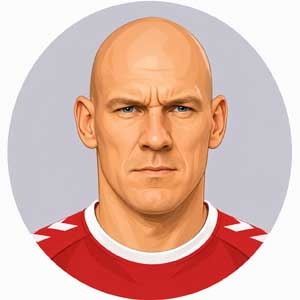
Netherlands - Defensive MidfielderVan Bommel, Mark
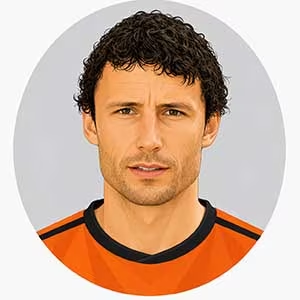
A menacing midfield general who turned aggressive defensive containment and tactical gamesmanship into high art, Mark Peter Gertruda Andreas van Bommel was the ultimate combative pivot across four of Europe's top leagues. Breaking through at Fortuna Sittard before establishing his domestic reign as the captain and driving engine of Guus Hiddink’s PSV Eindhoven, the Limburg-born enforcer achieved the rare feat of winning domestic league titles in the Netherlands, Spain, Germany, and Italy. Operating as a deep-lying defensive anchor (controleur) or box-to-box midfielder, Van Bommel blended a heavy, bone-crunching tackling style with clean positional discipline and a sharp passing range that could spray forty-yard diagonals or unleash venomous long-range strikes. After a trophy-laden season with Frank Rijkaard’s Barcelona in 2005–06—winning La Liga and the UEFA Champions League—he moved to Bayern Munich, where he became the first non-German captain in the club's history, capturing two Bundesliga-Pokal doubles (2007–08, 2009–10) and reaching the 2010 Champions League final. He capped his European odyssey at Massimiliano Allegri’s AC Milan, instantly organizing the midfield to secure the 2010–11 Scudetto. Across 79 caps and 10 goals for the Netherlands, his pinnacle was the 2010 World Cup in South Africa, anchoring the Oranje to the final through relentless physical intimidation. Yet his game had sharp, unmistakable limitations: he lacked explosive agility and recovery pace against nimble dribblers on the turn, was prone to reckless lunges when stretched across wide channels, and his offensive output dried up almost entirely once he was shifted away from his early-career box-to-box duties.
Combative, hyper-antagonistic, and calculated in his aggression, Van Bommel viewed football as a psychological war of attrition where every foul, verbal barb, and subtle referee manipulation had a strategic objective. He lived right on the disciplinary knife-edge, mastering the dark art of breaking up opposition transitions with tactical jersey pulls, hidden elbow checks, and constant, whispering provocations aimed at baiting rival playmakers into red cards. On the pitch, his presence radiated pure menace; he actively sought out hostile away crowds, feeding on whistles and boos to elevate his intensity. Inside the locker rooms of Munich, Milan, and the Dutch national team, he was an untouchable alpha leader who demanded total physical commitment, commanding the respect of volcanic managers like Louis van Gaal while maintaining strict tactical order among his peers. When targeted by opponents seeking physical revenge, Van Bommel never flinched or complained; he absorbed the blow with an ironic smirk and struck back with double the force on the very next loose ball. Match officials found him an exhausting, relentless presence who constantly disputed decisions with faux innocence, cementing his legacy as one of the most divisive, feared, and tactically intelligent enforcers in modern European football.


 All Time Bayern MunichClub