We use Google Analytics to understand how visitors use this site. Analytics cookies are only activated with your consent. For details, read our Privacy Policy.
Profile lensThe same player, read from a different angle.
Athletic81
Acceleration
76
Pace
74
Agility
77
Strength
84
Balance
79
Jumping
82
Stamina
87
Fitness
88
Technical79
Dribbling
77
Short Passing
81
Long Passing
83
Finishing
59
Shot Accuracy
66
Shot Power
74
Shooting Technique
71
Heading
75
Tackling
84
Crossing
78
Free Kick
68
Penalties
66
First Touch
80
Mental84
Composure
83
Aggression
85
Consistency
84
Creativity
73
Leadership
83
Work Rate
93
Tactical80
Vision
80
Off the Ball
65
Defensive Positioning
82
Teamwork
85
Anticipation
80
Marking
79
Attacking69
Crossing
78
Finishing
59
Heading Accuracy
75
Shot Accuracy
66
Off the Ball
65
Technique77
Dribbling
77
Free Kick
68
Short Passing
81
Long Passing
83
First Touch
80
Shot Technique
71
Movement77
Acceleration
76
Pace
74
Agility
77
Balance
79
Physicality83
Shot Power
74
Jumping
82
Stamina
87
Strength
84
Fitness
88
Defending82
Marking
79
Tackling
84
Def. Positioning
82
Mentality & Game Reading81
Aggression
85
Composure
83
Penalties
66
Vision
80
Leadership
83
Work Rate
93
Teamwork
85
Anticipation
80
Consistency
84
Creativity
73
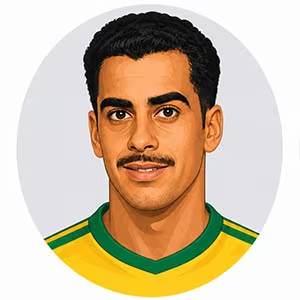
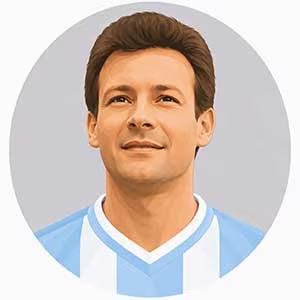
Uruguay - Defensive MidfielderGonçalves, Néstor
On 26 October 1966, Peñarol entered the Santiago Bernabéu carrying a 2–0 advantage over Real Madrid from the first leg of the Intercontinental Cup. Néstor Gonçalves, captain and central reference of the midfield, spent the return match protecting the space in front of his defence while Madrid attempted to force the contest open. Peñarol did not retreat into disorder. Pedro Rocha scored from the penalty spot, Alberto Spencer added another, and the Uruguayans won 2–0 again. Gonçalves lifted the trophy after a 4–0 aggregate victory over the European champions. It was an appropriate summit for a player whose authority came from making competitive discipline contagious rather than making himself visually dominant.
Gonçalves was a defensive midfielder in the classical Uruguayan number-five tradition, positioned centrally to protect the defence, recover possession and give structure to the players ahead of him. He was physically strong, tactically conservative when danger demanded it and highly attentive to second balls, but he was not simply a destroyer. His value lay in reading where the next contest would occur, arriving early enough to prevent attacks developing, and then releasing possession efficiently rather than carrying it unnecessarily. Peñarol used more expressive players around him; Gonçalves supplied the equilibrium that allowed them to take risks. He arrived in Montevideo after playing in Salto and joined Peñarol in 1957, never representing another senior club. During fourteen seasons he became one of the central figures of the greatest period in the club’s history, winning nine Uruguayan championships, including five consecutively from 1958 to 1962, three Copa Libertadores titles and two Intercontinental Cups. He played in six Libertadores finals, a remarkable measure of sustained exposure to South American football’s highest-pressure matches. By the middle of the 1960s he had inherited not merely a position but much of the symbolic responsibility previously associated with Peñarol’s great captains. In 1966 he led the side through the Libertadores triumph and then the two victories over Real Madrid. For Uruguay he earned 50 official caps according to the AUF and appeared at the 1962 and 1966 World Cups, reaching the quarter-finals in England.
His strengths were strongly connected to structure. Gonçalves was not a midfielder built to break compact opponents through dribbling, repeated forward carries or creative passing from advanced positions. When his team needed individual invention rather than balance, others provided it. His aggressive occupation of central space also depended on reading the play correctly: stepping toward an opponent or second ball at the wrong moment could leave the defence exposed behind him. Nor was he especially suited to games demanding constant high-speed transitions over large distances. His authority and positional intelligence compensated for those limitations, but as athletic margins declined, the model depended increasingly on collective organisation. His loyalty could also be interpreted as a professional limitation. Real Madrid and River Plate reportedly pursued him, but he asked Peñarol not to sell him and chose to remain in Montevideo. The decision reinforced his identity but also meant his game was never tested for an extended period outside the environment that understood him best.
Psychologically, Gonçalves appears to have understood leadership primarily as obligation. His later remarks about football repeatedly returned to work: not every teammate could possess exceptional quality, he argued, but those who lacked it still owed the side energy and effort. That standard helps explain why his captaincy became so durable. He was not asking teammates to supply a sacrifice he avoided himself; his role required repeated defensive work with little statistical reward, and he performed it through more than a decade of title races and continental campaigns. The refusal to leave Peñarol provides another unusually concrete signal. According to club historical records, interest came from both Real Madrid and River Plate and Gonçalves personally asked president Gastón Guelfi not to sell him, despite the financial benefit such a transfer could have provided. He wanted to finish his career at Peñarol. This was not low ambition: he repeatedly competed for Libertadores and world titles. It was ambition attached to institution rather than personal mobility. Pressure therefore appears to have increased his sense of duty rather than his need for individual escape. His behaviour in decisive matches supports that interpretation. Six Libertadores finals and two Intercontinental triumphs produced no surviving pattern of disciplinary collapse, public blame or avoidance of responsibility. Physical confrontation was intrinsic to the midfield role he played, yet his historical reputation centres on authority and competitive toughness rather than uncontrolled retaliation. His leadership was more demanding than comforting. Sources around Peñarol consistently describe him as a caudillo and a forceful personality, and later recollections emphasise that he spoke directly rather than softening what he believed. That directness could make him imposing, but it was linked to standards rather than spectacle. Even retirement followed the same attachment. In 1970 he left the field during his final match against Cerro in tears, ending his playing career without having worn another professional shirt, and afterward remained connected to Peñarol, including work with younger players. His emotional investment was therefore extremely high, but not fragile. Failure did not send him searching for distance from the institution; responsibility bound him more tightly to it. Gonçalves did not appear to reduce tension by becoming detached. He reduced it by knowing what the shirt, the role and the collective expected him to do.


 All Time UruguayNT