We use Google Analytics to understand how visitors use this site. Analytics cookies are only activated with your consent. For details, read our Privacy Policy.
Profile lensThe same player, read from a different angle.
Athletic81
Acceleration
74
Pace
72
Agility
73
Strength
87
Balance
82
Jumping
91
Stamina
86
Fitness
85
Technical80
Dribbling
78
Short Passing
81
Long Passing
78
Finishing
84
Shot Accuracy
82
Shot Power
84
Shooting Technique
81
Heading
88
Tackling
54
Crossing
76
Free Kick
73
Penalties
73
First Touch
82
Mental82
Composure
85
Aggression
82
Consistency
81
Creativity
78
Leadership
81
Work Rate
82
Tactical85
Vision
85
Off the Ball
86
Defensive Positioning
44
Teamwork
83
Anticipation
86
Marking
33
Player Traits
Attacking83
Crossing
76
Finishing
84
Heading Accuracy
88
Shot Accuracy
82
Off the Ball
86
Technique79
Dribbling
78
Free Kick
73
Short Passing
81
Long Passing
78
First Touch
82
Shot Technique
81
Movement75
Acceleration
74
Pace
72
Agility
73
Balance
82
Physicality87
Shot Power
84
Jumping
91
Stamina
86
Strength
87
Fitness
85
Defending44
Marking
33
Tackling
54
Def. Positioning
44
Mentality & Game Reading82
Aggression
82
Composure
85
Penalties
73
Vision
85
Leadership
81
Work Rate
82
Teamwork
83
Anticipation
86
Consistency
81
Creativity
78
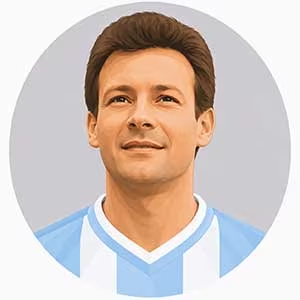
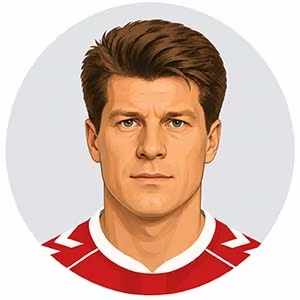
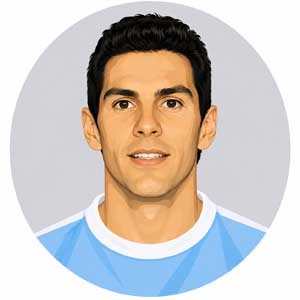
Uruguay - Attacking MidfielderPoyet, Gustavo
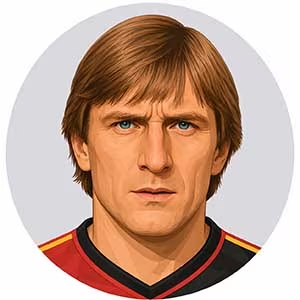
Operating as a roving central or attacking midfielder with license to break lines, Poyet excelled at reading the rhythm of attacking transitions. He avoided static duels, preferring to hold his run just outside the penalty box before surging into the blind spot of center-halves to meet crosses with textbook headers or acrobatic, low-backlift volleys. After building his European reputation in Spain across seven decorated campaigns at Real Zaragoza between 1990 and 1997—amassing 294 appearances, 80 goals, lifting the 1993–94 Copa del Rey and the historic 1994–95 UEFA Cup Winners' Cup over Arsenal—he moved to Chelsea on a free transfer. Under Gianluca Vialli, he became a core pillar of the cosmopolitan Blues renaissance across 145 matches and 49 goals, lifting the 1997–98 Cup Winners' Cup, the 1998 UEFA Super Cup (scoring the late winner against Real Madrid in Monaco), the 1999–2000 FA Cup, and the 2000 Charity Shield, before concluding his playing career with Tottenham Hotspur and Swindon Town. For Uruguay, across 26 caps and three goals between 1993 and 2000, his international crowning achievement arrived at the 1995 Copa América on home soil, where he featured throughout the tournament, scored against Bolivia, and converted his spot-kick in the final shootout against reigning world champions Brazil to lift the continental title.
That lethal offensive intuition, however, existed alongside distinct physical and tactical trade-offs. Poyet was not a nimble, quick-footed dribbler who beat defenders with rapid changes of direction in tight channels, nor was he a deep-lying metronome built to orchestrate low-risk possession sequences under heavy pressing. His defensive work rate was determined and physical, but his aggressive, tackle-first mindset could lead to reckless fouls and frequent cautions when tracking quick, elusive playmakers in transition. Furthermore, severe cruciate ligament knee damage in his debut season in England permanently tested his lateral agility, reinforcing his reliance on anticipation over raw acceleration.
Psychologically, Poyet was an intoxicating hurricane of boisterous charisma, infectious humor, and intense competitive drive. He embraced the high-pressure cauldrons of British derbies and European cup finals with radiant enthusiasm, approaching the sport as a joyous adventure while fiercely defending his teammates at the first sign of trouble. On the pitch, his body language was unmistakably kinetic and expressive: broad grins, theatrical hand gestures directing wide players where to deliver the cross, and euphoric leaps into the crowd upon finding the net. Inside the Zaragoza, Chelsea, and Uruguayan dressing rooms, his vibrant personality made him an adored, unifying catalyst whose uncanny goalscoring instincts and clutch European moments cemented a unique, unforgettable legacy among modern South American midfielders.


 All Time UruguayNT