We use Google Analytics to understand how visitors use this site. Analytics cookies are only activated with your consent. For details, read our Privacy Policy.
Profile lensThe same player, read from a different angle.
Athletic82
Acceleration
82
Pace
81
Agility
83
Strength
79
Balance
84
Jumping
76
Stamina
85
Fitness
84
Technical90
Dribbling
88
Short Passing
93
Long Passing
89
Finishing
88
Shot Accuracy
82
Shot Power
89
Shooting Technique
87
Heading
76
Tackling
57
Crossing
89
Free Kick
83
Penalties
81
First Touch
93
Mental85
Composure
94
Aggression
78
Consistency
77
Creativity
90
Leadership
84
Work Rate
85
Tactical90
Vision
93
Off the Ball
85
Defensive Positioning
58
Teamwork
93
Anticipation
87
Marking
44
Player Traits
Attacking84
Crossing
89
Finishing
88
Heading Accuracy
76
Shot Accuracy
82
Off the Ball
85
Technique89
Dribbling
88
Free Kick
83
Short Passing
93
Long Passing
89
First Touch
93
Shot Technique
87
Movement83
Acceleration
82
Pace
81
Agility
83
Balance
84
Physicality83
Shot Power
89
Jumping
76
Stamina
85
Strength
79
Fitness
84
Defending53
Marking
44
Tackling
57
Def. Positioning
58
Mentality & Game Reading86
Aggression
78
Composure
94
Penalties
81
Vision
93
Leadership
84
Work Rate
85
Teamwork
93
Anticipation
87
Consistency
77
Creativity
90
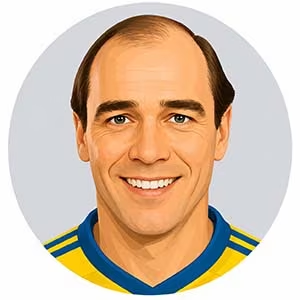
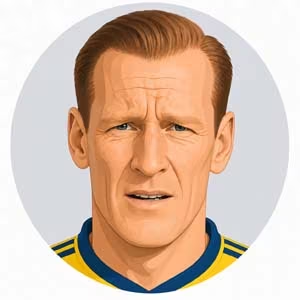
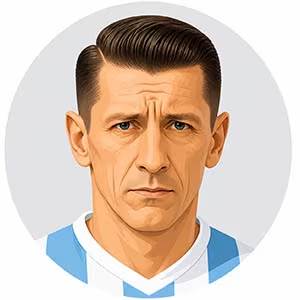
Sweden - Attacking MidfielderGren, Gunnar
When Swedish football conquered the continent in the late 1940s and 1950s, the intellectual blueprint belonged entirely to Gunnar Gren, the midfield architect whose tactical calculation earned him the reverent Italian moniker Il Professore. Developing at Gårda BK and IFK Göteborg—where he secured the 1941–42 Allsvenskan and the 1946 Guldbollen—Gren reached global fame as the "G" in the mythical Gre-No-Li trident at AC Milan alongside Gunnar Nordahl and Nils Liedholm. Rather than overwhelming opponents with sheer physicality or explosive speed, Gren dictated matches through immaculate spatial geometry, pristine one-touch wall passes, and an uncanny ability to manipulate tempo. Operating as an inside-right playmaker, he possessed the rare vision to slow down a frantic contest before releasing a millimeter-perfect through-ball into Nordahl's devastating running lanes. At Milan, he captured the 1950–51 Scudetto and the 1951 Latin Cup, later bringing his refined orchestrations to Fiorentina and Genoa. On the international stage across 57 caps and 32 goals, he was the cerebral linchpin of Sweden’s 1948 Olympic gold medal in London and, a full decade later at nearly 38 years of age, steered his nation to the final of the 1958 World Cup on home soil.
Methodical, sober, and intensely demanding, Gren viewed football not as a chaotic physical contest, but as an applied science where every movement had to serve a collective purpose. He had no patience for wasteful individual dribbling or defensive lapses, constantly instructing younger teammates on pitch geometry and body orientation with the quiet authority of an academic lecturer. On the pitch, his emotional baseline was remarkably flat and unflappable; whether facing aggressive South American pressing or the hostile cauldrons of the Italian peninsula, he never lost his positional discipline or rushed a pass under pressure. Inside the dressing room, he commanded immense respect across diverse factions, serving as the essential tactical bridge between Swedish pragmatism and Italian professional rigor. When brutal man-markers attempted to hack him off the ball, Gren neutralized their aggression with quick, disguised first-time releases rather than engaging in retaliatory skirmishes. Match officials and opposing defenders encountered a figure of immaculate sporting etiquette: composed, polite, and completely focused on the strategic mastery of the game, leaving an immortal legacy as one of the most intellectually gifted inside-forwards in European football history.