We use Google Analytics to understand how visitors use this site. Analytics cookies are only activated with your consent. For details, read our Privacy Policy.
Profile lensThe same player, read from a different angle.
Athletic82
Acceleration
91
Pace
87
Agility
86
Strength
77
Balance
78
Jumping
72
Stamina
86
Fitness
78
Technical82
Dribbling
84
Short Passing
83
Long Passing
79
Finishing
85
Shot Accuracy
83
Shot Power
83
Shooting Technique
78
Heading
75
Tackling
54
Crossing
87
Free Kick
73
Penalties
73
First Touch
84
Mental81
Composure
85
Aggression
84
Consistency
77
Creativity
79
Leadership
80
Work Rate
83
Tactical81
Vision
81
Off the Ball
85
Defensive Positioning
58
Teamwork
79
Anticipation
84
Marking
44
Player Traits
Attacking83
Crossing
87
Finishing
85
Heading Accuracy
75
Shot Accuracy
83
Off the Ball
85
Technique80
Dribbling
84
Free Kick
73
Short Passing
83
Long Passing
79
First Touch
84
Shot Technique
78
Movement86
Acceleration
91
Pace
87
Agility
86
Balance
78
Physicality79
Shot Power
83
Jumping
72
Stamina
86
Strength
77
Fitness
78
Defending52
Marking
44
Tackling
54
Def. Positioning
58
Mentality & Game Reading81
Aggression
84
Composure
85
Penalties
73
Vision
81
Leadership
80
Work Rate
83
Teamwork
79
Anticipation
84
Consistency
77
Creativity
79
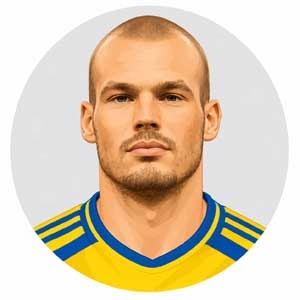
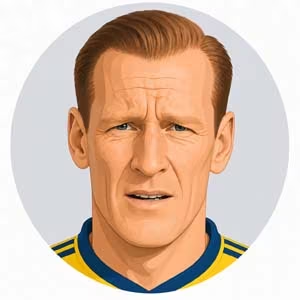
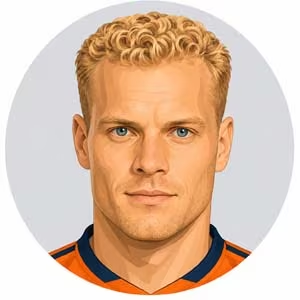
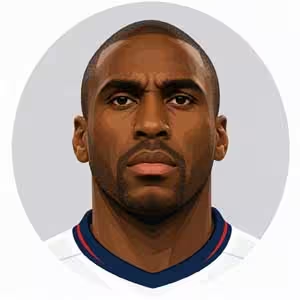
Sweden - Right MidfielderLjungberg, Freddie
A streak of bright red hair and perfectly timed, ghosting runs into the eighteen-yard box defined the counter-attacking thrust of Arsène Wenger’s greatest Arsenal vintage. Karl Fredrik Ljungberg arrived at Highbury from Halmstads BK in the autumn of 1998, scoring against Manchester United within minutes of his debut and immediately embedding himself as the dynamic wide weapon of North London. Operating primarily as an inverted right or left winger with the license to drift centrally, Ljungberg was a master of off-the-ball movement: reading passing lanes two sequences ahead, darting behind full-backs off Dennis Bergkamp’s through-balls, and finishing with ice-cold precision on the slide or on the half-volley. His career apex arrived during the historic 2001–02 double campaign, where in the absence of the injured Robert Pirès, he scored six vital goals in the final five league matches and netted a spectacular solo strike in the FA Cup final against Chelsea, earning the Premier League Player of the Season award. An integral component of the 2003–04 Invincibles, he accumulated two Premier League titles and three FA Cups over nine seasons at Arsenal. For Sweden, across 75 caps and 14 goals, he captained his country across two World Cups (2002, 2006) and three European Championships.
Physical wear-and-tear, however, took a relentless toll on Ljungberg’s energetic style. Because his game relied heavily on continuous, high-intensity sprint bursts and absorbing heavy body checks from defenders, chronic hip ailments, recurring hamstring strains, and severe foot injuries stripped him of his razor-sharp burst in his late twenties, curtailing his later spells at West Ham United, Seattle Sounders, and Celtic. Tactically, he was not a traditional static touchline dribbler who could beat full-backs from a standing start, relying heavily on dynamic interplay and intelligent collective movement to unlock his threat.
Tenacious, fashionable, and driven by a ferocious competitive engine, Ljungberg was the ultimate big-game fighter wrapped in a modern cultural icon. While celebrated globally for high-profile modeling campaigns, on the pitch he was an uncompromising scrapper who never backed down from a physical confrontation, famously clashing with opponents in heated North London and Manchester derbies. On the pitch, his body language was pure kinetic urgency: sprinting fifty yards to support an attack, throwing himself into low crosses, and arguing passionately with referees over aggressive fouls. Inside the Arsenal and Swedish dressing rooms, he was a vocal, driven professional whose relentless standard-setting commanded immense respect from heavyweights like Patrick Vieira and Thierry Henry. Opposing full-backs found his ghosting movement an absolute nightmare to track over ninety minutes, leaving an eternal legacy as one of the most clutch, intelligent, and influential wide attackers in Premier League history.