We use Google Analytics to understand how visitors use this site. Analytics cookies are only activated with your consent. For details, read our Privacy Policy.
Profile lensThe same player, read from a different angle.
Athletic82
Acceleration
74
Pace
85
Agility
65
Strength
97
Balance
90
Jumping
86
Stamina
79
Fitness
80
Technical77
Dribbling
70
Short Passing
72
Long Passing
72
Finishing
68
Shot Accuracy
61
Shot Power
89
Shooting Technique
64
Heading
86
Tackling
94
Crossing
68
Free Kick
64
Penalties
60
First Touch
72
Mental83
Composure
83
Aggression
90
Consistency
85
Creativity
58
Leadership
84
Work Rate
83
Tactical80
Vision
68
Off the Ball
57
Defensive Positioning
88
Teamwork
77
Anticipation
83
Marking
88
Player Traits
Attacking68
Crossing
68
Finishing
68
Heading Accuracy
86
Shot Accuracy
61
Off the Ball
57
Technique69
Dribbling
70
Free Kick
64
Short Passing
72
Long Passing
72
First Touch
72
Shot Technique
64
Movement79
Acceleration
74
Pace
85
Agility
65
Balance
90
Physicality86
Shot Power
89
Jumping
86
Stamina
79
Strength
97
Fitness
80
Defending90
Marking
88
Tackling
94
Def. Positioning
88
Mentality & Game Reading77
Aggression
90
Composure
83
Penalties
60
Vision
68
Leadership
84
Work Rate
83
Teamwork
77
Anticipation
83
Consistency
85
Creativity
58
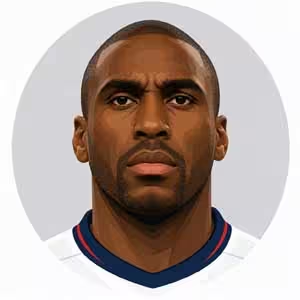
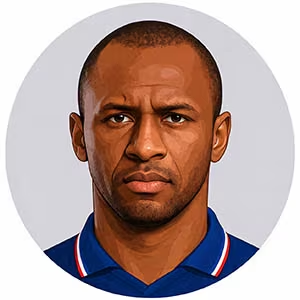
England - Centre-backCampbell, Sol
Physical mass, raw recovery pace, and an imposing aerial reach made Sulzeer Jeremiah Campbell the definitive athletic centerpiece of Arsène Wenger’s defensive transition at Arsenal in the early 2000s. Developed at Tottenham Hotspur, where he captained the club to the 1999 League Cup, Campbell executed the most incendiary free-transfer across North London in 2001, immediately elevating the physical floor of Arsenal’s backline. Standing six-foot-two and built like a heavyweight boxer, he was exceptionally difficult to roll or outmuscle in static duels, yet his decisive attribute was his speed over thirty yards, which allowed Arsenal to maintain a high defensive line without fear of balls played over the top. Rather than relying on refined, progressive distribution, his game was built around containment: timing sliding challenges in open channels, muscling center-forwards off the ball with broad shoulder contact, and powering away defensive headers from set pieces. As the anchor of the unbeaten Invincibles side of 2003–04, Campbell collected two Premier League titles, three FA Cups, and scored Arsenal’s lone goal in the 2006 Champions League final against Barcelona, before lifting another FA Cup with Portsmouth in 2008. Across 73 caps for England spanning six consecutive major tournaments (1998 to 2006), he was a model of international consistency, twice being named to UEFA/FIFA tournament All-Star Teams.
Psychologically, Campbell was an intense, introverted, and highly sensitive individual who operated behind a thick, defensive armor of pride and stoic resilience. Enduring vitriolic terrace abuse, death threats, and immense public hostility following his move from White Hart Lane, he channeled external venom into an uncompromising, fortress-like focus on matchdays. On the pitch, his leadership was purely physical and authoritative; he held his defensive partner—whether Kolo Touré or Tony Adams—to strict positional accountability and relished shutting down elite, explosive strikers like Ruud van Nistelrooy and Thierry Henry in training. However, his deep sensitivity meant that sudden loss of form or personal crises could occasionally destabilize his equilibrium, as seen in his famous mid-game substitution and departure from Highbury against West Ham in 2006. Inside the dressing room, he was a serious, independent-minded figure who kept his distance from standard locker-room trivialities, demanding absolute professional respect from teammates and staff alike. In high-stakes knockout environments, his competitive bravery was unquestioned, attacking defensive headers with total disregard for injury. Toward referees and aggressive opposing forwards, Campbell maintained a stern, imposing posture: physical, intimidating, and rarely drawn into petty verbal spats, cementing his legacy as one of the most physically dominant English center-backs of the modern era.