We use Google Analytics to understand how visitors use this site. Analytics cookies are only activated with your consent. For details, read our Privacy Policy.
Profile lensThe same player, read from a different angle.
Athletic83
Acceleration
75
Pace
78
Agility
75
Strength
81
Balance
87
Jumping
95
Stamina
84
Fitness
92
Technical78
Dribbling
73
Short Passing
75
Long Passing
73
Finishing
58
Shot Accuracy
60
Shot Power
80
Shooting Technique
66
Heading
85
Tackling
93
Crossing
68
Free Kick
58
Penalties
58
First Touch
73
Mental91
Composure
87
Aggression
93
Consistency
93
Creativity
60
Leadership
96
Work Rate
95
Tactical83
Vision
75
Off the Ball
58
Defensive Positioning
90
Teamwork
82
Anticipation
83
Marking
91
Player Traits
Attacking66
Crossing
68
Finishing
58
Heading Accuracy
85
Shot Accuracy
60
Off the Ball
58
Technique70
Dribbling
73
Free Kick
58
Short Passing
75
Long Passing
73
First Touch
73
Shot Technique
66
Movement79
Acceleration
75
Pace
78
Agility
75
Balance
87
Physicality86
Shot Power
80
Jumping
95
Stamina
84
Strength
81
Fitness
92
Defending91
Marking
91
Tackling
93
Def. Positioning
90
Mentality & Game Reading82
Aggression
93
Composure
87
Penalties
58
Vision
75
Leadership
96
Work Rate
95
Teamwork
82
Anticipation
83
Consistency
93
Creativity
60
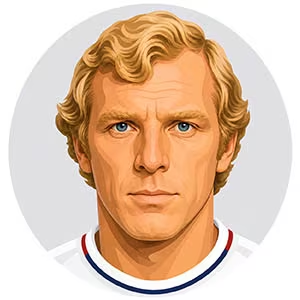
England - Centre-backWright, Billy
Defensive heroism throughout the post-war era found its ultimate benchmark in William Ambrose Wright, the trailblazing center-half who spent two decades anchoring Wolverhampton Wanderers and the English national team. Starting as an inside-forward and wing-half before transitioning to the heart of the defense, Wright redefined central marking through anticipation and ground recovery. Standing five-foot-eight—unusually compact for an English center-half—he compensated for his lack of towering height with a spring-loaded vertical leap, immaculate aerial timing, and sharp recovery pace over ten yards. He was not a brutal, destructive stopper who relied on agricultural clearances; Wright’s game was rooted in reading the trajectory of through-balls, intercepting cleanly on the slide without conceding fouls, and distributing out from the back with composed, side-foot passes. Under Stan Cullis at Molineux, he captained Wolves across more than 540 appearances, winning three First Division championships (1953–54, 1957–58, 1958–59) and the 1949 FA Cup, while spearheading the club’s famous floodlit international friendlies against continental giants like Honvéd and Spartak Moscow. For England, he was a historic pioneer: the first footballer in world history to reach 100 international caps (finishing with 105, 90 as captain), leading his country through three consecutive World Cups (1950, 1954, and 1958) and finishing as runner-up for the 1957 Ballon d'Or behind Alfredo Di Stéfano.
Spotless integrity, chivalric sportsmanship, and an unshakeable sense of duty defined Wright’s stature as the quintessential English gentleman-athlete. In an era known for bruising physical collisions, he was never cautioned or sent off in his entire professional career—a testament to his flawless positional discipline and clean tackling technique. His psychological resilience was put through the ultimate public trial during England's traumatic 6–3 and 7–1 defeats to Hungary's Aranycsapat in 1953 and 1954; rather than deflecting blame or making excuses, Wright faced the press and the nation with dignified humility, openly acknowledging the tactical superiority of the Magyars while working relentlessly to adapt his own game. Inside the Wolves and England dressing rooms, he was a calm, paternal leader who led entirely by example, commanding the universal respect of peers and superiors through his Spartan conditioning, modesty, and absence of ego. When facing explosive, elusive forwards who attempted to pull him out of position, he maintained deep focus, relying on spatial discipline rather than rash challenges. Referees, teammates, and international opponents viewed him as a monumental standard of fair play, leaving behind an immortal legacy as the most respected, disciplined, and iconic defender of his generation.