We use Google Analytics to understand how visitors use this site. Analytics cookies are only activated with your consent. For details, read our Privacy Policy.
Profile lensThe same player, read from a different angle.
Athletic84
Acceleration
82
Pace
76
Agility
83
Strength
83
Balance
86
Jumping
94
Stamina
85
Fitness
80
Technical77
Dribbling
72
Short Passing
72
Long Passing
71
Finishing
52
Shot Accuracy
62
Shot Power
84
Shooting Technique
66
Heading
84
Tackling
92
Crossing
63
Free Kick
58
Penalties
55
First Touch
74
Mental88
Composure
89
Aggression
92
Consistency
92
Creativity
52
Leadership
92
Work Rate
82
Tactical86
Vision
71
Off the Ball
52
Defensive Positioning
93
Teamwork
83
Anticipation
94
Marking
94
Player Traits
Attacking 63
Crossing
63
Finishing
52
Heading Accuracy
84
Shot Accuracy
62
Off the Ball
52
Technique 69
Dribbling
72
Free Kick
58
Short Passing
72
Long Passing
71
First Touch
74
Shot Technique
66
Movement 82
Acceleration
82
Pace
76
Agility
83
Balance
86
Physicality 85
Shot Power
84
Jumping
94
Stamina
85
Strength
83
Fitness
80
Defending 93
Marking
94
Tackling
92
Def. Positioning
93
Mentality & Game Reading 80
Aggression
92
Composure
89
Penalties
55
Vision
71
Leadership
92
Work Rate
82
Teamwork
83
Anticipation
94
Consistency
92
Creativity
52
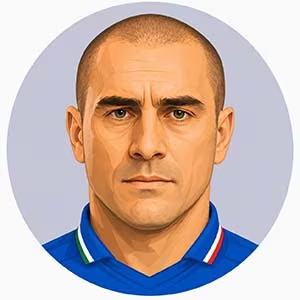
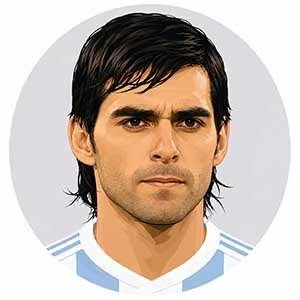
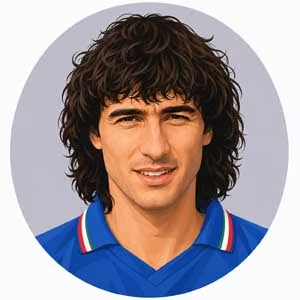
Italy - Centre-backCannavaro, Fabio
In Dortmund on 4 July 2006, Italy were leading Germany 1–0 in the final minute of extra time when a German clearance dropped towards the centre circle. Fabio Cannavaro moved forward rather than retreating towards his own penalty area, rose above the first opponent and headed the ball away, then immediately stepped ahead of Lukas Podolski to win the next possession as well. Seconds later Alberto Gilardino released Alessandro Del Piero for Italy’s second goal. Cannavaro had been defending for almost 120 minutes in a World Cup semi-final, with Germany throwing players forward and one mistake capable of reopening the match. His response was still to compress the danger before it reached his defensive line. That sequence was not an isolated flourish. Throughout the tournament Cannavaro repeatedly defended by moving towards developing attacks, trusting anticipation and timing to prevent forwards from establishing possession. Under maximum competitive pressure, his instinct was rarely to increase the safety distance between himself and the problem.
At 1.76 metres, Cannavaro could not defend elite centre-forwards through dimensions alone. He compensated with an exceptional vertical leap, powerful lower body, rapid acceleration and precise reading of the pass before reception. Rather than allowing a striker to control and then beginning the duel, he frequently stepped around or ahead of the opponent to intercept the ball itself. When that was impossible, his recovery speed allowed him to remain effective after the first movement had failed. He was also unusually strong aerially relative to height because he attacked the flight early rather than contesting from a static position. His distribution was cleaner than the old stereotype suggests. Cannavaro was not an elite playmaking centre-back, but he could carry into available space and pass progressively when the route was clear; describing him as entirely dependent on a creative partner understates his competence. Parma developed the athletic front-foot version, Juventus refined his positional control, and by 2006 experience had reduced some unnecessary intervention without removing aggression. Italy conceded only two goals during that World Cup, neither from an opposing player in open play, and Cannavaro played every minute as captain before winning the Ballon d’Or.
The same defensive construction necessarily carried risk. Cannavaro’s height remained a genuine disadvantage when opponents could force him into static aerial contests rather than allowing him to attack the trajectory. His preference for stepping forward also meant that a failed anticipation could create space behind him, particularly once age reduced the recovery speed that had previously repaired aggressive decisions. At Real Madrid those margins became more visible. Cannavaro remained an experienced and successful defender but was less consistently dominant than during his final Juventus seasons, and high defensive lines could expose declining acceleration. His ball progression was functional rather than transformative: teams requiring the centre-back to dictate possession continuously through pressure were not using his greatest strength. Physical decline therefore affected more than raw pace. The younger Cannavaro could make an aggressive interpretation knowing that athleticism provided a second solution; the older player increasingly needed the first judgement to be correct. His optimal defending was proactive, but proactivity without recovery capacity becomes exposure.
Psychologically, Cannavaro is best defined by **pressure-forward responsibility**. The 2006 tournament repeatedly shows a captain whose response to increasing danger was to move closer to the decisive action rather than protect himself from being responsible for it. This was not fearlessness in any measurable internal sense. It was observable risk orientation: front-foot interceptions, aerial challenges despite a height disadvantage and willingness to defend large spaces while carrying captaincy in elimination matches. His leadership also differed from purely territorial command. Cannavaro was highly expressive and communicative, but teammates’ recollections emphasise energy and collective connection as much as correction or intimidation. The Calciopoli crisis created another useful form of pressure immediately before the World Cup: Juventus teammates arrived with their club environment under extraordinary external scrutiny, yet Cannavaro consistently attempted to separate national-team responsibility from the institutional crisis surrounding them. That compartmentalisation did not require passivity; he publicly defended teammates and the legitimacy of focusing on the tournament. Evidence does not support turning his emotional style into chronic referee instability or indiscriminate aggression. Nor should his occasional hard challenges be interpreted automatically as loss of control; most belonged directly to his defensive method. What distinguishes him is more precise: **when the competitive cost of an approaching action increased, Cannavaro often increased his willingness to become the player who met it first**.