We use Google Analytics to understand how visitors use this site. Analytics cookies are only activated with your consent. For details, read our Privacy Policy.
Profile lensThe same player, read from a different angle.
Athletic79
Acceleration
80
Pace
76
Agility
83
Strength
73
Balance
80
Jumping
71
Stamina
86
Fitness
80
Technical84
Dribbling
85
Short Passing
92
Long Passing
87
Finishing
76
Shot Accuracy
75
Shot Power
80
Shooting Technique
80
Heading
72
Tackling
60
Crossing
83
Free Kick
75
Penalties
73
First Touch
87
Mental82
Composure
88
Aggression
76
Consistency
80
Creativity
82
Leadership
78
Work Rate
81
Tactical82
Vision
88
Off the Ball
80
Defensive Positioning
58
Teamwork
90
Anticipation
80
Marking
52
Player Traits
Attacking77
Crossing
83
Finishing
76
Heading Accuracy
72
Shot Accuracy
75
Off the Ball
80
Technique84
Dribbling
85
Free Kick
75
Short Passing
92
Long Passing
87
First Touch
87
Shot Technique
80
Movement80
Acceleration
80
Pace
76
Agility
83
Balance
80
Physicality78
Shot Power
80
Jumping
71
Stamina
86
Strength
73
Fitness
80
Defending57
Marking
52
Tackling
60
Def. Positioning
58
Mentality & Game Reading82
Aggression
76
Composure
88
Penalties
73
Vision
88
Leadership
78
Work Rate
81
Teamwork
90
Anticipation
80
Consistency
80
Creativity
82
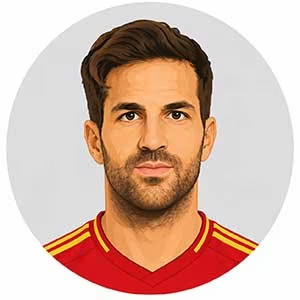
Spain - Centre MidfielderFàbregas, Cesc
Cesca was born in Arenys de Mar, near Barcelona, in 1987. He left La Masia for Arsenal at sixteen, one of the most talked-about academy departures in Barcelona's history, and made his first-team debut for his new club within months. He was a central midfielder of exceptional passing range and game intelligence: quick in thought rather than in the legs, capable of the incisive through ball into the channel and the patient switch of play alike, and a genuine goal threat from midfield, arriving late into the box with timing that made him difficult to track. He captained Arsenal from nineteen and made over 300 appearances before an emotional return to Barcelona in 2011, where he won two La Liga titles and the 2015 Champions League, before a final chapter at Chelsea produced two further Premier League titles under José Mourinho and Antonio Conte. For Spain he won 110 caps, was a starting or impact midfielder across the victorious Euro 2008, World Cup 2010 and Euro 2012 campaigns — the only sustained international trophy run of the modern era — and set the Spanish record for assists.
His limitations were physical and, at times, structural to his career path. Fàbregas was not a dominant physical presence and could be overrun in midfields that pressed him aggressively and denied him time on the ball, a vulnerability that grew more pronounced as he aged and lost a step of his early acceleration. His return to Barcelona proved tactically uncomfortable: deployed in a false-nine or advanced role rather than the deep-lying orchestrator position that suited him best, his influence there never matched his Arsenal or Chelsea peaks, and he moved between formations and roles more than a player of his standing usually tolerates. His defensive contribution remained limited throughout his career, requiring a holding midfielder to cover for him.
Temperamentally he carried the weight of premature responsibility with unusual composure, though not without cost. Fàbregas led Arsenal's midfield through calm organization rather than volume, directing play with short verbal instruction and consistent positioning rather than emotional display, a maturity that impressed teammates significantly older than him from his earliest seasons as captain. He rarely lost his composure with referees and maintained a clean disciplinary record relative to a central midfielder of his usage. The emotional core of his career, however, was the pull between two clubs he loved in different ways: leaving Barcelona as a teenager produced a longing he spoke about often, and the eventual return, followed by a departure that fans on both sides read as another rupture, revealed a player whose sense of belonging never fully settled in either place. He was demonstrative in celebration and visibly affected by big occasions, particularly matches involving Arsenal after his departure, suggesting an attachment that outlasted the institutional relationship itself. Away from the pitch he was articulate, media-comfortable from a young age as a consequence of early captaincy, and largely free of controversy, carrying the poise that leadership at nineteen had forced him to develop years before it would have arrived naturally. Composed beyond his years yet quietly unresolved about where he belonged, Fàbregas built a career of sustained excellence around a question of identity he never fully answered.