We use Google Analytics to understand how visitors use this site. Analytics cookies are only activated with your consent. For details, read our Privacy Policy.
Profile lensThe same player, read from a different angle.
Athletic79
Acceleration
76
Pace
76
Agility
77
Strength
78
Balance
82
Jumping
74
Stamina
88
Fitness
83
Technical85
Dribbling
82
Short Passing
88
Long Passing
90
Finishing
83
Shot Accuracy
81
Shot Power
87
Shooting Technique
79
Heading
74
Tackling
68
Crossing
88
Free Kick
82
Penalties
76
First Touch
86
Mental82
Composure
84
Aggression
82
Consistency
80
Creativity
75
Leadership
83
Work Rate
80
Tactical82
Vision
88
Off the Ball
83
Defensive Positioning
65
Teamwork
86
Anticipation
77
Marking
54
Attacking82
Crossing
88
Finishing
83
Heading Accuracy
74
Shot Accuracy
81
Off the Ball
83
Technique85
Dribbling
82
Free Kick
82
Short Passing
88
Long Passing
90
First Touch
86
Shot Technique
79
Movement78
Acceleration
76
Pace
76
Agility
77
Balance
82
Physicality82
Shot Power
87
Jumping
74
Stamina
88
Strength
78
Fitness
83
Defending62
Marking
54
Tackling
68
Def. Positioning
65
Mentality & Game Reading81
Aggression
82
Composure
84
Penalties
76
Vision
88
Leadership
83
Work Rate
80
Teamwork
86
Anticipation
77
Consistency
80
Creativity
75
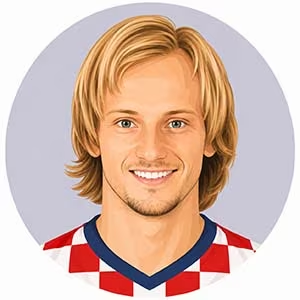
Croatia - Centre MidfielderRakitić, Ivan
Camp Nou, 4 April 2015, Champions League quarter-final against Paris Saint-Germain. Barcelona need a spark and Ivan Rakitić provides it twice, curling in a free-kick and then finishing a driven low shot, two goals from a midfielder officially signed to sit deeper and do the unglamorous work around Xavi, Iniesta and Busquets. That was the paradox of his career at Barcelona: brought in to be the connective tissue, and repeatedly the one who produced the goal nobody expected from him, including the opener in the Champions League final two months later.
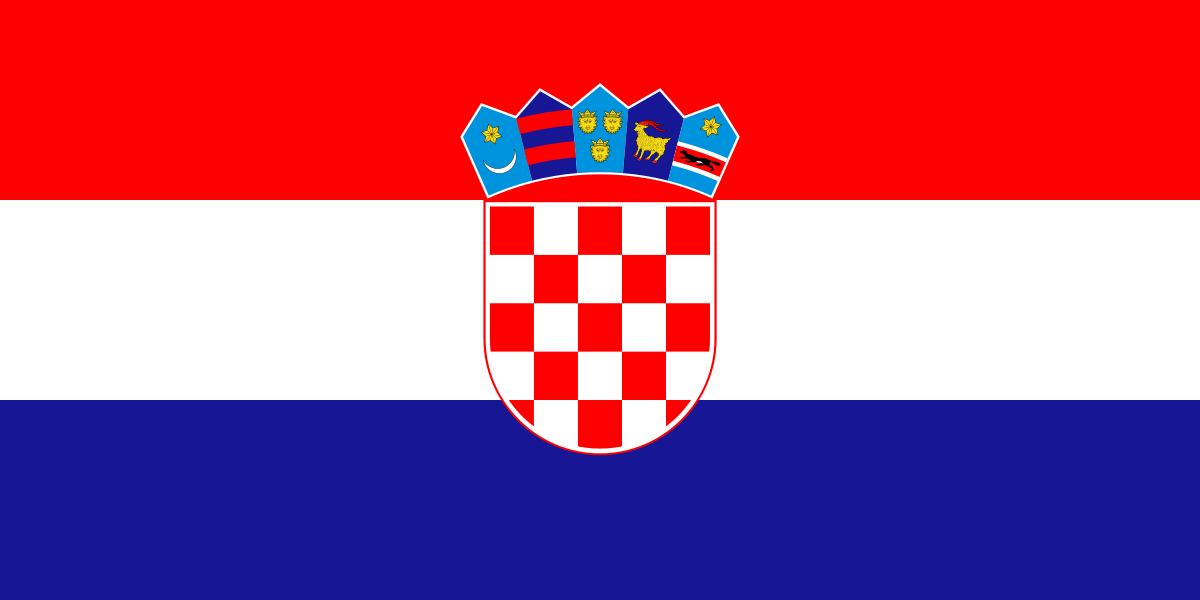
Born in Rheinfelden, Switzerland, in 1988 to Croatian parents who had emigrated for work, Rakitić chose to represent Croatia over Switzerland as a teenager, a decision that shaped his identity as much as any tactical trait did. He was a genuinely complete central midfielder: capable of playing the deep, controlling role or a more advanced box-to-box position, with a passing range that covered both the short combination and the long diagonal switch, a reliable shot from distance, and defensive discipline that made him trusted in systems requiring positional sacrifice. He emerged at Hajduk Split, moved to Schalke, then Sevilla, where he won the 2014 Europa League and was named La Liga's best midfielder, before Barcelona signed him that same year. Across five seasons at the club he won four La Liga titles, four Copas del Rey and the 2015 Champions League, scoring in the final against Juventus, before returning to Sevilla for a second spell. For Croatia he won over 100 caps, was a first-choice midfielder in the side that reached the 2018 World Cup final — the country's greatest result — and remained a starter into his mid-thirties for a golden generation built around Modrić and himself.
His limitations were the natural consequence of his adaptability. Rakitić was rarely the most dominant physical presence in central midfield and depended on positioning rather than power to win individual battles, which left him vulnerable against opponents who combined size with technical quality in central areas. His willingness to subordinate his own game to whatever the team required meant his individual statistical output undersold his importance for long stretches, and coaches who used him purely as a defensive screen got less from him than those who trusted him further forward. In his final Barcelona seasons, as younger midfielders emerged, his role narrowed and his influence diminished accordingly, a decline he accepted with less public friction than many players in a similar position generate.
Temperamentally he was composed, articulate and unusually pragmatic about his own role, moving between a supporting function and a leading one without evident discomfort in either. Rakitić rarely argued with referees, maintained a clean disciplinary record relative to his defensive responsibilities, and was known within Barcelona's dressing room as a stabilizing, technically reliable presence rather than an emotional leader — respected without being the most visible personality in a squad containing considerably larger characters. He was demonstrably proud of his Croatian identity, having actively chosen it over an easier international path through Switzerland, and he spoke about that decision with a conviction that suggested identity mattered to him more than convenience — a rare case in the corpus of a deliberate, contested choice of national allegiance rather than an inherited one. Away from the pitch he was media-comfortable, businesslike in interviews, and largely free of controversy across a fifteen-year career in four countries. Adaptable, understated and quietly decisive at the moments that mattered most, Rakitić built a career on being exactly what each specific team needed him to be, and rarely more than that.