We use Google Analytics to understand how visitors use this site. Analytics cookies are only activated with your consent. For details, read our Privacy Policy.
Profile lensThe same player, read from a different angle.
Athletic82
Acceleration
83
Pace
77
Agility
82
Strength
80
Balance
81
Jumping
80
Stamina
90
Fitness
81
Technical85
Dribbling
91
Short Passing
92
Long Passing
82
Finishing
75
Shot Accuracy
74
Shot Power
80
Shooting Technique
85
Heading
76
Tackling
76
Crossing
80
Free Kick
72
Penalties
77
First Touch
90
Mental88
Composure
88
Aggression
75
Consistency
85
Creativity
87
Leadership
90
Work Rate
91
Tactical87
Vision
90
Off the Ball
82
Defensive Positioning
77
Teamwork
95
Anticipation
82
Marking
71
Player Traits
Attacking77
Crossing
80
Finishing
75
Heading Accuracy
76
Shot Accuracy
74
Off the Ball
82
Technique85
Dribbling
91
Free Kick
72
Short Passing
92
Long Passing
82
First Touch
90
Shot Technique
85
Movement81
Acceleration
83
Pace
77
Agility
82
Balance
81
Physicality82
Shot Power
80
Jumping
80
Stamina
90
Strength
80
Fitness
81
Defending75
Marking
71
Tackling
76
Def. Positioning
77
Mentality & Game Reading86
Aggression
75
Composure
88
Penalties
77
Vision
90
Leadership
90
Work Rate
91
Teamwork
95
Anticipation
82
Consistency
85
Creativity
87
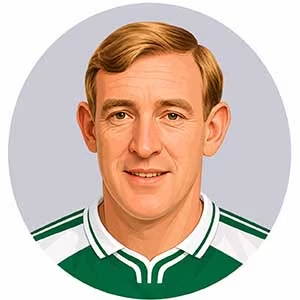
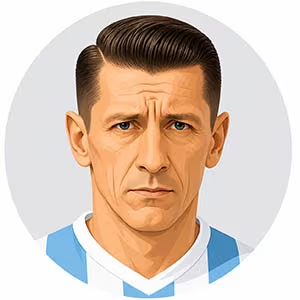
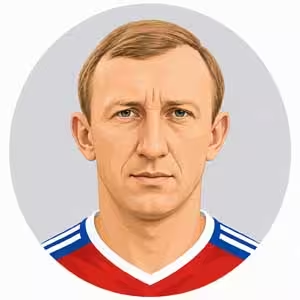
Russia - Centre MidfielderNetto, Igor
Uruguay had equalized, the Soviet players were walking back for the restart, and the referee was pointing to the centre circle. Then the captain of the USSR approached him and explained, in gestures, that the ball had passed through a hole in the side netting and had never crossed the line. The goal was cancelled. The Soviet Union won 2–1 and reached the quarter-finals of the 1962 World Cup — and Igor Netto had just handed world football the most famous act of honesty in its history, at the direct expense of his own country, in an era when his country did not reward that kind of independence.
Born in Moscow in 1930 to a Baltic German family, Netto was a left-half in the old British sense: the connective tissue of the team, positioned in front of the defence but expected to arrive in the opposition box. He was tall for the role at 1.78m, unusually elegant on the ball for a Soviet midfielder of his generation, and famous for a first touch that removed pressure rather than inviting it. His game was built on reading — intercepting passes before they were played, screening the back four by position rather than by tackling, and setting the tempo of possession with short, unhurried distribution. He spent his entire eighteen-year club career at Spartak Moscow, from 1949 to 1966, making 367 appearances and winning five Soviet top-flight titles and three Soviet Cups. He captained the USSR for nearly a decade, leading the team to Olympic gold in Melbourne in 1956 and to victory in the inaugural European Nations' Cup in 1960, the only continental title the Soviet Union ever won, across 54 internationals. He was also a serious ice hockey player, winning a Soviet championship with Spartak's hockey side — an overlap that shaped the physical fearlessness underneath the refinement.
His limitations were physical rather than technical. Netto was not quick, and against direct opponents who ran at him in open space he could be beaten in a straight line; his defending depended on anticipation, so a chaotic, transition-heavy match with broken lines suited him far less than a controlled one. He was also injury-prone in his final international years, and his influence declined sharply when the game around him accelerated beyond his ability to organize it.
What made him a captain was character, and it was not a comfortable character to play alongside. Netto was severe, cerebral and openly demanding, a man who corrected teammates constantly and without diplomacy, and who reserved his sharpest criticism for players he believed were capable of more. He argued with coaches, with officials and with Soviet sporting authorities, protected by his stature and by an obstinacy that made him difficult to intimidate. That same rigidity produced the Uruguay moment: to him it was not a gesture but simple arithmetic, since a goal that had not been scored could not be allowed to stand, and he was reportedly bewildered that anyone found it remarkable. He was equally incapable of theatrical protest, almost never simulated contact, and treated diving and time-wasting as beneath the profession. Off the pitch he belonged to Moscow's cultural world rather than its sporting one: married to the celebrated actress Olga Yakovleva, a lifelong devotee of theatre and chess, well-read and reserved in public, he was the rare footballer of his era whose private life contained no scandal because it contained no interest in scandal. Cold in manner, incorruptible by instinct, and respected far more widely than he was liked, Netto remains the moral reference point of Soviet football.


 All-Time 1950s1950s