We use Google Analytics to understand how visitors use this site. Analytics cookies are only activated with your consent. For details, read our Privacy Policy.
Profile lensThe same player, read from a different angle.
Athletic78
Acceleration
76
Pace
75
Agility
74
Strength
80
Balance
78
Jumping
73
Stamina
87
Fitness
80
Technical84
Dribbling
85
Short Passing
87
Long Passing
85
Finishing
81
Shot Accuracy
80
Shot Power
81
Shooting Technique
78
Heading
71
Tackling
72
Crossing
81
Free Kick
73
Penalties
74
First Touch
85
Mental82
Composure
86
Aggression
78
Consistency
78
Creativity
79
Leadership
82
Work Rate
81
Tactical84
Vision
86
Off the Ball
83
Defensive Positioning
65
Teamwork
92
Anticipation
80
Marking
68
Attacking79
Crossing
81
Finishing
81
Heading Accuracy
71
Shot Accuracy
80
Off the Ball
83
Technique82
Dribbling
85
Free Kick
73
Short Passing
87
Long Passing
85
First Touch
85
Shot Technique
78
Movement76
Acceleration
76
Pace
75
Agility
74
Balance
78
Physicality80
Shot Power
81
Jumping
73
Stamina
87
Strength
80
Fitness
80
Defending68
Marking
68
Tackling
72
Def. Positioning
65
Mentality & Game Reading82
Aggression
78
Composure
86
Penalties
74
Vision
86
Leadership
82
Work Rate
81
Teamwork
92
Anticipation
80
Consistency
78
Creativity
79
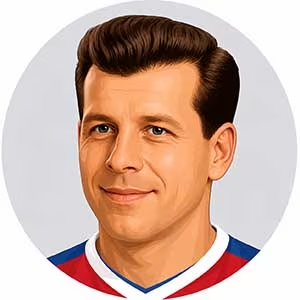
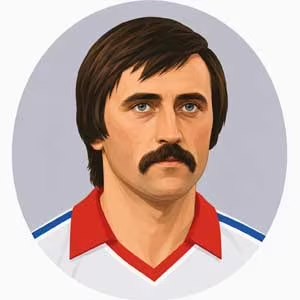
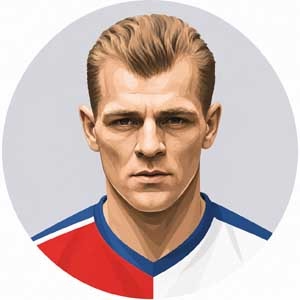
Czech Republic - Centre MidfielderMasopust, Josef
Drifting gracefully across a muddy pitch in Santiago de Chile before clipping a delicate, outside-of-the-boot finish past Gilmar in the 1962 World Cup final captured the aristocratic, effortless elegance of a miner's son from Střimice who became the ideological architect of Czechoslovak football. Josef Masopust was the ultimate complete central midfielder of the early 1960s, pioneering the slalom—a hypnotic, gliding dribbling sequence where he dropped his shoulders and weaved between lunging challenges without ever looking down at the leather ball.
Operating as an inside-left or deep-lying conductor, Masopust was the beating tactical heart of both Dukla Prague and the national side. He married immaculate spatial vision with crisp, one-touch combination play, crisp tackling, and an uncanny ability to transition from a defensive recovery directly into a 40-yard offensive drive. As the undisputed talisman of army club Dukla Prague between 1952 and 1968, he won eight Czechoslovak First League championships and three Czechoslovak Cups, leading the club to the 1966–67 European Cup semi-finals. For Czechoslovakia, across 63 caps and ten goals, his international pinnacle arrived at the 1962 World Cup, where his sublime midfield orchestrations carried an unheralded side all the way to the final against Brazil, earning him the prestigious 1962 Ballon d'Or as the first Eastern European player in history to claim the award.
Masopust’s refined, rhythmic game, however, relied on collective spatial harmony and tactical intelligence around him. He was not an explosive physical athlete or a bone-crunching enforcer who thrived in chaotic, unstructured physical warfare; if an opponent resorted to continuous cynical hacking on pitch surfaces where the ball could not be rolled cleanly and referees permitted overt physical violence, his artistic dribbling and measured passing tempo could be disrupted. Furthermore, his scoring output was based on calculated, late arrivals rather than high-volume penalty-box finishing.
Noble, intensely dignified, and carrying an unshakeable moral compass, Masopust was widely revered as the absolute gentleman-footballer of the Cold War era. His commitment to sportsmanship became legendary during the 1962 World Cup group match against Brazil, where, upon noticing that an injured Pelé could barely walk but had to stay on the pitch, Masopust refused to tackle or challenge him, gently standing off out of pure respect for a fellow artist. On the pitch, his body language was calm, upright, and poetic: surveying passing lanes with serene composure, accelerating through midfield with fluid grace, and leading by moral authority rather than shouting. Inside the Dukla Prague and Czechoslovak dressing rooms, his stature was patriarchal and untouchable—a noble, visionary maestro whose chivalry, spatial intelligence, and golden right foot left an indelible mark on European football history.