We use Google Analytics to understand how visitors use this site. Analytics cookies are only activated with your consent. For details, read our Privacy Policy.
Profile lensThe same player, read from a different angle.
Athletic80
Acceleration
71
Pace
74
Agility
74
Strength
87
Balance
85
Jumping
76
Stamina
88
Fitness
85
Technical83
Dribbling
85
Short Passing
88
Long Passing
85
Finishing
77
Shot Accuracy
74
Shot Power
83
Shooting Technique
79
Heading
78
Tackling
68
Crossing
81
Free Kick
71
Penalties
74
First Touch
84
Mental82
Composure
82
Aggression
86
Consistency
80
Creativity
74
Leadership
85
Work Rate
85
Tactical83
Vision
86
Off the Ball
82
Defensive Positioning
68
Teamwork
87
Anticipation
81
Marking
62
Player Traits
Attacking78
Crossing
81
Finishing
77
Heading Accuracy
78
Shot Accuracy
74
Off the Ball
82
Technique82
Dribbling
85
Free Kick
71
Short Passing
88
Long Passing
85
First Touch
84
Shot Technique
79
Movement76
Acceleration
71
Pace
74
Agility
74
Balance
85
Physicality84
Shot Power
83
Jumping
76
Stamina
88
Strength
87
Fitness
85
Defending66
Marking
62
Tackling
68
Def. Positioning
68
Mentality & Game Reading82
Aggression
86
Composure
82
Penalties
74
Vision
86
Leadership
85
Work Rate
85
Teamwork
87
Anticipation
81
Consistency
80
Creativity
74
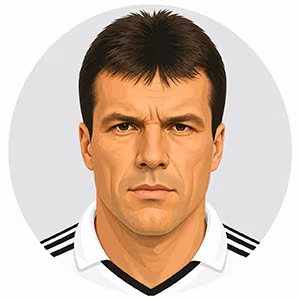
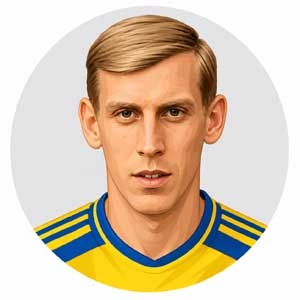
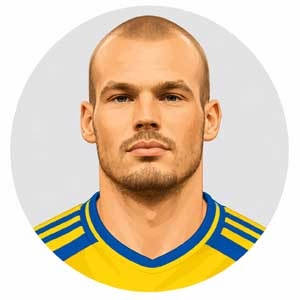
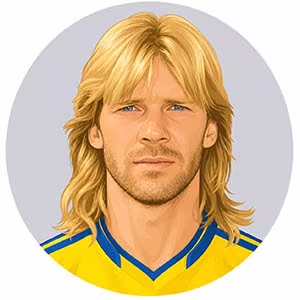
Sweden - Centre MidfielderStrömberg, Glenn
In the summer of 1987, Atalanta had just been relegated when Glenn Strömberg was offered the chance to leave. Bigger clubs were interested, and remaining meant dropping into Serie B after three seasons in Italy. He stayed. Strömberg later explained the decision in unusually direct terms: he felt partly responsible for the relegation and wanted to repair it. Emiliano Mondonico made him captain, and Atalanta immediately won promotion before embarking on an improbable run to the European Cup Winners’ Cup semi-finals while still a second-division club. It was the moment when Strömberg stopped being merely a successful foreign signing and became identified with Bergamo itself: responsibility answered failure more strongly than prestige answered opportunity.
Strömberg was a tall, powerful central midfielder, around 1.90 metres, whose game combined physical range, technical security and tactical intelligence. Early in his career he relied heavily on athleticism and natural technique, carrying the ball through midfield, competing strongly in duels and arriving forward with enough timing to score. Sven-Göran Eriksson pushed him toward a more sophisticated interpretation, instructing him to read spaces earlier rather than solving situations through strength after they had developed. Strömberg later credited that lesson with transforming his football. At IFK Göteborg he became part of the side that won the 1982 Swedish championship and UEFA Cup, starting both legs of the final against Hamburg. He followed Eriksson to Benfica in January 1983, where he made 44 official appearances, scored six goals, won consecutive Portuguese league titles and the 1982–83 Portuguese Cup, and reached another UEFA Cup final. Benfica’s more technical environment forced another adjustment; Strömberg later recalled initially struggling badly in training against smaller, skilful teammates before learning to improve his balance and technique. Atalanta signed him in 1984, and Bergamo became his footballing home. Across eight seasons he operated in central midfield, sometimes more defensively and sometimes with greater freedom to advance, and won Sweden’s Guldbollen in 1985. After relegation in 1987 he captained Atalanta back to Serie A and then to the 1987–88 Cup Winners’ Cup semi-finals. His international career lasted from 1982 to 1990 and included the 1990 World Cup.
His strengths depended significantly on mobility. Strömberg’s long frame and running power allowed him to cover large areas, but opponents who moved the ball quickly around him could force him to turn repeatedly and expose the limits of his acceleration. He was technically good rather than an elite creative specialist, so teams expecting him to dictate possession through constant invention could reduce his effectiveness. His forward runs also required cover behind him. The later stages of his career revealed how dependent the overall package was on physical capacity: after a serious injury, Atalanta coach Bruno Giorgi proposed using him as a libero, a role Strömberg refused. Rather than prolong his career in a function he did not want, he retired at 32. That decision shows adaptability had limits; he could learn new tactical demands, but not indefinitely detach himself from the footballing identity he considered his own.
Psychologically, Strömberg combined strong collective responsibility with a considerably sharper sense of personal pride than his calm public manner might suggest. Relegation provides the cleanest example of the first. He did not interpret the drop as a reason to seek a more prestigious environment; because he believed foreign players had received greater credit when Atalanta succeeded, he accepted that they should also carry greater responsibility when the team failed. He stayed and helped repair the damage. Personal humiliation triggered something very different. During a pre-season match after he had become captain, a supporter called him “Marisa”, a taunt rival fans had used about his long blond hair. Hearing it from his own crowd provoked an immediate response: Strömberg jumped the barrier, confronted the spectator directly and shouted his name and status back at him. The episode is important precisely because it was atypical. Routine opposition abuse had been tolerated; perceived betrayal from his own group crossed a different threshold. His relationship with coaches shows similarly conditional rather than passive compliance. Eriksson told him to abandon habits built on physical and technical superiority and learn to read the game differently; Strömberg accepted the criticism and later identified Eriksson as the best coach he had worked with. Mondonico gained similar loyalty through personal connection and trust. Yet when Giorgi proposed converting him permanently into a libero late in his career, Strömberg simply refused and retired. Authority worked when he believed the requested transformation still belonged to his footballing identity. His emotional memory could also be long. Decades after Atalanta’s 1988 elimination by Mechelen, he said the defeat had become harder, not easier, to accept with time. There is therefore little evidence of emotional detachment. Strömberg felt affiliation and failure intensely, but most negative activation was converted into responsibility or persistence rather than blame. The exception was direct identity-based provocation, especially from within his own group, where his restraint could disappear abruptly.


 All Time SwedenNT