We use Google Analytics to understand how visitors use this site. Analytics cookies are only activated with your consent. For details, read our Privacy Policy.
Profile lensThe same player, read from a different angle.
Athletic83
Acceleration
89
Pace
87
Agility
91
Strength
66
Balance
77
Jumping
74
Stamina
91
Fitness
85
Technical83
Dribbling
86
Short Passing
84
Long Passing
87
Finishing
82
Shot Accuracy
79
Shot Power
83
Shooting Technique
81
Heading
73
Tackling
54
Crossing
88
Free Kick
80
Penalties
82
First Touch
85
Mental84
Composure
86
Aggression
83
Consistency
84
Creativity
82
Leadership
83
Work Rate
84
Tactical84
Vision
87
Off the Ball
83
Defensive Positioning
60
Teamwork
88
Anticipation
82
Marking
52
Player Traits
Attacking 81
Crossing
88
Finishing
82
Heading Accuracy
73
Shot Accuracy
79
Off the Ball
83
Technique 84
Dribbling
86
Free Kick
80
Short Passing
84
Long Passing
87
First Touch
85
Shot Technique
81
Movement 86
Acceleration
89
Pace
87
Agility
91
Balance
77
Physicality 80
Shot Power
83
Jumping
74
Stamina
91
Strength
66
Fitness
85
Defending 55
Marking
52
Tackling
54
Def. Positioning
60
Mentality & Game Reading 84
Aggression
83
Composure
86
Penalties
82
Vision
87
Leadership
83
Work Rate
84
Teamwork
88
Anticipation
82
Consistency
84
Creativity
82
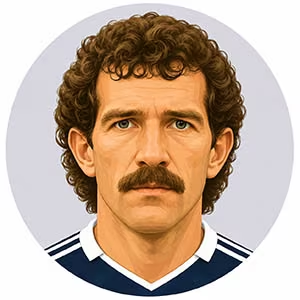
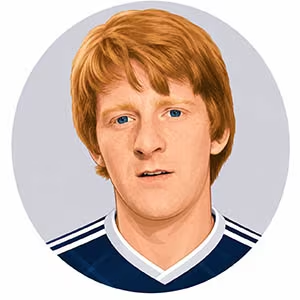
Scotland - Right MidfielderStrachan, Gordon
Strachan was a small, technically precise midfielder whose intelligence allowed him to influence matches without physical dominance. He operated from the right, centrally or as an attacking midfielder, using close control, short acceleration and rapid combination rather than pure speed. His low centre of gravity helped him protect possession, while his passing and movement allowed him to connect midfield with attack and arrive around the penalty area. Ferguson’s Aberdeen demanded considerable work without the ball, so Strachan’s creative function was never detached from pressing and recovery. At Manchester United he won the FA Cup in 1985 but eventually lost momentum as injuries and changing circumstances reduced his effectiveness. The move to Leeds in 1989 appeared, superficially, to be a step downward: he was thirty-two and joining a Second Division club. Instead, Howard Wilkinson made him captain and placed substantial responsibility around him. Leeds won promotion, then finished fourth in their first season back and became English champions in 1991–92. Strachan’s transformation from supposedly declining midfielder into the organising senior player of a title-winning team is essential to his profile.
His limitations were physical and stylistic. Strachan lacked size, aerial power and the stride length to dominate large spaces, and recurring back problems eventually required careful management. His game worked best when technical combinations and positional intelligence could reduce the need for repeated open-field athletic contests. He could carry through pressure but was not an explosive winger capable of separating indefinitely through pace, nor a purely defensive midfielder who could control central territory through physical duelling. Age made those constraints more obvious and forced adaptation. Wilkinson deliberately built a regime at Leeds that allowed Strachan to preserve his body while maintaining influence, and Strachan himself became exceptionally attentive to preparation. That adaptation should not be rewritten as immunity to physical decline: his later effectiveness depended on managing it. Nor should his confrontational edge be treated as universally productive. A player who uses opposition, criticism and disagreement as fuel can occasionally expend energy on the conflict itself. The evidence supports strong competitive activation through friction, not the claim that every confrontation improved his football.
Psychologically, Strachan’s clearest distinguishing feature is antagonistic activation: opposition, doubt and interpersonal friction could increase rather than merely accompany his competitive engagement. His relationship with Ferguson is the strongest evidence because it contained genuine conflict without fitting either obedience or permanent rupture. Strachan later acknowledged that the pair argued repeatedly at Aberdeen and Manchester United, while Ferguson eventually sold him; years afterwards they reconstructed the relationship sufficiently for Strachan to speak warmly about what he had learned from him. The competitive mechanism survived the interpersonal difficulty. At Leeds, Wilkinson used a different form of authority, entrusting Strachan with captaincy and demanding that he become an example for younger players. Strachan responded by changing preparation, diet and training habits and by exercising standards inside the group rather than simply demanding creative freedom. This was therefore not rebellion as identity. He could respond strongly both to confrontation and to trust. His public manner also retained the same mechanism after playing: questions he considered foolish were often met with humour, sarcasm or counterattack rather than neutral compliance. That later behaviour should not be imported directly into playing ratings, but it is consistent with a longstanding refusal to become passive inside an interaction. Evidence for systematic referee-driven performance degradation, retaliatory fouling or teammate blame is insufficient and should remain unknown. The more defensible pattern is that Strachan frequently required neither harmony nor reassurance to function; resistance itself could become usable competitive energy, provided the conflict still left him a meaningful role in solving the football problem.


 All Time Scotland NT