We use Google Analytics to understand how visitors use this site. Analytics cookies are only activated with your consent. For details, read our Privacy Policy.
Profile lensThe same player, read from a different angle.
Athletic77
Acceleration
71
Pace
68
Agility
79
Strength
82
Balance
80
Jumping
83
Stamina
68
Fitness
84
Technical45
Dribbling
54
Short Passing
58
Long Passing
62
Shot Accuracy
44
Shot Power
86
Shooting Technique
42
Heading
44
Free Kick
44
Penalties
44
First Touch
57
Mental84
Composure
86
Consistency
85
Leadership
70
Goalkeeping87
Reflexes
88
Positioning
87
Handling
87
Kicking
85
Goalkeeping87
Reflexes
88
Positioning
87
Handling
87
Kicking
85
Attacking44
Heading Accuracy
44
Shot Accuracy
44
Technique53
Dribbling
54
Free Kick
44
Short Passing
58
Long Passing
62
First Touch
57
Shot Technique
42
Physicality81
Shot Power
86
Jumping
83
Stamina
68
Strength
82
Fitness
84
Movement75
Acceleration
71
Pace
68
Agility
79
Balance
80
Mentality & Game Reading71
Composure
86
Penalties
44
Leadership
70
Consistency
85
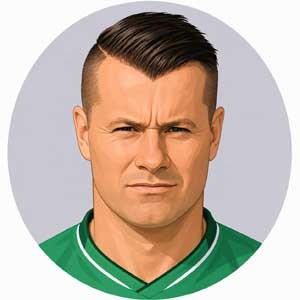
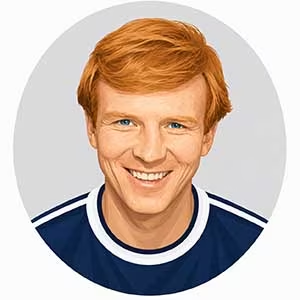
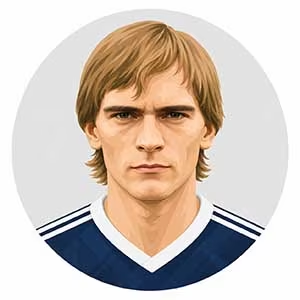
Scotland - GoalkeeperLeighton, Jim
Les Sealey, the goalkeeper who had replaced him for the biggest match of his career, offered Jim Leighton his winner's medal afterward — a gesture of genuine sympathy from one professional to another. Leighton refused it outright. If the situation were reversed, he told Sealey, you wouldn't have accepted it either. Weeks later, when a medal arrived from the club that Leighton had, in fact, legitimately earned by playing the drawn first match, he sent that back too, telling Manchester United to return it to the Football Association. He wanted no part of anything that looked like charity.
Born in Johnstone, Scotland, in 1958, Leighton was a technically excellent, positionally reliable goalkeeper who became central to Alex Ferguson's transformation of Aberdeen into a genuine force in European football, winning seven domestic trophies and the 1983 Cup Winners' Cup against Real Madrid. When Ferguson took charge at Manchester United, he brought Leighton with him in 1988 for a then-record fee for a goalkeeper, and Leighton had a strong opening season. But after United conceded three goals in the drawn 1990 FA Cup final against Crystal Palace — a collective defensive failure rather than an individual one, by most contemporary accounts — Ferguson dropped him for the replay in favor of Les Sealey, who kept a clean sheet as United won 1–0 to deliver Ferguson's first major trophy at the club. Leighton watched from the stands. He never started for United again in anything comparable, moved on through Arsenal, Reading, Dundee and Sheffield United, and rebuilt his career and reputation at Hibernian from 1993, eventually returning to Aberdeen and continuing to play international football into his forties. For Scotland he won 91 caps, at the time the most of any Scottish goalkeeper in history, and remains one of the few Scottish players to have appeared at four separate World Cups.
His limitations in the specific moment that defined his public reputation were more circumstantial than technical — a shaky, confidence-affected performance in one high-stakes match, following an otherwise excellent season, that a manager building his reputation on ruthless decision-making chose to treat as decisive rather than as a single bad afternoon.
Temperamentally he was defined by a pride that refused any consolation he had not fully earned, and by a rupture with his own mentor that he carried, unresolved, for the rest of his life. He and Ferguson did not speak again after the 1990 decision — a silence Leighton confirmed decades later would remain permanent, offering a measured rather than bitter assessment: Ferguson, he said, understood the game and its tactics better than almost anyone, but handling people was a different matter entirely. That the estrangement followed nine trophies won together at Aberdeen, including a genuinely historic European triumph, only sharpened the sense of a professional relationship that had once been close enough to bring Leighton south to Manchester in the first place. Rather than let the humiliation define the remainder of his career, he treated the years after 1990 as, in his own words, effectively a second career — one built without another major trophy but with a sustained return to his best form at both club and international level, a comeback observers later described as returning from the dead. He accepted the setback without public complaint beyond his refusal of unearned sympathy, channeling whatever resentment he carried into continued performance rather than grievance. Proud, quietly principled, and permanently marked by a single decision he never fully reconciled with the man who made it, Leighton built one of Scottish football's longest and most respected international careers on the refusal to be defined by the worst afternoon of it.


 All Time ScotlandNT