We use Google Analytics to understand how visitors use this site. Analytics cookies are only activated with your consent. For details, read our Privacy Policy.
Profile lensThe same player, read from a different angle.
Athletic77
Acceleration
71
Pace
68
Agility
80
Strength
85
Balance
78
Jumping
85
Stamina
67
Fitness
80
Technical47
Dribbling
58
Short Passing
63
Long Passing
62
Shot Accuracy
48
Shot Power
86
Shooting Technique
47
Heading
48
Free Kick
47
Penalties
48
First Touch
60
Mental82
Composure
86
Consistency
74
Leadership
86
Goalkeeping91
Reflexes
97
Positioning
93
Handling
86
Kicking
87
Goalkeeping91
Reflexes
97
Positioning
93
Handling
86
Kicking
87
Attacking48
Heading Accuracy
48
Shot Accuracy
48
Technique56
Dribbling
58
Free Kick
47
Short Passing
63
Long Passing
62
First Touch
60
Shot Technique
47
Physicality81
Shot Power
86
Jumping
85
Stamina
67
Strength
85
Fitness
80
Movement74
Acceleration
71
Pace
68
Agility
80
Balance
78
Mentality & Game Reading74
Composure
86
Penalties
48
Leadership
86
Consistency
74
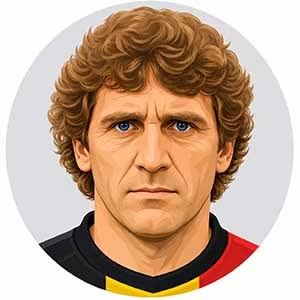
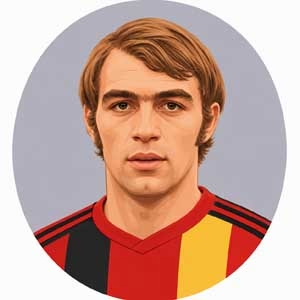
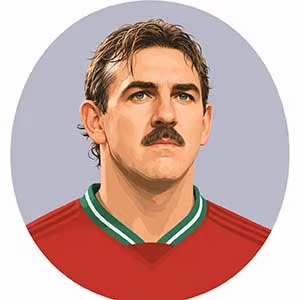
Belgium - GoalkeeperPfaff, Jean-Marie
A theatrical leap toward the top corner, a grin flashed at the camera, and an instinctive mastery of floor recovery established Jean-Marie Pfaff as one of the most explosive and idiosyncratic goalkeeping phenomenons of the 1980s. Emerging from KSK Beveren—where his miraculous displays led an unheralded provincial side to the 1978–79 Belgian First Division title and a Belgian Cup—El Simpático reached global elite status across six seasons at Bayern Munich. Standing five-foot-eleven, he lacked the towering physical frame typical of German shot-stoppers, yet he possessed extraordinary explosive leg power, hyper-elastic diving mechanics, and an almost superhuman reflex speed on point-blank deflections. With Bayern, he clinched three consecutive Bundesliga titles (1985–1987) and two DFB-Pokals, overcoming a disastrous debut where he threw an own goal off a throw-in against Werder Bremen. His international zenith spanned 64 caps for Belgium, culminating in the 1986 World Cup in Mexico: Pfaff pulled off a series of tournament-defining reaction saves against the USSR and Spain to drag the Red Devils to the semi-finals, ultimately winning the inaugural IFFHS World's Best Goalkeeper award in 1987. On the tactical downside, his hyper-active style leaned heavily toward the erratic: he had an obsessive tendency to over-parry shots into dangerous central zones rather than cleanly holding the ball, frequently misjudged high crosses due to his limited height, and was prone to theatrical, unnecessary dives on balls that were drifting comfortably wide.
Behind the toothy smile and the media-friendly persona lay an insecure, hyper-competitive, and occasionally petty character driven by an insatiable need for validation. Pfaff treated every match as an audition for the global spotlight; he thrived under intense media scrutiny, yet his rampant vanity and demand for individual attention regularly alienated team-mates. His relationship with national team competitor Michel Preud'homme and captain Eric Gerets was fraught with passive-aggressive tension, and at the 1982 World Cup, he famously pushed a journalist into a swimming pool, leading to a temporary internal suspension. On the pitch, his emotional baseline was erratic: when playing well, he projected indestructible, clownish bravado that completely demoralized opposing strikers, but when an error occurred, he was quick to deflect blame onto his center-backs with theatrical gesticulations. Inside the Bayern locker room, Paul Breitner and Karl-Heinz Rummenigge initially viewed him as an intolerable showman, though they respected his relentless training ethic. Toward referees and aggressive center-forwards, Pfaff deployed a mixture of tactical charm and exaggerated agony to draw fouls, leaving a legacy as an electrifying, acrobatic, but undeniably divisive master between the posts.