We use Google Analytics to understand how visitors use this site. Analytics cookies are only activated with your consent. For details, read our Privacy Policy.
Profile lensThe same player, read from a different angle.
Athletic82
Acceleration
75
Pace
78
Agility
73
Strength
87
Balance
85
Jumping
85
Stamina
82
Fitness
87
Technical76
Dribbling
69
Short Passing
71
Long Passing
74
Finishing
62
Shot Accuracy
60
Shot Power
83
Shooting Technique
62
Heading
87
Tackling
87
Crossing
63
Free Kick
60
Penalties
60
First Touch
72
Mental83
Composure
79
Aggression
88
Consistency
87
Creativity
54
Leadership
85
Work Rate
85
Tactical80
Vision
69
Off the Ball
66
Defensive Positioning
86
Teamwork
79
Anticipation
82
Marking
85
Player Traits
Attacking68
Crossing
63
Finishing
62
Heading Accuracy
87
Shot Accuracy
60
Off the Ball
66
Technique68
Dribbling
69
Free Kick
60
Short Passing
71
Long Passing
74
First Touch
72
Shot Technique
62
Movement78
Acceleration
75
Pace
78
Agility
73
Balance
85
Physicality85
Shot Power
83
Jumping
85
Stamina
82
Strength
87
Fitness
87
Defending86
Marking
85
Tackling
87
Def. Positioning
86
Mentality & Game Reading77
Aggression
88
Composure
79
Penalties
60
Vision
69
Leadership
85
Work Rate
85
Teamwork
79
Anticipation
82
Consistency
87
Creativity
54
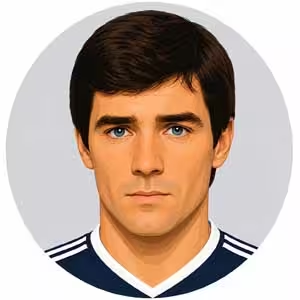
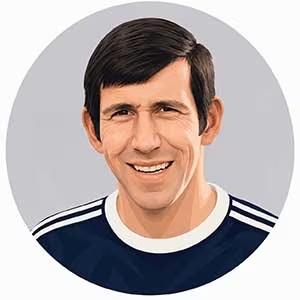
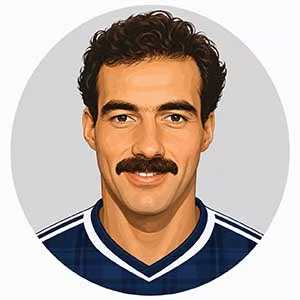
Scotland - Centre-backMcLeish, Alex
Serving as the rugged, uncompromising defensive cornerstone of Aberdeen’s historic golden era under Alex Ferguson, Alexander "Alex" McLeish was a pragmatic, no-nonsense central defender who maximized his physical attributes to build a remarkably durable career at the highest level of Scottish and European football. A one-club stalwart who made 692 competitive appearances for the Dons between 1978 and 1994, McLeish was the quintessential stopper in a classic complementary defensive pairing: while his partner Willie Miller provided elite positional anticipation, reading of the game, and tactical organization, McLeish provided the sheer height, physical aggression, and aerial dominance. Standing at six-foot-three with a powerful build, his technical game was straightforward and free of risk, focusing on winning primary headers from direct balls, making clean recovery tackles inside the penalty box, and clearing his lines efficiently into touch or upfield. He proved indispensable during Aberdeen's remarkable disruption of the Old Firm hegemony, winning three Scottish Premier Division titles, five Scottish Cups, and two League Cups, alongside playing every minute of the famous 1983 European Cup Winners' Cup triumph over Real Madrid in Gothenburg and the subsequent European Super Cup. Earning 77 caps for Scotland, he was a steady, reliable fixture across three consecutive World Cup squads (1982, 1986, and 1990), forming a dependable international partnership with Miller that gave the national side a solid defensive spine. Mentally and emotionally, McLeish was an authentic working-class leader driven by an intense work ethic, tactical discipline, and total commitment to the collective structure. He understood his limitations on the ball, never attempting risky play out from the back, and instead focused entirely on defensive reliability and fulfilling Ferguson's demanding tactical instructions. On the pitch, his leadership was vocal, functional, and steady; while Miller was the animated, fiery on-field general, McLeish was the composed, physically intimidating enforcer who organized the penalty box on set pieces and demanded high concentration from his full-backs. In the dressing room, he was a grounded, approachable, and highly respected professional—a steadying, mature presence who eventually captained the club and naturally transitioned into player-coaching in his twilight years. Under tournament pressure with Scotland, his mental approach was calm and resilient, rarely rattled by facing world-class attacking lines even when Scotland were pinned deep in defensive blocks. Toward referees and physical center-forwards, McLeish operated as a hard, combative competitor: he threw his weight into challenges and conceded his share of hard fouls to break up counter-attacks, but he remained fundamentally an honest, traditional defender who took his bumps, avoided cynical theatrics, and gave everything for the shirt over a sixteen-year career.



 All Time ScotlandNT