We use Google Analytics to understand how visitors use this site. Analytics cookies are only activated with your consent. For details, read our Privacy Policy.
Profile lensThe same player, read from a different angle.
Athletic81
Acceleration
74
Pace
78
Agility
72
Strength
88
Balance
82
Jumping
85
Stamina
82
Fitness
90
Technical77
Dribbling
74
Short Passing
75
Long Passing
74
Finishing
63
Shot Accuracy
60
Shot Power
85
Shooting Technique
62
Heading
84
Tackling
91
Crossing
67
Free Kick
60
Penalties
60
First Touch
72
Mental86
Composure
87
Aggression
88
Consistency
90
Creativity
60
Leadership
84
Work Rate
87
Tactical84
Vision
73
Off the Ball
68
Defensive Positioning
91
Teamwork
80
Anticipation
82
Marking
93
Player Traits
Attacking68
Crossing
67
Finishing
63
Heading Accuracy
84
Shot Accuracy
60
Off the Ball
68
Technique70
Dribbling
74
Free Kick
60
Short Passing
75
Long Passing
74
First Touch
72
Shot Technique
62
Movement77
Acceleration
74
Pace
78
Agility
72
Balance
82
Physicality86
Shot Power
85
Jumping
85
Stamina
82
Strength
88
Fitness
90
Defending92
Marking
93
Tackling
91
Def. Positioning
91
Mentality & Game Reading79
Aggression
88
Composure
87
Penalties
60
Vision
73
Leadership
84
Work Rate
87
Teamwork
80
Anticipation
82
Consistency
90
Creativity
60
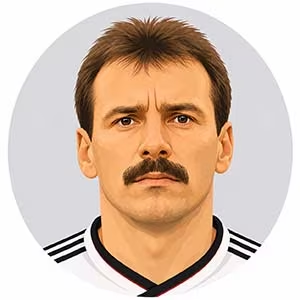
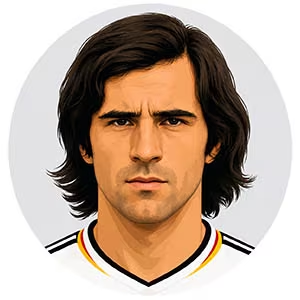
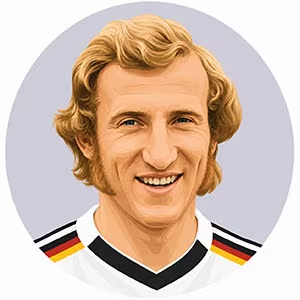
Germany - Centre-backSchwarzenbeck, Hans-Georg
A desperate, low-driven strike from thirty yards out in the 120th minute of the 1974 European Cup final against Atlético Madrid rescued Bayern Munich from defeat with virtually the last kick of the game, paving the way for a 4–0 replay rout and igniting the club's continental dynasty. Hans-Georg Schwarzenbeck—affectionately known across Bavaria as Katsche—was the uncompromising, selfless defensive bodyguard whose dirty work, aerial dominance, and man-marking tenacity provided the platform for Franz Beckenbauer to glide forward as the world's greatest libero.
Operating as an orthodox, hard-tackling central stopper, Schwarzenbeck was an immovable physical presence: tracking opposing center-forwards across every blade of grass, winning bruising aerial duels inside the box, and executing clean, no-nonsense sliding challenges. A loyal one-club titan, he made 554 appearances for Bayern Munich between 1966 and 1981, winning six Bundesliga championships, three DFB-Pokal cups, the 1967 European Cup Winners' Cup, and three consecutive European Cups (1974, 1975, 1976). For West Germany, across 44 caps, he formed an untouchable defensive partnership with Beckenbauer, capturing the 1972 European Championship and the 1974 World Cup on home soil.
Schwarzenbeck’s game, however, was deliberately stripped of aesthetic refinement. He was not a cultured distributor; his passing was strictly pragmatic, limited to short, safe lay-offs to Beckenbauer or basic clearances into the stands under heavy pressure. When dragged into open space against nimble, low-center-of-gravity forwards who avoided physical contact, his heavy turning radius and deliberate linear pace could be tested if his initial physical challenge missed.
Quiet, unassuming, and completely devoid of modern ego, Schwarzenbeck was the quintessential working-class hero. He had zero interest in media attention or commercial glamour, quietly operating a stationery shop in Munich after his retirement. On the pitch, his presence was honest and resolute: absorbing bruising collisions without complaint, keeping his focus fixed entirely on neutralizing his direct opponent, and celebrating triumphs with understated satisfaction. Inside the Bayern Munich and West German locker rooms, he was an indispensable, beloved soldier whose loyalty, selflessness, and immaculate defensive discipline earned the profound gratitude of Beckenbauer, Gerd Müller, and Sepp Maier, leaving behind an immortal legacy as the ultimate defensive partner in football history.


 All Time Bayern MunichClub