We use Google Analytics to understand how visitors use this site. Analytics cookies are only activated with your consent. For details, read our Privacy Policy.
Profile lensThe same player, read from a different angle.
Athletic82
Acceleration
75
Pace
77
Agility
74
Strength
88
Balance
87
Jumping
85
Stamina
82
Fitness
85
Technical77
Dribbling
70
Short Passing
74
Long Passing
73
Finishing
54
Shot Accuracy
55
Shot Power
84
Shooting Technique
63
Heading
86
Tackling
90
Crossing
66
Free Kick
58
Penalties
55
First Touch
73
Mental86
Composure
85
Aggression
90
Consistency
87
Creativity
66
Leadership
88
Work Rate
91
Tactical81
Vision
71
Off the Ball
55
Defensive Positioning
87
Teamwork
77
Anticipation
84
Marking
90
Player Traits
Attacking63
Crossing
66
Finishing
54
Heading Accuracy
86
Shot Accuracy
55
Off the Ball
55
Technique69
Dribbling
70
Free Kick
58
Short Passing
74
Long Passing
73
First Touch
73
Shot Technique
63
Movement78
Acceleration
75
Pace
77
Agility
74
Balance
87
Physicality85
Shot Power
84
Jumping
85
Stamina
82
Strength
88
Fitness
85
Defending89
Marking
90
Tackling
90
Def. Positioning
87
Mentality & Game Reading79
Aggression
90
Composure
85
Penalties
55
Vision
71
Leadership
88
Work Rate
91
Teamwork
77
Anticipation
84
Consistency
87
Creativity
66
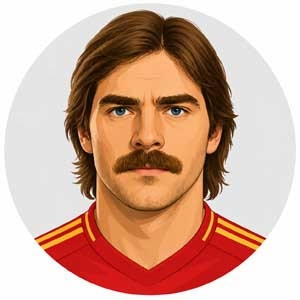
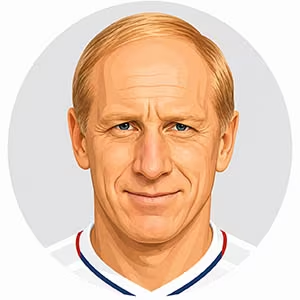
England - Centre-backFoulkes, Bill
Crawling out of the smoldering wreckage of the Munich air disaster in February 1958 to pull teammates from the snow, a former St Helens coal miner became the unyielding bedrock upon which Sir Matt Busby rebuilt Manchester United from the ashes. William Anthony Foulkes was the quintessential old-school British stopper: an uncompromising, physically imposing center-half who guarded the penalty area with brutal tackling, aerial supremacy, and relentless positional discipline. Across 688 appearances for the Red Devils between 1950 and 1970—second only to Bobby Charlton and Ryan Giggs in club longevity—Foulkes lifted four First Division titles, the 1963 FA Cup, and etched his name into legend on May 15, 1968, by calmly slotting home an improbable 88th-minute semi-final equalizer against Real Madrid at the Santiago Bernabéu to send United to their historic European Cup triumph at Wembley.
His classical stopper profile, however, was entirely devoid of modern aesthetic refinement. Foulkes was notoriously utilitarian on the ball; his distribution under pressure was limited to basic clearances into touch or safe sideways lay-offs, and his heavy frame left him vulnerable to agile, low-center-of-gravity forwards who could spin past his initial challenge in wide-open transitions.
Stoic, quiet, and possessing an unbreakable blue-collar spine, Foulkes approached the sport not as entertainment, but as an honest shift of hard labor. He carried the psychological scars of Munich without complaint or self-pity, anchoring the young generation with grim determination and uncompromising defensive standards. On the pitch, his body language was immovable and fearless: absorbing physical clashes without flinching, commanding the six-yard box through sheer presence, and keeping his defensive line organized under intense pressure. Inside the Old Trafford locker room, he was an untouchable, revered elder statesman who earned the profound respect of Busby, George Best, and Denis Law for his monastic loyalty, leaving behind an immortal legacy as the definitive iron man and heroic soul of Manchester United.