We use Google Analytics to understand how visitors use this site. Analytics cookies are only activated with your consent. For details, read our Privacy Policy.
Profile lensThe same player, read from a different angle.
Athletic79
Acceleration
69
Pace
71
Agility
78
Strength
94
Balance
88
Jumping
83
Stamina
65
Fitness
85
Technical53
Dribbling
58
Short Passing
62
Long Passing
72
Shot Accuracy
47
Shot Power
87
Shooting Technique
46
Heading
57
Free Kick
48
Penalties
45
First Touch
64
Mental78
Composure
75
Consistency
78
Leadership
90
Goalkeeping93
Reflexes
97
Positioning
92
Handling
95
Kicking
89
Goalkeeping93
Reflexes
97
Positioning
92
Handling
95
Kicking
89
Attacking52
Heading Accuracy
57
Shot Accuracy
47
Technique58
Dribbling
58
Free Kick
48
Short Passing
62
Long Passing
72
First Touch
64
Shot Technique
46
Physicality83
Shot Power
87
Jumping
83
Stamina
65
Strength
94
Fitness
85
Movement77
Acceleration
69
Pace
71
Agility
78
Balance
88
Mentality & Game Reading72
Composure
75
Penalties
45
Leadership
90
Consistency
78
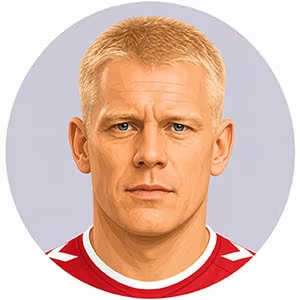
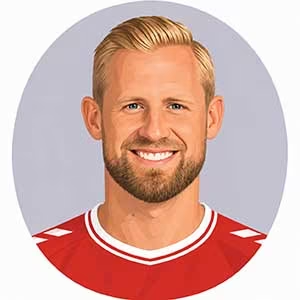
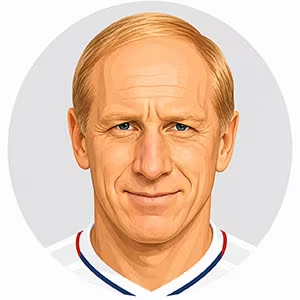
Denmark - GoalkeeperSchmeichel, Peter
At Old Trafford on 14 April 1999, Manchester United were seconds from elimination from the FA Cup when Arsenal were awarded a penalty. Dennis Bergkamp stepped forward; Peter Schmeichel moved to his left and blocked the shot. United survived into extra time despite playing with ten men, and Ryan Giggs eventually scored the winner. Seven weeks later, in Barcelona, Schmeichel captained United in the Champions League final because Roy Keane was suspended. Bayern Munich led from the sixth minute until United scored twice in stoppage time to complete the Treble. Schmeichel’s role in those situations was not simply to remain calm. His goalkeeping had always been conspicuously emotional: shouting, gesturing and physically expanding himself were part of how he occupied the position. The Arsenal penalty therefore mattered because acute pressure did not require him to become quieter or behaviourally neutral. He could remain highly activated while preserving the technical decision needed for the next action. His competitive effectiveness depended less on suppressing emotional intensity than on preventing that intensity from contaminating the following play.
At 1.93 metres, Schmeichel combined exceptional size with unusually explosive movement. His handball background contributed to the spread position that became one of his signatures: instead of committing early towards one corner in close-range situations, he could expand arms and legs simultaneously and force the attacker to find space around an enormous moving barrier. His starting position was aggressive, allowing him to close forwards rapidly and intervene behind a defensive line rather than remaining attached to the goal line. Crosses were attacked with similar authority, and his physical strength allowed him to claim balls in traffic rather than merely deflect them. Distribution added an offensive dimension. Schmeichel’s long side-arm throw could bypass the first phase of build-up and launch counterattacks immediately after a save, while his kicking offered further range. Manchester United’s own record gives him 398 appearances, five Premier League titles, three FA Cups and the 1999 Champions League; internationally, he won Euro 1992 with Denmark and accumulated 129 caps. His value therefore extended beyond shot prevention: he could transform defensive resolution directly into attacking transition.
There were nevertheless real limits behind the imposing image. Schmeichel’s aggressive positioning increased the consequences of an incorrect decision: leaving the line early could eliminate an attacker’s angle when read correctly but expose the goal when mistimed. His enormous frame and explosive set position were ideally suited to emergency saving, but his footwork in sustained possession was not developed for the later expectation that goalkeepers should operate as additional central defenders during elaborate build-up. The back-pass rule introduced in 1992 required adaptation, and Schmeichel’s distribution remained far more dangerous when launching play quickly than when circulating repeatedly under close pressure. His emotional intensity also created functional costs. Vocal confrontation could communicate urgency, but teammates did not necessarily experience every outburst as useful information. Gary Neville later recalled that Schmeichel could become furious with defenders even when the goalkeeper himself had made the mistake. That behaviour should not be romanticised as leadership. It could transfer tension outward and create interpersonal friction even while helping Schmeichel reset internally. The limitation was therefore not simply “temper”: the same mechanism that restored his own readiness could impose an emotional cost on the defensive unit around him.
Psychologically, Schmeichel is best defined by **externalised emotional reset**. He later explained his confrontational behaviour in unusually functional terms: after conceding or surviving a dangerous situation, he needed to release the emotion immediately because the goalkeeper could not remain mentally inside the previous action while the next one developed. Shouting at defenders therefore sometimes operated as discharge rather than considered attribution of blame. That does not excuse the behaviour or prove that every confrontation was strategically useful; indeed, accounts from former teammates show that he could direct anger unfairly. The important distinction is between emotional expression and subsequent performance degradation. Schmeichel could become visibly furious, externalise that reaction and then return quickly to the technical demands of goalkeeping. His relationship with Alex Ferguson shows the same intensity at interpersonal level. The pair had a famous confrontation after a match at Liverpool in which Schmeichel argued fiercely with the manager; Ferguson initially told him he was sacked, but Schmeichel subsequently apologised to Ferguson and then, crucially, apologised in front of the entire squad because teammates had witnessed the original dispute. Ferguson later regarded that second act as decisive in repairing the relationship. This was not low emotional aggression. It was **high emotional aggression combined with comparatively strong post-conflict reset and repair capacity**. Evidence from Euro 1992, the 1999 Treble run and repeated high-stakes matches provides little support for acute competitive pressure causing systematic degradation. Schmeichel’s distinctive pattern is more specific: **he did not regulate pressure by becoming calm; he regulated it by expelling emotion quickly enough to make himself available for the next problem**.