We use Google Analytics to understand how visitors use this site. Analytics cookies are only activated with your consent. For details, read our Privacy Policy.
Profile lensThe same player, read from a different angle.
Athletic78
Acceleration
66
Pace
72
Agility
81
Strength
83
Balance
83
Jumping
85
Stamina
60
Fitness
95
Technical45
Dribbling
50
Short Passing
55
Long Passing
60
Shot Accuracy
40
Shot Power
80
Shooting Technique
38
Heading
55
Free Kick
45
Penalties
30
First Touch
53
Mental93
Composure
93
Consistency
93
Leadership
91
Goalkeeping92
Reflexes
94
Positioning
97
Handling
92
Kicking
85
Goalkeeping92
Reflexes
94
Positioning
97
Handling
92
Kicking
85
Attacking48
Heading Accuracy
55
Shot Accuracy
40
Technique50
Dribbling
50
Free Kick
45
Short Passing
55
Long Passing
60
First Touch
53
Shot Technique
38
Physicality81
Shot Power
80
Jumping
85
Stamina
60
Strength
83
Fitness
95
Movement76
Acceleration
66
Pace
72
Agility
81
Balance
83
Mentality & Game Reading77
Composure
93
Penalties
30
Leadership
91
Consistency
93
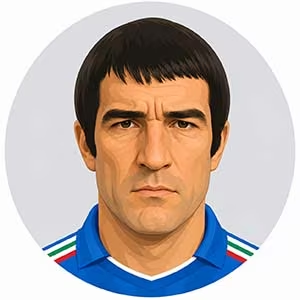
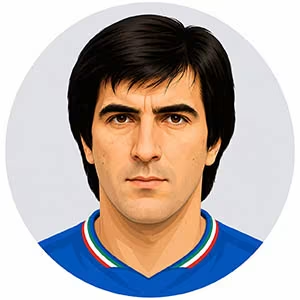
Italy - GoalkeeperZoff, Dino
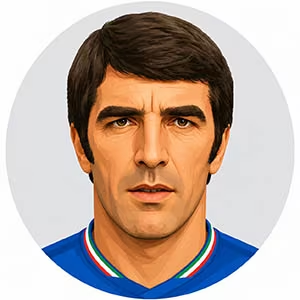
Madrid, 11 July 1982, the eighty-eighth minute of the World Cup final. Dino Zoff caught a cross, held it against his chest, and looked up at the clock. He was forty years and four months old, he had not spoken to the Italian press in three weeks, and he was about to become the oldest man ever to win the World Cup and the only goalkeeper to captain a winning side. He did not celebrate until the whistle. Nothing in twenty-two years of professional football had ever persuaded him that a thing was finished before it was finished.
Born in Mariano del Friuli in 1942, Zoff was rejected as a boy for being too short — his grandmother reportedly fed him eggs by the dozen — and grew into a monument to austere discipline and positional economy. His technical hallmark was flawless handling: he rarely surrendered a rebound, absorbing the ball cleanly rather than parrying, and his positioning was so precise that acrobatic saves were largely unnecessary. He treated goalkeeping as an exercise in the elimination of risk. After Udinese, Mantova and Napoli, he joined Juventus in 1972 and stayed eleven seasons, winning six Serie A titles, two Coppe Italia and the 1977 UEFA Cup, and making 476 appearances for the club before retiring at forty-one. For Italy he won 112 caps, the 1968 European Championship, and the 1982 World Cup, and he holds the record for the longest run without conceding in international football — 1,142 minutes, spanning nearly two years.
His conservatism was a genuine tactical limitation. Zoff almost never operated outside his box and did not sweep behind a high line, which suited Italian football of the period but confined the defensive shape around him. His distribution was functional rather than constructive. As he moved through his late thirties his lateral speed declined, exposing him to long-range shooting — most damagingly at the 1978 World Cup, where he was beaten from distance by Arie Haan in a defeat against the Netherlands and by Zico's free-kick against Brazil, errors the Italian press attributed to age and never entirely stopped mentioning.
Mentally he was an extreme introvert whose icy calm functioned as a stabilising anchor for everyone in front of him. He spoke rarely, gave almost nothing away in interviews, and organised his defence through short, flat instructions rather than volume — the antithesis of the demonstrative goalkeeping tradition that surrounded him. He argued with referees essentially never, showed no visible reaction to conceding, and treated an error as a fact to be corrected rather than an event to be processed; teammates described a man whose demeanour was identical after a clean sheet and after a defeat. That control was tested most severely in Spain in 1982, when Italy drew all three group matches, the press turned savage, and criticism was directed at Zoff personally over his age and his goals conceded. The squad responded with the silenzio stampa, refusing to speak to journalists for the remainder of the tournament, and Zoff — captain, oldest player, and principal target — said nothing at all, then produced the save on Oscar in the last minute against Brazil that kept the run alive and a final in which he was never beaten from open play. His refusal to display emotion could read as coldness, and he made no effort to correct the impression. Away from the pitch he was reserved, modest, and conspicuously ordinary, a Friulian of few words with no interest in the celebrity that Italian football offered him, and he carried the same understatement into a long management career. Austere, unhurried and entirely unmoveable, Zoff won a World Cup at forty by never once giving anyone the satisfaction of a reaction.