We use Google Analytics to understand how visitors use this site. Analytics cookies are only activated with your consent. For details, read our Privacy Policy.
Profile lensThe same player, read from a different angle.
Athletic77
Acceleration
66
Pace
65
Agility
84
Strength
84
Balance
82
Jumping
82
Stamina
63
Fitness
86
Technical45
Dribbling
50
Short Passing
53
Long Passing
54
Shot Accuracy
40
Shot Power
82
Shooting Technique
40
Heading
46
Free Kick
53
Penalties
35
First Touch
55
Mental90
Composure
96
Consistency
79
Leadership
96
Goalkeeping95
Reflexes
99
Positioning
96
Handling
97
Kicking
87
Goalkeeping95
Reflexes
99
Positioning
96
Handling
97
Kicking
87
Attacking43
Heading Accuracy
46
Shot Accuracy
40
Technique51
Dribbling
50
Free Kick
53
Short Passing
53
Long Passing
54
First Touch
55
Shot Technique
40
Physicality79
Shot Power
82
Jumping
82
Stamina
63
Strength
84
Fitness
86
Movement74
Acceleration
66
Pace
65
Agility
84
Balance
82
Mentality & Game Reading77
Composure
96
Penalties
35
Leadership
96
Consistency
79
Curated interpretation
Signature Moves
Role-defining patterns—not attributes, traits or Inner Game measures. Three ways Lev Yashin changes the meaning of the role around him.
01
Before the Kick
His presence changes the opponent’s decision before the strike, turning the finish into a psychological duel he seems to enter first.
02
No Gap in the Net
His legendary arm-span makes the goal appear to contract around him, replacing an available finish with the sensation that no gap remains.
03
First Line, Last Line
He is the last defender and the first attacker: commanding the box, then releasing the counterattack with long distribution.
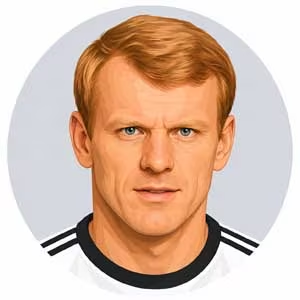
Russia - GoalkeeperYashin, Lev
At Wembley on 23 October 1963, Lev Yashin entered the second half of the FA Centenary match with a Rest of the World side facing England and immediately became the centre of the game. England attacked repeatedly; Yashin saved from Jimmy Greaves, Bobby Charlton and others and completed his forty-five minutes without conceding. The performance helped crystallise his international reputation, but its mechanism was already familiar. Yashin did not wait for shots to define the goalkeeper’s involvement. He moved beyond his line, attacked crosses, intercepted balls before forwards could reach them and continuously instructed defenders about spaces they could not see behind themselves. The goalkeeper therefore became an active participant in preventing the shot rather than merely the final obstacle after everything else had failed. This activity should not be confused with emotional serenity. Yashin later described considerable nervous tension before matches and regarded that state as normal. The calm visible once danger became concrete was produced after anticipation, not necessarily before it.
At 1.89 metres, Yashin combined reach and explosive reactions with unusually aggressive spatial interpretation. He could remain deep and produce reflex saves, but his historical importance came partly from refusing to treat the penalty area as the boundary of goalkeeping thought. He advanced to intercept through balls, punched or caught crosses decisively and organised defenders continuously. After gaining possession, he looked to restart attacks rapidly through long throws and kicks rather than allowing every save to reset the match slowly. Contemporary descriptions sometimes exaggerated these traits into the claim that he invented the sweeper-keeper; he did not. Goalkeepers had left their lines and initiated attacks before him. What Yashin did was integrate these behaviours at exceptional level and visibility, demonstrating that a goalkeeper could control space proactively without sacrificing elite shot-stopping. He spent his entire senior club career with Dynamo Moscow, winning five Soviet league championships, helped the USSR win the 1956 Olympic tournament and 1960 European Championship, and in 1963 became the first—and remains the only—goalkeeper to win the Ballon d’Or.
There were limits behind that authority. Proactive goalkeeping necessarily increased the consequences of incorrect judgement: leaving the line could eliminate danger before it developed, but a mistimed intervention exposed space that a conventional goalkeeper would still occupy. Yashin was also playing before the modern expectation that goalkeepers participate continuously in short build-up under coordinated pressing; his distribution was progressive for its era but should not be retrofitted into contemporary goalkeeper-playmaker standards. More importantly, his career contained genuine failure. At the 1962 World Cup he conceded four goals against Colombia after the Soviet Union had led 4–1, including Marcos Coll’s famous goal directly from a corner, and his tournament was criticised severely at home. The reaction was sufficiently intense that accounts describe Yashin considering retirement. He did not simply remain unaffected and continue as before. He returned, rebuilt his standing and the following year produced both the Wembley performance and his Ballon d’Or season. This is evidence of recovery after reputational damage, not evidence that criticism never penetrated him.
Psychologically, Yashin is best defined by **anticipatory anxiety converted into preparatory vigilance**. His own descriptions of match preparation undermine the later image of the emotionally impenetrable goalkeeper. He said that a goalkeeper who was not tormented before a match was a bad goalkeeper because the position demanded awareness of what could go wrong. He developed personal routines around that tension and famously described pre-match preparation through a cigarette to calm the nerves followed by something stronger to activate the muscles—details unnecessary to reproduce literally in the player profile but important as evidence that calm was actively managed rather than naturally absolute. The distinction becomes especially useful after 1962. Public criticism affected him strongly enough that withdrawal from football became conceivable, yet the eventual response was not permanent avoidance of responsibility. He returned to the same exposed position and restored his international authority. His vocal behaviour during matches provides another contrast: Yashin could shout constantly at defenders and exercise strong territorial command without strong evidence that this communication represented indiscriminate emotional aggression. Much of it was preventative information—using the goalkeeper’s panoramic view to correct danger before intervention became necessary. Evidence for persistent referee confrontation, retaliatory behaviour or teammate-directed blame after individual errors is insufficient and should remain unknown. The stronger pattern is that **Yashin did not require anxiety to disappear before functioning; he used awareness of possible failure to prepare himself for it, and when failure became public and severe, recovery required reconstruction rather than emotional denial**.