We use Google Analytics to understand how visitors use this site. Analytics cookies are only activated with your consent. For details, read our Privacy Policy.
Profile lensThe same player, read from a different angle.
Athletic78
Acceleration
72
Pace
76
Agility
66
Strength
89
Balance
76
Jumping
82
Stamina
77
Fitness
89
Technical75
Dribbling
69
Short Passing
75
Long Passing
64
Finishing
64
Shot Accuracy
63
Shot Power
85
Shooting Technique
61
Heading
88
Tackling
91
Crossing
60
Free Kick
66
Penalties
62
First Touch
71
Mental81
Composure
77
Aggression
90
Consistency
80
Creativity
65
Leadership
86
Work Rate
86
Tactical83
Vision
71
Off the Ball
60
Defensive Positioning
90
Teamwork
86
Anticipation
83
Marking
89
Player Traits
Attacking67
Crossing
60
Finishing
64
Heading Accuracy
88
Shot Accuracy
63
Off the Ball
60
Technique68
Dribbling
69
Free Kick
66
Short Passing
75
Long Passing
64
First Touch
71
Shot Technique
61
Movement73
Acceleration
72
Pace
76
Agility
66
Balance
76
Physicality84
Shot Power
85
Jumping
82
Stamina
77
Strength
89
Fitness
89
Defending90
Marking
89
Tackling
91
Def. Positioning
90
Mentality & Game Reading79
Aggression
90
Composure
77
Penalties
62
Vision
71
Leadership
86
Work Rate
86
Teamwork
86
Anticipation
83
Consistency
80
Creativity
65
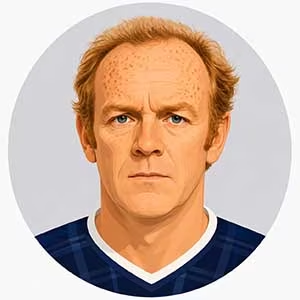
England - Centre-backCharlton, Jack
He was the ordinary one. Bobby Charlton was the World Cup's elegant genius and the survivor of Munich; Jack was the older brother, a lanky, awkward Northumberland centre-half who was twenty-nine before England capped him and who nearly quit football twice in his twenties out of boredom. Then Alf Ramsey picked him, explaining afterwards that he did not necessarily choose the best players — he chose the best team. Jack Charlton played every minute of England's World Cup win and was, by his own cheerful admission, the least gifted man on the pitch.
Born in Ashington in 1935 into a mining family that produced four professional footballers among his uncles, Charlton went down the pit at fifteen before joining Leeds United, where he stayed for twenty-three years and 773 appearances, a club record that will not be broken. He was 1.88m and gangling, nicknamed the Giraffe, and his game was built almost entirely on aerial dominance and functional destruction: he headed everything, cleared without ceremony, and marked centre-forwards out of matches by occupying their space rather than out-manoeuvring them. On the ground he was slow, ungainly and technically modest, and he compensated with positional discipline drilled into him by Don Revie, who transformed a wayward twenty-something into the organisational spine of the Leeds side that dominated English football. He won the First Division in 1969, the FA Cup in 1972, the League Cup in 1968 and two Inter-Cities Fairs Cups, and was named Footballer of the Year in 1967. For England he won 35 caps and the 1966 World Cup, playing alongside Bobby Moore in the tournament's most effective partnership.
His limitations were obvious and he catalogued them himself with some enjoyment. Charlton was slow, uncomfortable with the ball at his feet, and easily beaten by quick, mobile forwards who dragged him away from the penalty area where his height meant everything. He was a liability in possession, offering no passing range beyond the immediate, and in matches played on the ground at speed he could look thoroughly out of place. He also picked up a considerable number of fouls, since his defending was rudimentary enough that contact was frequently the only tool available.
Temperamentally he was blunt, opinionated and entirely without self-consciousness. Charlton spoke his mind to teammates, managers, journalists and administrators alike, notoriously kept a mental list of forwards who had wronged him and intended to settle it, and argued with referees as a matter of habit rather than strategy. It was not malice — he was gregarious, funny and widely liked, a man who genuinely enjoyed the company of almost everyone he met — but he had no filter and no interest in developing one. He organised his defence vocally and constantly, and his relationship with Bobby was famously distant for decades despite the shared triumph, a rift rooted in family rather than football that he discussed with characteristic directness. He was pragmatic to the core: he cared about winning and considered aesthetics an indulgence, an outlook that later defined his extraordinary spell as manager of the Republic of Ireland. Away from football he was a countryman first — fishing and shooting occupied him more than football did, and he escaped to them whenever possible — married for over sixty years, uninterested in glamour, and utterly at ease with being the less talented Charlton. Awkward, honest and impossible to dislike, he built a great career out of understanding precisely what he could not do.