We use Google Analytics to understand how visitors use this site. Analytics cookies are only activated with your consent. For details, read our Privacy Policy.
Profile lensThe same player, read from a different angle.
Athletic80
Acceleration
78
Pace
76
Agility
75
Strength
84
Balance
74
Jumping
84
Stamina
82
Fitness
86
Technical83
Dribbling
78
Short Passing
83
Long Passing
82
Finishing
65
Shot Accuracy
66
Shot Power
73
Shooting Technique
74
Heading
83
Tackling
91
Crossing
78
Free Kick
66
Penalties
68
First Touch
83
Mental84
Composure
92
Aggression
77
Consistency
78
Creativity
70
Leadership
85
Work Rate
82
Tactical86
Vision
81
Off the Ball
70
Defensive Positioning
92
Teamwork
90
Anticipation
86
Marking
87
Player Traits
Attacking72
Crossing
78
Finishing
65
Heading Accuracy
83
Shot Accuracy
66
Off the Ball
70
Technique78
Dribbling
78
Free Kick
66
Short Passing
83
Long Passing
82
First Touch
83
Shot Technique
74
Movement76
Acceleration
78
Pace
76
Agility
75
Balance
74
Physicality82
Shot Power
73
Jumping
84
Stamina
82
Strength
84
Fitness
86
Defending90
Marking
87
Tackling
91
Def. Positioning
92
Mentality & Game Reading81
Aggression
77
Composure
92
Penalties
68
Vision
81
Leadership
85
Work Rate
82
Teamwork
90
Anticipation
86
Consistency
78
Creativity
70
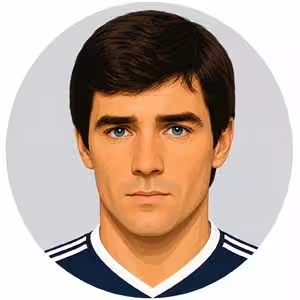
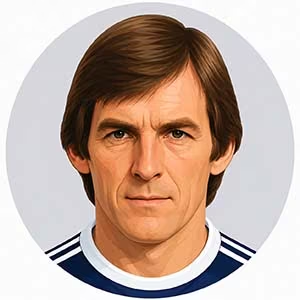
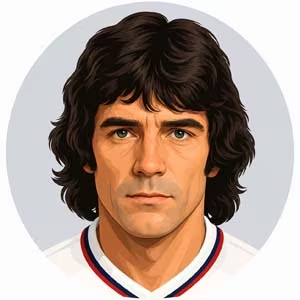
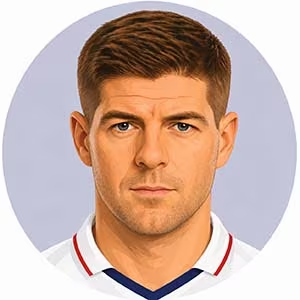
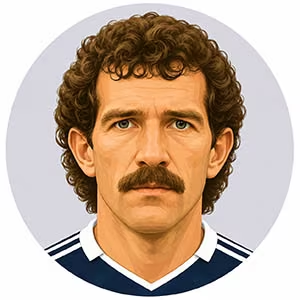
Scotland - Centre-backHansen, Alan
Bob Paisley famously parted with £100,000 in 1977 to bring a lanky, elegant defender from Partick Thistle to Merseyside, unwittingly securing the aristocratic cornerstone of Liverpool’s golden empire. Alan Hansen dismantled the stereotype of the brutish British center-half, replacing mud-and-thunder hoofs with pure spatial geometry. Operating with an upright, effortless stride, Jockey was a master of interception: stepping into passing lanes before strikers could react, killing aerial balls with a velvet touch, and striding thirty yards out from the backline with his head high to initiate rapid counter-attacks. Over 620 appearances at Anfield, he accumulated an astonishing eight First Division championships, three European Cups (1978, 1981, 1984), two FA Cups, and four League Cups, captaining the historic 1985–86 domestic double-winning squad. For Scotland, across 26 caps, his international journey was frustratingly sporadic—partly due to competition from Aberdeen's Alex McLeish and Willie Miller, and partly due to the bizarre defensive mix-up with Miller against the Soviet Union at Spain '82.
His cerebral, unhurried mastery had its vulnerabilities. Hansen detested messy, chaotic aerial dogfights against bruising target men like Joe Jordan or John Fashanu, relying heavily on the physical enforcers beside him—first Phil Thompson, then Mark Lawrenson—to handle the direct physical violence. When isolated without cover against direct long-ball assaults on heavy winter pitches, his reluctance to engage in ugly, ball-and-all collisions could leave his penalty box exposed, and chronic knee ailments finally caught up with his graceful mobility in the late 1980s.
Cold, composed, and radiating the unbothered confidence of a master chess player, Hansen looked like he was playing in slippers while everyone else was engaged in trench warfare. He never panicked: where other stoppers hacked the ball into the stands under pressure, Hansen feinted past an onrushing forward inside his own six-yard box with a nonchalant flick of the ankle. On the pitch, his communication was sharp, dry, and tactical, organizing Liverpool’s offside trap with mathematical precision. Inside the Anfield boot-room culture, his dry Scottish wit and complete lack of vanity made him a revered locker-room general, eventually succeeding Souness as the team's undisputed captain and moral compass. Referees rarely had to blow the whistle on him because his timing was immaculate, leaving behind an immortal legacy as the most elegant, forward-thinking, and decorated ball-playing defender in British football history.