We use Google Analytics to understand how visitors use this site. Analytics cookies are only activated with your consent. For details, read our Privacy Policy.
Profile lensThe same player, read from a different angle.
Athletic81
Acceleration
76
Pace
75
Agility
77
Strength
79
Balance
87
Jumping
84
Stamina
81
Fitness
87
Technical82
Dribbling
75
Short Passing
80
Long Passing
82
Finishing
60
Shot Accuracy
66
Shot Power
88
Shooting Technique
69
Heading
83
Tackling
92
Crossing
78
Free Kick
66
Penalties
71
First Touch
79
Mental82
Composure
87
Aggression
82
Consistency
85
Creativity
73
Leadership
70
Work Rate
85
Tactical84
Vision
79
Off the Ball
65
Defensive Positioning
91
Teamwork
82
Anticipation
83
Marking
90
Attacking70
Crossing
78
Finishing
60
Heading Accuracy
83
Shot Accuracy
66
Off the Ball
65
Technique75
Dribbling
75
Free Kick
66
Short Passing
80
Long Passing
82
First Touch
79
Shot Technique
69
Movement79
Acceleration
76
Pace
75
Agility
77
Balance
87
Physicality84
Shot Power
88
Jumping
84
Stamina
81
Strength
79
Fitness
87
Defending91
Marking
90
Tackling
92
Def. Positioning
91
Mentality & Game Reading80
Aggression
82
Composure
87
Penalties
71
Vision
79
Leadership
70
Work Rate
85
Teamwork
82
Anticipation
83
Consistency
85
Creativity
73
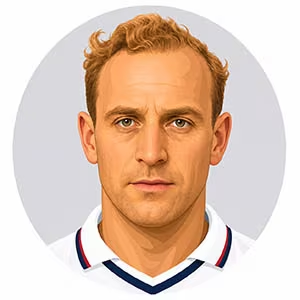
Netherlands - Centre-backvan der Hart, Cor
The legendary 1953 Watersnoodwedstrijd in Paris—a charity match played by exiled Dutch professionals against France that catalyzed the birth of professional football in the Netherlands—had its tactical spine anchored by a majestic sweeper from Amsterdam. Cor van der Hart was the cerebral, ball-playing pioneer of Dutch defending in the 1950s, bridging the era of physical stoppers with the tactical dawn of Total Football. Deployed as a sweeping libero or central defensive organizer, Van der Hart possessed an extraordinary passing range with both feet, stepping out from the backline with his head held high to initiate attacking phases with forty-yard diagonal balls. After refining his craft in Ligue 1 with Lille OSC (winning the 1953–54 French Division 1 title and the 1953 Coupe de France), he returned home to captain the great Ajax side of the late 1950s, capturing two Eredivisie championships (1956–57, 1959–60). For the Netherlands, across 44 caps and two goals, he was the undisputed captain and tactical leader of the national side throughout the late 1950s.
His cultured, unhurried style had its boundaries against raw transitional speed. Van der Hart was a positional master rather than an explosive sprinter; when isolated against lightning-fast, direct wingers in open-field footraces, his lack of recovery pace left him exposed unless supported by physical full-backs. Furthermore, his insistence on playing neat ground passes out of danger occasionally created high-risk scenarios inside his own defensive third against aggressive, high-pressing forwards on muddy winter pitches.
Dignified, articulate, and possessing a sharp analytical mind that later made him a respected tactician alongside Rinus Michels, Van der Hart commanded matches through pure intellectual superiority. He viewed defending not as an act of destruction, but as the initial phase of attacking construction. On the pitch, his body language was regal and commanding: directing defensive lines with calm authority, timing his standing tackles to perfection, and refusing to resort to crude physical violence. Inside the Ajax and Dutch national team dressing rooms, he was the revered captain and tactical mentor to an emerging generation that included a young Sjaak Swart and Piet Keizer, establishing the structural blueprint for modern Dutch football culture. Match officials admired his spotless, gentlemanly conduct, cementing an eternal legacy as the visionary defensive aristocrat who modernized the art of Dutch defending.