We use Google Analytics to understand how visitors use this site. Analytics cookies are only activated with your consent. For details, read our Privacy Policy.
Profile lensThe same player, read from a different angle.
Athletic77
Acceleration
71
Pace
76
Agility
69
Strength
86
Balance
77
Jumping
79
Stamina
82
Fitness
78
Technical80
Dribbling
78
Short Passing
81
Long Passing
80
Finishing
68
Shot Accuracy
68
Shot Power
85
Shooting Technique
70
Heading
79
Tackling
85
Crossing
76
Free Kick
77
Penalties
72
First Touch
80
Mental81
Composure
86
Aggression
76
Consistency
77
Creativity
70
Leadership
83
Work Rate
80
Tactical82
Vision
78
Off the Ball
70
Defensive Positioning
85
Teamwork
80
Anticipation
83
Marking
84
Attacking72
Crossing
76
Finishing
68
Heading Accuracy
79
Shot Accuracy
68
Off the Ball
70
Technique78
Dribbling
78
Free Kick
77
Short Passing
81
Long Passing
80
First Touch
80
Shot Technique
70
Movement73
Acceleration
71
Pace
76
Agility
69
Balance
77
Physicality82
Shot Power
85
Jumping
79
Stamina
82
Strength
86
Fitness
78
Defending85
Marking
84
Tackling
85
Def. Positioning
85
Mentality & Game Reading79
Aggression
76
Composure
86
Penalties
72
Vision
78
Leadership
83
Work Rate
80
Teamwork
80
Anticipation
83
Consistency
77
Creativity
70
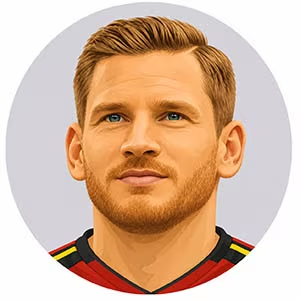
Belgium - Centre-backVertonghen, Jan
There is a specific kind of defender whose highlight reel is almost entirely boring, and Jan Vertonghen belongs to that category by design rather than by limitation. Ask a Tottenham supporter for his best moment and most will struggle to name one — not because he lacked quality, but because his quality expressed itself as the absence of crises rather than the presence of drama. He made twelve years at the highest level look like the natural order of things, which is precisely the hardest illusion to sustain in football.
Born in Sint-Niklaas in 1987, Vertonghen was a versatile defender equally competent at centre-back and left-back, a rare double comfort that made him valuable across systems and eras. He was composed on the ball for a defender of his generation, reading danger early rather than reacting to it, strong in the air relative to his frame, and disciplined enough positionally that his pace — solid but unremarkable — was rarely tested in isolation. He came through Ajax's academy, winning two Eredivisie titles before Tottenham signed him in 2012, where he spent seven seasons as a first-choice defender, reaching the 2019 Champions League final under Mauricio Pochettino. He later moved to Benfica, where he continued performing at a high level into his mid-thirties, adding Portuguese league titles to a resume already dense with consistency if thin on major individual silverware. For Belgium he won 148 caps, a national record, and was a fixture of the so-called golden generation that reached the 2018 World Cup semi-final, playing every position across the back line as Roberto Martínez's system required.
His limitations were the quiet kind that rarely produced a headline. Vertonghen's recovery pace was ordinary rather than elite, which occasionally exposed him against genuinely fast forwards in transition, and his distribution, while competent, was rarely progressive enough to break defensive lines by itself. In Belgium's golden generation specifically, his positional versatility was sometimes read as tactical flexibility for the coach and sometimes as an inability to nail down one clearly superior role, a criticism that followed the entire back line of that team more than it followed him individually. Against sides that isolated him in wide areas one-on-one, particularly in his later, less mobile seasons, he could be more troubled than his reputation suggested.
Temperamentally he was even-keeled to the point of being genuinely difficult to write interesting sentences about, which teammates and coaches across three countries treated as the highest compliment available. Vertonghen organized his defensive line through calm, continuous communication rather than confrontation, rarely argued with referees, and built a disciplinary record clean enough to be almost invisible across more than 700 senior appearances. He accepted positional changes — centre-back to left-back and back again, repeatedly, across club and country — without the friction that similar requests produced in less adaptable players, treating tactical instruction as information rather than as a challenge to his standing. He was respected without being especially vocal, a stabilizing dressing-room presence at every club he played for rather than its emotional center. Away from the pitch he was private, family-oriented, and essentially free of controversy across a public career spanning two decades and four countries, adapting to the Netherlands, England and Portugal with a linguistic and cultural ease that mirrored his positional flexibility on the pitch. Solid, adaptable and constitutionally undramatic, Vertonghen built one of European football's longest sustained careers on the unglamorous premise that nothing needed to go wrong.


 All Time BelgiumNT