We use Google Analytics to understand how visitors use this site. Analytics cookies are only activated with your consent. For details, read our Privacy Policy.
Profile lensThe same player, read from a different angle.
Athletic83
Acceleration
83
Pace
85
Agility
79
Strength
82
Balance
78
Jumping
82
Stamina
85
Fitness
87
Technical78
Dribbling
77
Short Passing
77
Long Passing
79
Finishing
66
Shot Accuracy
62
Shot Power
79
Shooting Technique
73
Heading
79
Tackling
84
Crossing
78
Free Kick
65
Penalties
66
First Touch
80
Mental86
Composure
79
Aggression
84
Consistency
92
Creativity
69
Leadership
88
Work Rate
91
Tactical80
Vision
73
Off the Ball
73
Defensive Positioning
84
Teamwork
86
Anticipation
81
Marking
83
Attacking72
Crossing
78
Finishing
66
Heading Accuracy
79
Shot Accuracy
62
Off the Ball
73
Technique75
Dribbling
77
Free Kick
65
Short Passing
77
Long Passing
79
First Touch
80
Shot Technique
73
Movement81
Acceleration
83
Pace
85
Agility
79
Balance
78
Physicality83
Shot Power
79
Jumping
82
Stamina
85
Strength
82
Fitness
87
Defending84
Marking
83
Tackling
84
Def. Positioning
84
Mentality & Game Reading81
Aggression
84
Composure
79
Penalties
66
Vision
73
Leadership
88
Work Rate
91
Teamwork
86
Anticipation
81
Consistency
92
Creativity
69
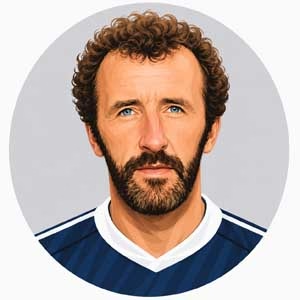
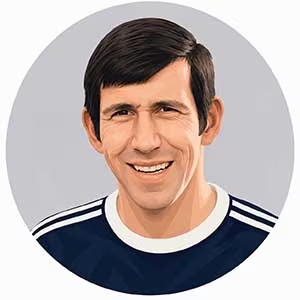
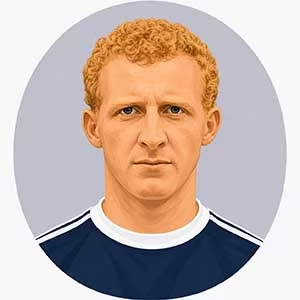
Scotland - Right BackMcGrain, Danny
On 21 May 1979, Celtic entered their final league match against Rangers knowing victory would secure the title. Johnny Doyle was sent off with the score level, leaving Celtic with ten men against their closest rivals. They won 4–2. Danny McGrain, captain and right-back, had returned that season from an ankle problem serious enough for doctors to suggest his career might be finished, and the injury had already cost him the 1978 World Cup. His pace was no longer quite what it had been. Yet he finished the campaign leading Celtic through the match that became known simply as the night when ten men won the league.
McGrain was a right-back whose game combined elite one-against-one defending with unusually progressive use of the position. Around 1.78 metres tall, he was neither imposing in the air nor dependent on strength. His advantages were balance, acceleration, anticipation and exceptional tackling technique. Rather than merely shadowing a winger toward the touchline, he could judge when to stand off, when to match the run and when to commit fully, often sliding across an opponent’s path and emerging with the ball rather than simply clearing it. Earlier in his career his speed allowed him to overlap repeatedly and carry possession deep into opposition territory; Celtic used those forward runs as a genuine attacking mechanism rather than decoration from full-back. He could play on either side and represented Scotland at left-back as well as on his natural right. After joining Celtic’s youth system in 1967, he made his first-team debut in 1970 and remained until 1987, accumulating well over 600 competitive appearances. He won seven Scottish league championships, five Scottish Cups and two League Cups and became club captain in 1977 after Kenny Dalglish’s departure. His international debut came in 1973. McGrain won 62 Scotland caps, captained the national side ten times and appeared at the 1974 and 1982 World Cups; he missed Argentina 1978 because of the long-term ankle injury. Even after serious physical setbacks reduced some of his explosive athleticism, he adapted by relying more heavily on anticipation and distribution. He finished his playing career with Hamilton Academical in 1987–88 and helped them win promotion.
His game was not without conditions. McGrain’s attacking contribution depended substantially on the athletic capacity to recover after advancing, and when injury and age reduced his pace he could no longer cover the same territory with the same freedom. He was also a defender whose best solution against difficult wide players was often engagement rather than passive containment; mistiming that decision could leave space behind him. As a young player he admitted trying to kick Jimmy Johnstone in training because he could not otherwise get near him, before learning that diving into tackles against technically superior opponents was counterproductive. He became markedly more selective, but the anecdote exposes the original impulse. Nor was he an attacking full-back built around final-third invention: his overlaps, carrying and support were valuable, but teams requiring their full-back to become a primary playmaker would have asked for something outside his strongest profile.
Psychologically, McGrain’s most revealing trait was not simply toughness but his willingness to adjust without treating correction as humiliation. When recalling those early training sessions against Johnstone, he openly described his younger approach as stupid and explained how repeated failure taught him to stand off technically gifted opponents instead. He remembered listening to Billy McNeill directing teammates and absorbing lessons from senior players rather than presenting his development as self-generated. The same attitude appears in his relationship with Jock Stein. McGrain acknowledged that Stein could reprimand players severely, but said the criticism remained inside the dressing room and emphasised what he had learned from him; authoritative coaching did not seem to trigger a need to contest status publicly. On the field, however, his competitive threshold was extremely high. He described his tackling as strong because his timing was strong, while insisting that he never entered challenges intending to injure opponents. The distinction is supported by the reputation he built as a hard but fair defender: physical confrontation was something he initiated willingly without needing hostility to become personal. There is little evidence of repeated retaliation, referee confrontation or disciplinary escalation under provocation. Adversity instead tended to produce practical adaptation. A fractured skull early in his career left him with months of double vision; he rebuilt confidence gradually, initially practising headers with a balloon. A later ankle injury kept him out for more than a year and was at one stage considered career-threatening. When he returned, the lost pace was compensated for through positioning and anticipation rather than attempts to reproduce a physical level that was no longer available. He then captained Celtic to further championships and remained a regular into his mid-thirties. His captaincy appears similarly low-theatre: he had learned from vocal leaders around him, but accounts of McGrain himself emphasise reliability, standards and example more than constant public correction of teammates. He could accept instruction, absorb physical punishment and operate in intensely hostile matches without requiring emotional escalation to maintain aggression. This makes his baseline distinct from simple calmness. McGrain was highly activated competitively, willing to tackle and confront, but the activation rarely needed an external grievance. Pressure sharpened the work; it did not have to become anger first.