We use Google Analytics to understand how visitors use this site. Analytics cookies are only activated with your consent. For details, read our Privacy Policy.
Profile lensThe same player, read from a different angle.
Athletic83
Acceleration
86
Pace
86
Agility
83
Strength
73
Balance
76
Jumping
83
Stamina
85
Fitness
88
Technical76
Dribbling
74
Short Passing
76
Long Passing
77
Finishing
64
Shot Accuracy
64
Shot Power
77
Shooting Technique
68
Heading
78
Tackling
83
Crossing
75
Free Kick
65
Penalties
63
First Touch
74
Mental86
Composure
82
Aggression
82
Consistency
91
Creativity
63
Leadership
87
Work Rate
87
Tactical79
Vision
72
Off the Ball
68
Defensive Positioning
84
Teamwork
84
Anticipation
82
Marking
81
Attacking70
Crossing
75
Finishing
64
Heading Accuracy
78
Shot Accuracy
64
Off the Ball
68
Technique72
Dribbling
74
Free Kick
65
Short Passing
76
Long Passing
77
First Touch
74
Shot Technique
68
Movement83
Acceleration
86
Pace
86
Agility
83
Balance
76
Physicality81
Shot Power
77
Jumping
83
Stamina
85
Strength
73
Fitness
88
Defending83
Marking
81
Tackling
83
Def. Positioning
84
Mentality & Game Reading79
Aggression
82
Composure
82
Penalties
63
Vision
72
Leadership
87
Work Rate
87
Teamwork
84
Anticipation
82
Consistency
91
Creativity
63
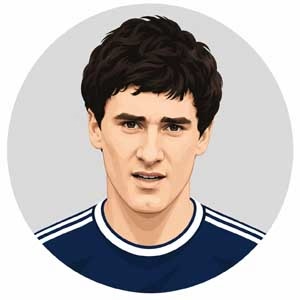
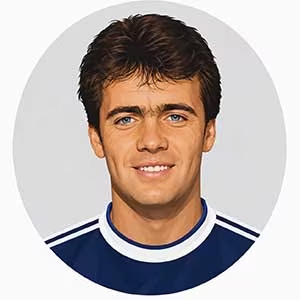
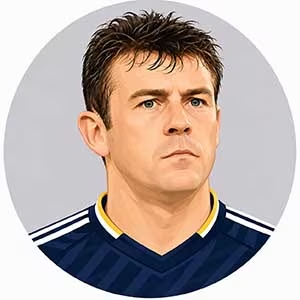
Scotland - Right BackCaldow, Eric
His own obituary carried the description as its headline: a gentleman of the game who was never booked. Across 407 first-team appearances for Rangers, Eric Caldow was never once cautioned by a referee, and across the same span he never once scored from open play either — every one of his 25 goals came from the penalty spot, a curious symmetry for a player otherwise defined by his positional discipline rather than by any offensive instinct at all.
Born in Cumnock, Ayrshire, in 1934, Caldow worked briefly as an apprentice painter before joining Rangers at fourteen, developing at Muirkirk Juniors before returning to Ibrox at eighteen. He was a full-back equally comfortable on either flank, valued above all for his recovery speed — he had enough pace to get back and correct himself even when beaten in a straight footrace, which allowed him to defend with a positional calm that few contemporaries could match. He made his Rangers debut in 1953 and stayed until 1966, playing in two genuinely great Rangers sides spanning that entire era, captaining the club to its first European final along the way. For Scotland he won 40 caps, captained the national side for three years, and was ever-present through both the 1958 and 1962 World Cup qualifying campaigns, one of only five players to feature in every one of Scotland's matches at the 1958 finals in Sweden. He was, at the time of his career's abrupt end, widely regarded as the best left-back in the world — a judgment later ratified when Daily Record readers picked him at left-back in a Scotland Team of the Millennium poll in 2000.
His limitations, in the specific and unusual sense that applies to his career, were less about his own ability than about the ending forced on it. On his fortieth cap, at Wembley in April 1963, an England forward's tackle broke Caldow's leg in three places just six minutes into the match — a horrific, career-defining injury suffered while he was still Scotland's unchallenged first choice and on pace to break the national appearance record. Scotland played out the rest of the game with ten men and won anyway, sealed by Jim Baxter, the player operating just in front of him. Caldow never played for his country again. He managed only three league appearances for Rangers the following season as he tried, largely unsuccessfully, to recover the level he had lost.
Temperamentally he combined that spotless disciplinary record with a genuine institutional loyalty that cost him a more glamorous path more than once. He turned down the chance to become Manchester United's captain in succession to Roger Byrne, killed in the Munich air disaster, because when it came to actually signing the paperwork he found he could not bring himself to leave Rangers — a decision made purely on attachment rather than any football logic, since United would have offered him a considerably higher profile. He returned instead to captain Rangers itself, though he lost that armband later in his career to Bobby Shearer, a decision by manager Scot Symon that, by his own later account, he never forgave — a rare and specific grudge from a player otherwise remembered almost entirely for his equanimity. Away from the pitch he later managed at a modest level, with Corby Town, Hurlford United and Stranraer, and lived quietly for decades afterward. His final years were affected by Alzheimer's disease, and he died in 2019 at eighty-four. Immaculately disciplined, fiercely loyal to a single institution even when better offers arrived, and defined publicly by a devastating injury he never fully overcame, Caldow remains, by the testimony of supporters who watched both eras, one of the finest left-backs Scottish football ever produced.