We use Google Analytics to understand how visitors use this site. Analytics cookies are only activated with your consent. For details, read our Privacy Policy.
Profile lensThe same player, read from a different angle.
Athletic85
Acceleration
84
Pace
84
Agility
85
Strength
83
Balance
85
Jumping
80
Stamina
93
Fitness
87
Technical82
Dribbling
80
Short Passing
82
Long Passing
83
Finishing
66
Shot Accuracy
72
Shot Power
87
Shooting Technique
75
Heading
82
Tackling
84
Crossing
82
Free Kick
65
Penalties
66
First Touch
82
Mental89
Composure
83
Aggression
85
Consistency
91
Creativity
71
Leadership
92
Work Rate
97
Tactical83
Vision
78
Off the Ball
73
Defensive Positioning
82
Teamwork
92
Anticipation
85
Marking
85
Player Traits
Attacking75
Crossing
82
Finishing
66
Heading Accuracy
82
Shot Accuracy
72
Off the Ball
73
Technique78
Dribbling
80
Free Kick
65
Short Passing
82
Long Passing
83
First Touch
82
Shot Technique
75
Movement85
Acceleration
84
Pace
84
Agility
85
Balance
85
Physicality86
Shot Power
87
Jumping
80
Stamina
93
Strength
83
Fitness
87
Defending84
Marking
85
Tackling
84
Def. Positioning
82
Mentality & Game Reading84
Aggression
85
Composure
83
Penalties
66
Vision
78
Leadership
92
Work Rate
97
Teamwork
92
Anticipation
85
Consistency
91
Creativity
71
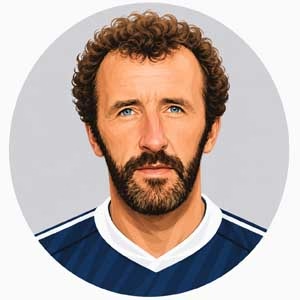
Spain - Right BackSegarra, Joan
Barcelona had just lost the 1961 European Cup final in Bern, beaten by Benfica after hitting the woodwork four times, and the captain who had led the club through its greatest decade walked off having played his last major match at thirty-four. Joan Segarra had by then worn the armband for nearly ten years, through the Kubala era, five league titles and two Fairs Cups, and in all that time he had been sent off exactly never. Barcelona supporters gave him a nickname that says everything about how he was perceived: Cinturó de Castedat — the Chastity Belt — because nothing got past him and nothing about him was ever improper.
Born in Barcelona in 1927 and raised in Sant Vicenç dels Horts, Segarra joined the club in 1949 and stayed until 1964, playing 388 official matches. He was a defender of unusual adaptability for the period, operating as a left-half, centre-half and full-back depending on the system and the opponent, and equally comfortable in all three. At 1.79m he was strong and quick enough for the era, but his game was built on positioning and clean interception rather than physical confrontation — he tackled with timing, rarely committed himself early, and was famous for winning the ball without fouling in a decade of Spanish football that offered every incentive to do otherwise. In possession he was composed and constructive, capable of starting attacks with a first pass rather than clearing. He captained the side of Kubala, Kocsis, Czibor, Suárez and Evaristo under Ferdinand Daučík and then Helenio Herrera, winning four La Liga titles, six Copas del Generalísimo, and back-to-back Fairs Cups in 1958 and 1960. He earned 21 caps for Spain and played at the 1950 World Cup in Brazil, where Spain finished fourth — their best result until 2010.
His limitations were those of a defender defined by restraint. Segarra was not dominant in the air against the biggest centre-forwards, and his refusal to defend by aggression meant that forwards who beat him in the first movement generally stayed beaten, since he would not resort to the tactical foul that his contemporaries used as routine insurance. He offered little going forward beyond distribution, and in matches that became physically brutal — common in the Spanish game of the fifties — his side could look under-armed with him as its senior defender.
That restraint was a deliberate ethic, not a temperament by accident. Segarra was the club captain in the fullest institutional sense: the player who negotiated with the board on the squad's behalf, who spoke to the press when the results demanded it, who mediated between Herrera and a dressing room that frequently disliked him, and who handled the Kubala years with a diplomacy the situation constantly required. He did all of it quietly. He did not raise his voice on the pitch, corrected teammates privately, and addressed referees with a courtesy that made him one of the few Spanish defenders of the era whom officials trusted on sight. Provocation had no purchase on him; opponents who tried to draw him into a confrontation received nothing back and generally stopped trying. He was deeply religious and famously austere in habit, without any interest in the social life available to a footballer in 1950s Barcelona, and his private conduct across fifteen years produced not a single controversy. He remained at the club after retiring, and stayed loyal to it for the rest of his life without ever seeking power within it. Fair, unhurried and quietly unshakeable, Segarra was the man an unstable, brilliant, chaotic Barcelona relied on precisely because he never once became part of the chaos.