We use Google Analytics to understand how visitors use this site. Analytics cookies are only activated with your consent. For details, read our Privacy Policy.
Profile lensThe same player, read from a different angle.
Athletic81
Acceleration
73
Pace
75
Agility
72
Strength
89
Balance
81
Jumping
89
Stamina
85
Fitness
87
Technical77
Dribbling
71
Short Passing
72
Long Passing
70
Finishing
62
Shot Accuracy
63
Shot Power
74
Shooting Technique
62
Heading
91
Tackling
88
Crossing
64
Free Kick
65
Penalties
62
First Touch
74
Mental85
Composure
76
Aggression
85
Consistency
87
Creativity
65
Leadership
94
Work Rate
88
Tactical82
Vision
71
Off the Ball
60
Defensive Positioning
87
Teamwork
85
Anticipation
87
Marking
87
Player Traits
Attacking68
Crossing
64
Finishing
62
Heading Accuracy
91
Shot Accuracy
63
Off the Ball
60
Technique69
Dribbling
71
Free Kick
65
Short Passing
72
Long Passing
70
First Touch
74
Shot Technique
62
Movement75
Acceleration
73
Pace
75
Agility
72
Balance
81
Physicality85
Shot Power
74
Jumping
89
Stamina
85
Strength
89
Fitness
87
Defending87
Marking
87
Tackling
88
Def. Positioning
87
Mentality & Game Reading80
Aggression
85
Composure
76
Penalties
62
Vision
71
Leadership
94
Work Rate
88
Teamwork
85
Anticipation
87
Consistency
87
Creativity
65
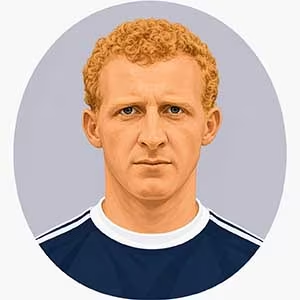
Scotland - Centre-backMcNeill, Billy
Billy McNeill was the towering, golden-haired monolith of Lanarkshire who lifted the European Cup high into the scorching Lisbon sky in May 1967, becoming the first British player in history to hoist the continent’s supreme prize as the undisputed on-pitch general of Jock Stein’s immortal Lisbon Lions. Known across world football by the affectionate moniker Cesar—after the suave actor Cesar Romero—McNeill was the archetype of the dominant, imperious traditional center-half: a leader of colossal physical stature, spotless positional geometry, and an aerial supremacy that turned Celtic’s penalty box into an impenetrable fortress.
Operating as the defensive anchor and organizing fulcrum of Stein’s aggressive, revolutionary 4-2-4 formation, McNeill was a master of defensive anticipation and aerial domination. Standing over six feet tall with an astonishing vertical leap, broad shoulders, and impeccable timing, he was almost impossible to beat in direct aerial duels, repelling long clearances with thunderous headers and attacking set-pieces in the opposing box to score vital, clutch goals. A consummate one-club legend, he spent his entire eighteen-year senior playing career at Celtic Park between 1957 and 1975, amassing a staggering 790 official appearances (never once substituted) and 37 goals. Under his captaincy, Celtic captured an extraordinary haul of silverware: nine consecutive Scottish League championships (1965–66 through 1973–74), seven Scottish Cups, six Scottish League Cups, the historic 1966–67 European Cup triumph over Helenio Herrera’s Inter Milan, and a second European Cup final appearance in 1970 against Feyenoord. For Scotland, across 29 caps and one goal, he was a revered national captain, notably leading the backline during Scotland’s famous 3–2 victory over reigning world champions England at Wembley in 1967.
That commanding physical and aerial authority, however, lived alongside the structural realities of the classic British center-half era. McNeill was a resolute, front-foot stopper rather than a dynamic, elusive sweeper built for long forty-yard recovery footraces against rapid, low-gravity forwards who exploited wide-open transition spaces. While his passing was steady, composed, and tailored to feeding creative outlets like Bobby Murdoch and Tommy Gemmell, he was not an intricate ball-carrier through congested central channels under suffocating modern pressing traps. Furthermore, when isolated against agile, quick-turning dribblers on dry, fast pitches who avoided aerial battles altogether, his turning circle could be tested if his defensive partners failed to squeeze the space in front of him.
Emotionally, McNeill was an unshakeable monument of moral authority, calm dignity, and quiet gravitas. He possessed a natural, magnetic charisma that commanded immediate respect across the dressing room without ever needing to resort to histrionics, performative rage, or vulgar shouting. He embraced the immense weight of the captain's armband with deep humility and fierce pride, serving as the steady, psychological rudder that kept Stein's fiery, free-flowing squad composed amidst the hostile cauldron of European away nights and frantic Old Firm derbies. On the pitch, his body language was regal and composed: chest out, head held high, communicating defensive adjustments with clear, measured gestures, and rising above crowded goalmouths with serene certainty. Inside the Celtic Park and Scottish national team locker rooms, his word was absolute law—an adored, patriarchal figure whose courage, spotless integrity, and historic Lisbon triumph cemented his legacy as the greatest captain in Scottish football history.


 All Time ScotlandNT