We use Google Analytics to understand how visitors use this site. Analytics cookies are only activated with your consent. For details, read our Privacy Policy.
Profile lensThe same player, read from a different angle.
Athletic81
Acceleration
77
Pace
76
Agility
74
Strength
85
Balance
82
Jumping
85
Stamina
81
Fitness
84
Technical80
Dribbling
74
Short Passing
77
Long Passing
83
Finishing
68
Shot Accuracy
69
Shot Power
82
Shooting Technique
68
Heading
85
Tackling
87
Crossing
77
Free Kick
68
Penalties
66
First Touch
75
Mental80
Composure
81
Aggression
89
Consistency
85
Creativity
64
Leadership
70
Work Rate
90
Tactical83
Vision
72
Off the Ball
68
Defensive Positioning
89
Teamwork
82
Anticipation
87
Marking
87
Player Traits
Attacking73
Crossing
77
Finishing
68
Heading Accuracy
85
Shot Accuracy
69
Off the Ball
68
Technique74
Dribbling
74
Free Kick
68
Short Passing
77
Long Passing
83
First Touch
75
Shot Technique
68
Movement77
Acceleration
77
Pace
76
Agility
74
Balance
82
Physicality83
Shot Power
82
Jumping
85
Stamina
81
Strength
85
Fitness
84
Defending88
Marking
87
Tackling
87
Def. Positioning
89
Mentality & Game Reading79
Aggression
89
Composure
81
Penalties
66
Vision
72
Leadership
70
Work Rate
90
Teamwork
82
Anticipation
87
Consistency
85
Creativity
64
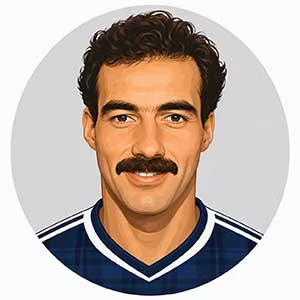
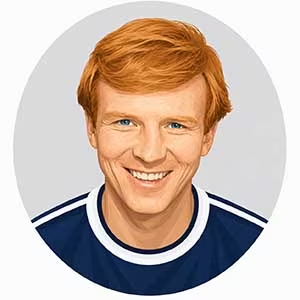
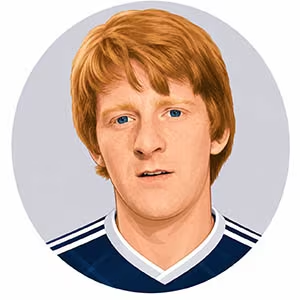
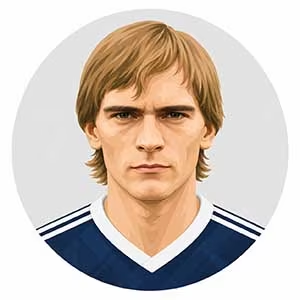
Scotland - Centre-backMiller, Willie
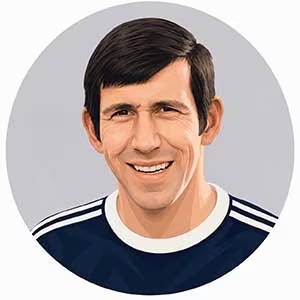
Born in Glasgow in 1955, Miller joined Aberdeen as a teenager, converted from forward to centre-back, and stayed for his entire career: 797 appearances between 1971 and 1990, a club record, and sixteen years as captain. He was small for the position at 1.78m and neither quick nor commanding in the air, and he defended almost entirely by anticipation and timing — reading the cross before it was struck, arriving in front of the striker rather than contesting the header, and making last-ditch interventions inside the six-yard box with a precision that made spectacular defending look procedural. He tackled cleanly and rarely committed himself, and his partnership with Alex McLeish became the most durable in Scottish football history. Under Ferguson he won three Scottish league titles, four Scottish Cups, the 1983 European Cup Winners' Cup and the European Super Cup against Hamburg, in a period when Aberdeen broke the Old Firm's monopoly entirely. For Scotland he won 65 caps, captained the side, and played at the 1982 and 1986 World Cups.
His limitations were physical and confined him to a specific role. Miller was ineffective as an aerial dominator and depended on McLeish or another taller partner to handle direct target men; he could be outmuscled in the box and beaten by pace in open space. He offered little in possession beyond a safe first pass, and in matches where his side was pushed into defending a high line or playing out under pressure, his contribution was reactive rather than constructive.
The authority he exercised was close to absolute and not always pleasant. Miller led by relentless, cutting verbal correction — teammates and Ferguson both described a captain who criticised players immediately and publicly, held standards that made him difficult to satisfy, and treated a defensive lapse as a personal affront. Ferguson later admitted that Miller and McLeish effectively ran the defence themselves and that his own instructions were frequently redundant, an unusual concession from a manager of his temperament. Miller argued with referees constantly, was a persistent and skilled tactical fouler, and used gamesmanship without embarrassment when the result required it. He was not warm, gave little away in public, and cultivated no relationship with the press beyond the necessary. Provocation had no effect on him; he was too controlled to be drawn and too confident to be intimidated. Away from football he was private, conventional and rooted in Aberdeen, where he later served as manager and director without ever leaving the club's orbit. Cold, exacting and technically limited, Miller became one of the finest defenders Britain has produced by removing every element of his game he could not perform perfectly.