We use Google Analytics to understand how visitors use this site. Analytics cookies are only activated with your consent. For details, read our Privacy Policy.
Profile lensThe same player, read from a different angle.
Athletic76
Acceleration
71
Pace
69
Agility
76
Strength
85
Balance
82
Jumping
85
Stamina
65
Fitness
78
Technical42
Dribbling
46
Short Passing
55
Long Passing
60
Shot Accuracy
44
Shot Power
74
Shooting Technique
42
Heading
48
Free Kick
44
Penalties
44
First Touch
50
Mental83
Composure
88
Consistency
80
Leadership
70
Goalkeeping88
Reflexes
92
Positioning
86
Handling
89
Kicking
85
Goalkeeping88
Reflexes
92
Positioning
86
Handling
89
Kicking
85
Attacking46
Heading Accuracy
48
Shot Accuracy
44
Technique50
Dribbling
46
Free Kick
44
Short Passing
55
Long Passing
60
First Touch
50
Shot Technique
42
Physicality77
Shot Power
74
Jumping
85
Stamina
65
Strength
85
Fitness
78
Movement75
Acceleration
71
Pace
69
Agility
76
Balance
82
Mentality & Game Reading71
Composure
88
Penalties
44
Leadership
70
Consistency
80
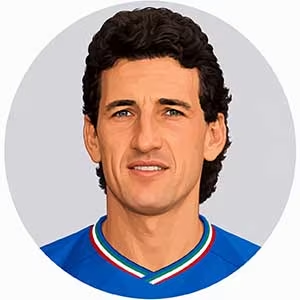
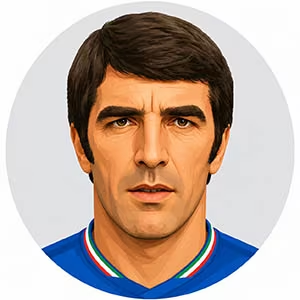
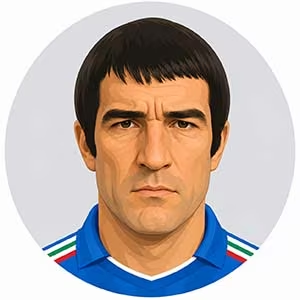
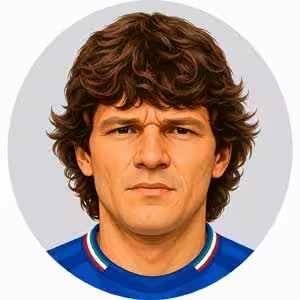
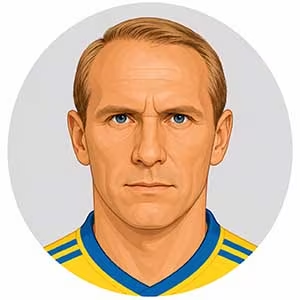
Italy - GoalkeeperGalli, Giovanni
Backup goalkeeper on a World Cup-winning squad is a strange kind of triumph — a winner's medal earned entirely from the bench. Giovanni Galli collected his in Spain in 1982, sitting behind Dino Zoff without playing a single match of Italy's victorious campaign, and four years later found himself in the opposite position entirely: Italy's undisputed starting goalkeeper at the 1986 World Cup in Mexico, the job now unambiguously his own.
Born in Pisa in 1958, Galli began as a midfielder in his hometown's youth system before switching to goalkeeper, a conversion that led him to Fiorentina's first team in 1977 at nineteen. He spent nine consecutive seasons there, coming close to the Scudetto in 1981–82 in a title race that went down to the final matchday against Juventus, before a 1986 transfer to Milan for five billion lire, at twenty-eight, placed him at the heart of one of the greatest club sides in football history. Across four seasons under Arrigo Sacchi — his former manager at Fiorentina as well — he won six major titles, including Serie A and back-to-back European Cups alongside Van Basten, Gullit and Rijkaard, before injuries and squad competition eventually cost him his place. He later played for Napoli, where he opened his spell by winning the Italian Supercup 5–1 over Juventus, then Torino, Parma and Lucchese, closing a nineteen-year professional career in 1996 with 496 Serie A appearances, among the most of any goalkeeper of his generation. For Italy he won 19 caps, appeared at Euro 1980 on home soil, and started every match of the 1986 World Cup.
His limitations were tied to a playing style built deliberately around effectiveness rather than spectacle — Galli was a dependable, unshowy shot-stopper rather than an acrobatic one, a quality that made him consistently reliable without ever producing the kind of individually breathtaking moments that define a goalkeeper's highlight reel. As Milan's squad deepened under Sacchi, he increasingly found himself rotated for European fixtures while a younger backup took league starts, a sign of a player whose specific value to the club had begun to narrow even as the team's overall success continued.
Temperamentally he was defined by the same quiet reliability that characterized his goalkeeping — a professional who accepted both a World Cup medal won entirely from the bench and, four years later, full responsibility as his country's undisputed number one, without either role appearing to unsettle him. He moved from Fiorentina to Milan alongside the same manager who had developed him, a continuity that suggests a working relationship built on genuine mutual trust rather than mere circumstance. After retiring he moved into football administration and, later, into Italian politics, a path considerably removed from the sport itself. Later in life, he wrote publicly and candidly about the death of his eldest son Niccolò, a promising young defender in Fiorentina's and Arsenal's youth systems, killed in a car accident in 2001 at seventeen — a profound personal loss Galli chose to share in a memoir rather than keep private, though it belongs to his life well after his own playing days had ended. Steady, understated, and defined across nearly two decades by consistency rather than flash, Galli built a career on being exactly as dependable as his sport demanded, whether that meant sitting quietly on a winning bench or standing alone as his country's last line of defense.