We use Google Analytics to understand how visitors use this site. Analytics cookies are only activated with your consent. For details, read our Privacy Policy.
Profile lensThe same player, read from a different angle.
Athletic74
Acceleration
66
Pace
61
Agility
79
Strength
85
Balance
82
Jumping
79
Stamina
60
Fitness
80
Technical43
Dribbling
50
Short Passing
55
Long Passing
58
Shot Accuracy
44
Shot Power
82
Shooting Technique
42
Heading
49
Free Kick
42
Penalties
42
First Touch
52
Mental87
Composure
88
Consistency
86
Leadership
85
Goalkeeping88
Reflexes
87
Positioning
92
Handling
89
Kicking
84
Goalkeeping88
Reflexes
87
Positioning
92
Handling
89
Kicking
84
Attacking47
Heading Accuracy
49
Shot Accuracy
44
Technique50
Dribbling
50
Free Kick
42
Short Passing
55
Long Passing
58
First Touch
52
Shot Technique
42
Physicality77
Shot Power
82
Jumping
79
Stamina
60
Strength
85
Fitness
80
Movement72
Acceleration
66
Pace
61
Agility
79
Balance
82
Mentality & Game Reading75
Composure
88
Penalties
42
Leadership
85
Consistency
86
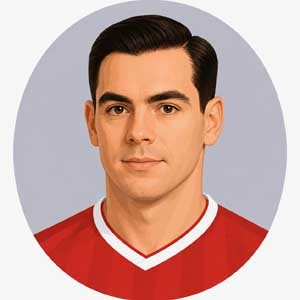
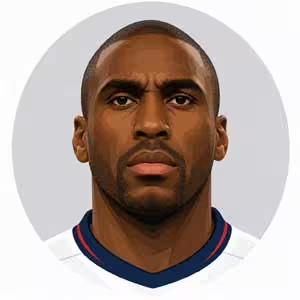
Wales - GoalkeeperKelsey, Jack
Wembley, October 1953, a friendly against a Rest of the World XI assembled to celebrate the Football Association's ninetieth anniversary. A twenty-two-year-old Welsh goalkeeper new to the England scene produced a performance regarded, in the years that followed, as one of the finest ever given between the posts on that pitch, undefeated with the world's best strikers as opponents. Jack Kelsey had been an Arsenal reserve two years earlier. Within a decade he was considered by many of his own goalkeeping contemporaries — including Lev Yashin, who called him one of the best in the world — the standard the position was measured against.
Born in Llansamlet, near Swansea, in 1929, the son of a steelworker, Kelsey combined an imposing physical presence — tall, broad-shouldered, exceptionally strong in the hands — with a calm positional sense unusual for the era's more instinctive, acrobatic goalkeeping culture. His handling was regarded as close to faultless, and he commanded his box and dealt with crosses through anticipation and physical dominance rather than spectacular diving saves, a style that made him look, to contemporaries, less flamboyant than he was effective. He joined Arsenal from Winch Wen and made his first-team debut in 1951, going on to make more than 350 appearances across a decade as the club's first-choice goalkeeper through the 1950s, though the period produced no major trophies for Arsenal, whose broader fortunes were in relative decline after the club's pre-war and immediate post-war dominance. He was recognised individually rather than collectively: named the First Division's outstanding goalkeeper in multiple seasons by his peers. For Wales he won 41 caps and was the first-choice goalkeeper for the country's sole appearance at a World Cup, in 1958, where Wales reached the quarter-finals.
His career ended abruptly rather than through decline. A serious spinal injury sustained in a 1962 match against Brazil's Botafogo, in a testimonial-style fixture, forced his retirement at thirty-three, at a point when he remained one of the most respected goalkeepers in Britain — a limitation imposed entirely by circumstance rather than by any erosion of ability. Within the era's tactical constraints, his game, like that of most goalkeepers of the period, offered nothing in distribution beyond a long clearance, and he played behind Arsenal defences that were not, for most of his career, strong enough to make full use of his consistency; a goalkeeper of his quality operating for a club regularly challenging for honours might have left a considerably larger trophy legacy.
Temperamentally he was quiet, physically imposing rather than vocally dominant, and widely respected rather than colourful. Kelsey organised his defence through presence and command of his area rather than continuous instruction, a natural authority that colleagues attributed to his sheer physical stature as much as to any verbal leadership. He was known as a calm, undemonstrative professional with a clean reputation, uninvolved in the disciplinary or media controversies that occasionally touched contemporaries at other clubs, and his standing among opposing goalkeepers — including the most decorated of his generation — reflected a professional admiration built on consistency rather than personality. He carried Welsh identity with evident pride through a period when the national team's opportunities for global visibility were rare, and the 1958 World Cup appearance remained, for a footballer of an unglamorous non-English nation in that era, the closest thing to international recognition available. Away from the pitch he lived without controversy, and the abruptness of his enforced retirement — a serious injury rather than a decline in form — left a career widely regarded by those who saw it as considerably greater than its trophy record documents. Steady, physically dominant and quietly authoritative, Kelsey belonged to a goalkeeping tradition built on presence rather than performance, cut short by circumstance rather than by time.



 All Time ArsenalClub