We use Google Analytics to understand how visitors use this site. Analytics cookies are only activated with your consent. For details, read our Privacy Policy.
Profile lensThe same player, read from a different angle.
Athletic79
Acceleration
79
Pace
75
Agility
81
Strength
76
Balance
80
Jumping
75
Stamina
82
Fitness
87
Technical92
Dribbling
93
Short Passing
92
Long Passing
93
Finishing
87
Shot Accuracy
86
Shot Power
84
Shooting Technique
89
Heading
77
Tackling
58
Crossing
91
Free Kick
82
Penalties
90
First Touch
95
Mental84
Composure
91
Aggression
78
Consistency
85
Creativity
93
Leadership
76
Work Rate
77
Tactical90
Vision
94
Off the Ball
87
Defensive Positioning
60
Teamwork
95
Anticipation
84
Marking
49
Player Traits
Attacking86
Crossing
91
Finishing
87
Heading Accuracy
77
Shot Accuracy
86
Off the Ball
87
Technique91
Dribbling
93
Free Kick
82
Short Passing
92
Long Passing
93
First Touch
95
Shot Technique
89
Movement79
Acceleration
79
Pace
75
Agility
81
Balance
80
Physicality81
Shot Power
84
Jumping
75
Stamina
82
Strength
76
Fitness
87
Defending56
Marking
49
Tackling
58
Def. Positioning
60
Mentality & Game Reading86
Aggression
78
Composure
91
Penalties
90
Vision
94
Leadership
76
Work Rate
77
Teamwork
95
Anticipation
84
Consistency
85
Creativity
93
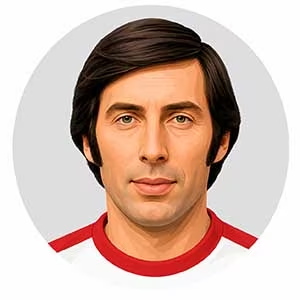
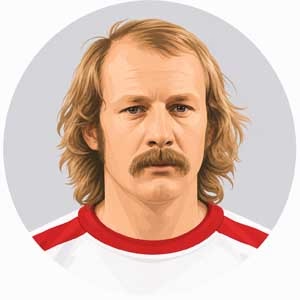
Poland - Attacking MidfielderDeyna, Kazimierz
Languid, upright elegance on the ball, panoramic vision, and curling trajectory from dead-ball deliveries made Kazimierz Deyna the tactical architect of Poland’s golden era throughout the 1970s. Forged at ŁKS Łódź before becoming the creative fulcrum of Legia Warsaw—where he captured two Polish league titles (1969, 1970) and reached the semi-finals of the 1969–70 European Cup—Rogal (The Croissant, earned for his banana-shaped curving shots) was a deep-lying orchestrator (playmaker-regista) of the highest European caliber. Operating in the central corridor with a deceptively lazy stride, Deyna possessed an exquisite first touch that opened up immediate 360-degree passing angles, allowing him to launch forty-yard diagonal balls that unlocked defensive lines or score directly from corner kicks (gol olímpico). Across 97 caps and 41 goals for Poland, he captained the national side through its greatest triumphs: winning the Gold Medal at the 1972 Munich Olympics as the tournament's top scorer, securing the Silver Medal in Montreal in 1976, and driving Kazimierz Górski’s squad to a historic third-place finish at the 1974 World Cup in West Germany, finishing third in the 1974 Ballon d'Or behind Johan Cruyff and Franz Beckenbauer.
Nevertheless, Deyna’s aristocratic game featured glaring physical and psychological liabilities. He played at his own deliberate pace, refusing to engage in heavy defensive tracking or physical midfield dogfights, which left his defensive line vulnerable against intense, high-pressing midfields. His move to Manchester City in 1978 exposed these limitations: struggling with the relentless physical tempo and brutal aerial challenges of English football, recurring injuries restricted him to just 38 league appearances before he transitioned to the North American Soccer League with the San Diego Sockers. Furthermore, when Poland was under severe psychological pressure at the 1978 World Cup in Argentina, his crucial penalty miss against Ubaldo Fillol exposed a vulnerability in clutch tournament moments.
Introverted, proud, and often carrying an air of melancholic detachment, Deyna was a complex genius who required tactical trust to flourish. He did not lead through vocal rhetoric or aggressive fist-pumping; he dictated terms through his supreme technical confidence, demanding that every transition funnel through his boots. On the pitch, his body language could swing toward aloofness when his team was out of possession, yet he would instantly silence critics with a single stroke of his right foot that changed the course of a match. Inside the Legia and Polish locker rooms, he was an enigmatic patriarch—deeply respected by fiery teammates like Robert Gadocha and Grzegorz Lato, even when regional club rivalries caused friction within the national setup. When marked by aggressive enforcers who sought to disrupt his cadence with physical fouls, Deyna responded with nonchalant first-time passes that exposed the space left behind by his marker. Referees found him calm and detached, cementing an enduring legacy as the most visionary, technically gifted, and elegant playmaker in the history of Eastern European football.