We use Google Analytics to understand how visitors use this site. Analytics cookies are only activated with your consent. For details, read our Privacy Policy.
Profile lensThe same player, read from a different angle.
Athletic80
Acceleration
91
Pace
83
Agility
87
Strength
68
Balance
74
Jumping
72
Stamina
82
Fitness
79
Technical82
Dribbling
88
Short Passing
74
Long Passing
87
Finishing
83
Shot Accuracy
77
Shot Power
88
Shooting Technique
79
Heading
67
Tackling
41
Crossing
84
Free Kick
86
Penalties
85
First Touch
85
Mental79
Composure
82
Aggression
78
Consistency
77
Creativity
84
Leadership
80
Work Rate
77
Tactical79
Vision
82
Off the Ball
83
Defensive Positioning
48
Teamwork
84
Anticipation
76
Marking
44
Player Traits
Attacking79
Crossing
84
Finishing
83
Heading Accuracy
67
Shot Accuracy
77
Off the Ball
83
Technique83
Dribbling
88
Free Kick
86
Short Passing
74
Long Passing
87
First Touch
85
Shot Technique
79
Movement84
Acceleration
91
Pace
83
Agility
87
Balance
74
Physicality78
Shot Power
88
Jumping
72
Stamina
82
Strength
68
Fitness
79
Defending44
Marking
44
Tackling
41
Def. Positioning
48
Mentality & Game Reading81
Aggression
78
Composure
82
Penalties
85
Vision
82
Leadership
80
Work Rate
77
Teamwork
84
Anticipation
76
Consistency
77
Creativity
84
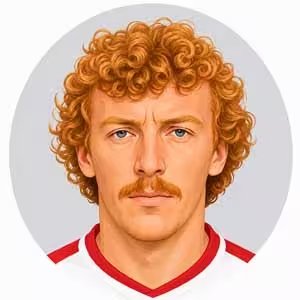
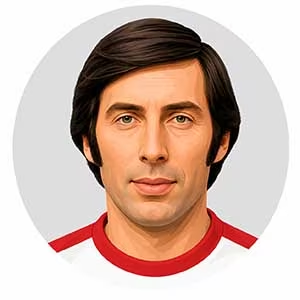
Poland - Left WingerGadocha, Robert
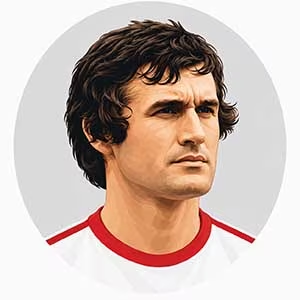
Gadocha was a left winger in the classical positional sense but an unusually complete interpreter of the role. Around 1.70 metres tall, he was light, fast and exceptionally balanced, carrying the ball close to either foot before suddenly changing pace or direction. His father had made him practise extensively with both feet as a child, and although he operated from the left, he was comfortable manipulating defenders without becoming predictable. Legia’s own history describes a winger who stayed wide, received almost on the touchline and then attacked the penalty area at full speed, beating opponents through body balance, short touches and acceleration. He could cross accurately after reaching the outside, cut inward to combine, and deliver dangerous corners and free kicks. Hockey experience in his youth also contributed to his balance and close control. After developing with Garbarnia and Wawel Kraków, Gadocha joined Legia Warsaw in the late 1960s and became one of the club’s defining attackers, winning consecutive Polish championships in 1969 and 1970 and reaching the 1970 European Cup semi-final. Legia records 279 competitive appearances and 88 goals for him. He was central to Poland’s Olympic gold in 1972 and the third-place finish at the 1974 World Cup, where his service repeatedly created goals for Grzegorz Lato, Andrzej Szarmach and Kazimierz Deyna. In 1975, after prolonged restrictions on Polish players moving abroad, he became one of the first major internationals permitted to join a Western European club, signing for Nantes. His international career ended later that year after 62 caps and 16 goals.
His freedom carried real tactical costs. Gadocha liked the duel and was willing to hold possession long enough to tempt defenders toward him, which inevitably produced turnovers when the dribble failed. Polish accounts explicitly remember that supporters tolerated those losses because of what happened when he beat two or three opponents, but the inefficiency still existed. Aggressive marking could also reduce his influence if defenders prevented him turning before the acceleration began. He was not physically imposing, and repeated contact could force him away from the rhythm in which balance and change of pace were most effective. His best football also depended on width and permission to isolate defenders; rigid systems that required the winger to circulate possession conservatively or spend long periods defending deep removed much of his value. After leaving Poland, he never reproduced the authority he had enjoyed at Legia and with the national team. The move to Nantes expanded his experience but also showed that adaptability was not unlimited: his peak had been built inside a team whose attacking structure gave his individualism room to operate.
Psychologically, Gadocha combined strong self-belief with a distinctly independent streak. Former teammates remembered him as an individualist who nevertheless joked with the group, could be helpful and was regarded as one of the more intellectually engaged members of the national side. Legia’s history emphasises ambition and stubbornness as qualities that helped him win over Warsaw supporters. That confidence could become sharp when status was challenged. One younger Legia teammate recalled nutmegging Gadocha in training and immediately receiving a kick in return; a trivial incident, but useful evidence that humiliation in direct competition could trigger retaliation rather than detachment. At the same time, Gadocha survived constant aggressive marking without developing a reputation for habitual disciplinary collapse. His primary response to defenders was usually to try the duel again. The political and institutional restrictions around his proposed foreign transfer reveal another trigger. By 1974–75, European clubs wanted him, yet Polish authorities repeatedly controlled whether he could leave. Gadocha pushed hard for the move and ultimately obtained permission to join Nantes, suggesting that institutional constraint was more difficult for him to accept than tactical discipline inside a team. The most uncomfortable episode concerns the 1974 World Cup. Argentine players later said they had collected money to incentivise Poland to beat Italy; intermediary Iggy Bocwinski claimed the payment reached Gadocha and that he kept it rather than distributing it to teammates. Grzegorz Lato, Władysław Żmuda and Jan Tomaszewski later treated the allegation seriously and criticised him. Gadocha denied the story, and no definitive documentary resolution exists. It therefore cannot responsibly be presented as established conduct, but the controversy materially affected how former teammates later viewed him. His behaviour after leaving the national team also suggests limited attachment to symbolic status. When foreign-club commitments complicated selection, he reportedly responded that younger players should now compete for places rather than publicly demanding continued inclusion. Gadocha’s profile is therefore contradictory in a useful way: socially integrated but individualistic, capable of team creation while strongly protective of personal standing, and highly tolerant of competitive risk while less tolerant of external control over his career.