We use Google Analytics to understand how visitors use this site. Analytics cookies are only activated with your consent. For details, read our Privacy Policy.
Profile lensThe same player, read from a different angle.
Athletic83
Acceleration
92
Pace
87
Agility
84
Strength
82
Balance
79
Jumping
77
Stamina
81
Fitness
83
Technical84
Dribbling
91
Short Passing
81
Long Passing
82
Finishing
84
Shot Accuracy
82
Shot Power
87
Shooting Technique
82
Heading
78
Tackling
37
Crossing
85
Free Kick
75
Penalties
74
First Touch
87
Mental77
Composure
82
Aggression
80
Consistency
78
Creativity
82
Leadership
72
Work Rate
73
Tactical78
Vision
82
Off the Ball
85
Defensive Positioning
40
Teamwork
77
Anticipation
77
Marking
38
Player Traits
Attacking83
Crossing
85
Finishing
84
Heading Accuracy
78
Shot Accuracy
82
Off the Ball
85
Technique83
Dribbling
91
Free Kick
75
Short Passing
81
Long Passing
82
First Touch
87
Shot Technique
82
Movement86
Acceleration
92
Pace
87
Agility
84
Balance
79
Physicality82
Shot Power
87
Jumping
77
Stamina
81
Strength
82
Fitness
83
Defending38
Marking
38
Tackling
37
Def. Positioning
40
Mentality & Game Reading78
Aggression
80
Composure
82
Penalties
74
Vision
82
Leadership
72
Work Rate
73
Teamwork
77
Anticipation
77
Consistency
78
Creativity
82
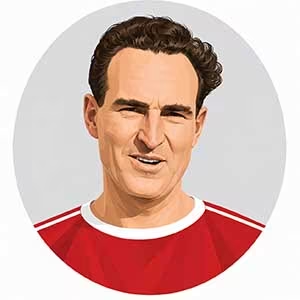
Denmark - Left WingerPræst, Carl Aage
The left touchline of post-war Serie A belonged to Carl Aage Præst, an elusive Danish outside-left whose balance, surgical crossing, and tactical discipline turned Juventus into the dominant force of Italian football in the early 1950s. Like his compatriot John Hansen, Præst caught the attention of Italian scouts during Denmark's bronze-medal run at the 1948 London Olympics, arriving in Turin from Østerbros Boldklub (ØB) as a refined, technically complete winger. Far from an individualistic dribbler who slowed down attacking transitions, Præst was a master of acceleration through body feints: dropping his left shoulder to unbalance his marker, driving straight toward the byline, and delivering driven, mathematically precise crosses into the path of Hansen and Giampiero Boniperti. Over seven seasons with Juventus spanning 232 league appearances and 51 goals, he formed the creative engine of two Scudetto-winning sides (1949–50 and 1951–52), before finishing his Italian journey with a brief stint at Lazio. His technical elegance was underpinned by an unusual physical stamina, allowing him to track back and provide defensive cover along the flank long before the wide midfielder role was formally modernized in Italian tactical manuals. Because turning professional barred him from international football under Denmark’s strict amateurism code, his senior national tally froze at 24 caps and 17 goals, preserving his legendary status primarily within the history of Italian club football.
Psychologically, Præst was an introverted, deeply modest professional whose quiet work ethic provided the perfect counterweight to the combustible, high-pressure atmosphere of 1950s Italian football. He navigated the cultural leap from post-war Copenhagen to the industrial spotlight of Turin with understated Scandinavian cool, completely immune to the vanity and celebrity trappings of the era. On the pitch, his temperament was placid and unyielding; he took heavy, cynical hacking from Italian full-backs who struggled to cope with his lateral agility, yet he never retaliated, rolled theatrically, or contested refereeing decisions. Inside the locker room, he was a peaceful, highly respected figure who communicated through tactical dependability rather than vocal outbursts, earning the lifelong admiration of Boniperti for his unselfish service to the team's forward line. Under the suffocating pressure of title run-ins against the fierce AC Milan and Inter sides of the era, his nervous system remained flat; he demanded the ball in tight spaces along the chalk and made split-second decisions with mechanical clarity. Toward match officials and opponents, Præst carried himself with old-school, aristocratic sportsmanship: absorbing bruising contact cleanly, getting instantly back to his feet, and letting his immaculate crossing technique serve as his only statement on the pitch.



 All Time DenmarkNT