We use Google Analytics to understand how visitors use this site. Analytics cookies are only activated with your consent. For details, read our Privacy Policy.
Profile lensThe same player, read from a different angle.
Athletic80
Acceleration
74
Pace
77
Agility
73
Strength
87
Balance
82
Jumping
86
Stamina
79
Fitness
84
Technical85
Dribbling
80
Short Passing
82
Long Passing
78
Finishing
91
Shot Accuracy
91
Shot Power
90
Shooting Technique
92
Heading
95
Tackling
33
Crossing
78
Free Kick
72
Penalties
78
First Touch
84
Mental79
Composure
85
Aggression
78
Consistency
78
Creativity
76
Leadership
75
Work Rate
74
Tactical84
Vision
81
Off the Ball
92
Defensive Positioning
37
Teamwork
82
Anticipation
86
Marking
33
Player Traits
Attacking89
Crossing
78
Finishing
91
Heading Accuracy
95
Shot Accuracy
91
Off the Ball
92
Technique81
Dribbling
80
Free Kick
72
Short Passing
82
Long Passing
78
First Touch
84
Shot Technique
92
Movement77
Acceleration
74
Pace
77
Agility
73
Balance
82
Physicality85
Shot Power
90
Jumping
86
Stamina
79
Strength
87
Fitness
84
Defending34
Marking
33
Tackling
33
Def. Positioning
37
Mentality & Game Reading79
Aggression
78
Composure
85
Penalties
78
Vision
81
Leadership
75
Work Rate
74
Teamwork
82
Anticipation
86
Consistency
78
Creativity
76
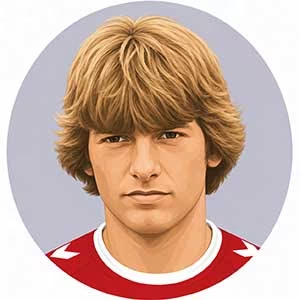
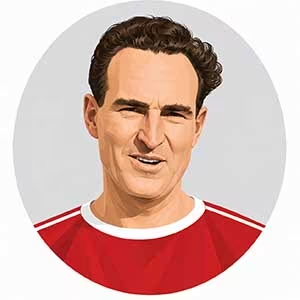
Denmark - ForwardHansen, John
Landing in post-war Italy following a sensational seven-goal campaign at the 1948 London Olympics, John Angelo Valdemar Østergaard Hansen became one of the most prolific foreign goalscorers in Serie A history, spearheading Juventus through one of their most dominant post-war eras. An inside-forward and central striker who learned his craft at Frem in Copenhagen, Hansen was a physical anomaly for Italian defenders of the late 1940s: robust, athletic, and possessing exceptional elevation and neck-muscle snap that made his aerial game virtually unplayable inside the eighteen-yard box. Far from a static target-man, his technical foundation included a heavy, accurate strike with either boot, sharp diagonal anticipation across the penalty arc, and an intuitive understanding of combination play alongside compatriot Karl Aage Præst and Giampiero Boniperti. Over a celebrated six-year spell with Juventus spanning 187 appearances, Hansen netted 124 league goals, capturing two Scudetti (1949–50 and 1951–52) and finishing as Serie A's Capocannoniere in 1952 with 30 goals—a staggering tally in an era dominated by rigid man-to-man marking. After a brief, solid stint with Lazio, Danish football’s strict amateurism rules permanently locked him out of the national side after just eight caps (and 10 goals), making his club achievements in Turin his definitive professional legacy.
Mentally and emotionally, Hansen was a figure of quiet nobility, immense dignity, and absolute professional focus who adapted effortlessly to the intense cultural demands of Italian Calcio. Making the leap from an amateur Danish printer to a high-profile foreign import in Turin, he never let fame or the sudden spotlight distort his grounded nature. On the pitch, his leadership was purely functional; he was not a vocal instigator or an emotional agitator, choosing instead to dictate matches through constant physical availability, high tactical discipline, and a willingness to absorb grueling challenges from Italian stoppers without complaint. Inside the locker room, he was universally admired by his Italian teammates—courteous, reserved, and fiercely dedicated to physical conditioning at a time when sports science was still in its infancy. Under the intense psychological heat of championship run-ins against Inter and Milan, his concentration remained unshakeable, treating high-leverage scoring chances with cool mechanical execution. Toward match officials and aggressive markers who frequently resorted to heavy physical obstruction, Hansen maintained an immaculate standard of Scandinavian sportsmanship: refusing to engage in retaliatory fouls, diving, or dissent, earning universal respect across Italian stadiums as one of the cleanest, most lethal gentleman-forwards of his era.


 All Time DenmarkNT