We use Google Analytics to understand how visitors use this site. Analytics cookies are only activated with your consent. For details, read our Privacy Policy.
Profile lensThe same player, read from a different angle.
Athletic82
Acceleration
92
Pace
87
Agility
95
Strength
65
Balance
77
Jumping
75
Stamina
83
Fitness
78
Technical81
Dribbling
92
Short Passing
77
Long Passing
76
Finishing
80
Shot Accuracy
76
Shot Power
79
Shooting Technique
82
Heading
63
Tackling
49
Crossing
82
Free Kick
78
Penalties
87
First Touch
87
Mental76
Composure
78
Aggression
77
Consistency
75
Creativity
83
Leadership
72
Work Rate
76
Tactical76
Vision
80
Off the Ball
81
Defensive Positioning
52
Teamwork
76
Anticipation
74
Marking
39
Player Traits
Attacking76
Crossing
82
Finishing
80
Heading Accuracy
63
Shot Accuracy
76
Off the Ball
81
Technique82
Dribbling
92
Free Kick
78
Short Passing
77
Long Passing
76
First Touch
87
Shot Technique
82
Movement88
Acceleration
92
Pace
87
Agility
95
Balance
77
Physicality76
Shot Power
79
Jumping
75
Stamina
83
Strength
65
Fitness
78
Defending47
Marking
39
Tackling
49
Def. Positioning
52
Mentality & Game Reading78
Aggression
77
Composure
78
Penalties
87
Vision
80
Leadership
72
Work Rate
76
Teamwork
76
Anticipation
74
Consistency
75
Creativity
83
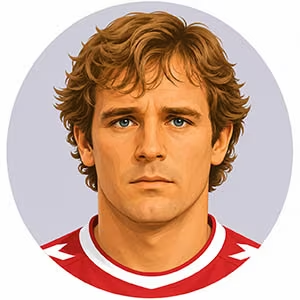
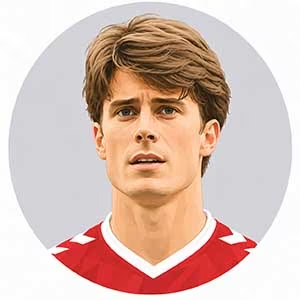
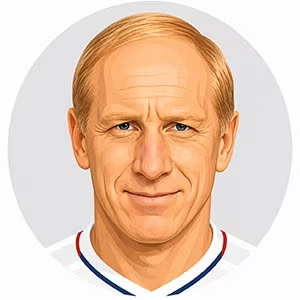
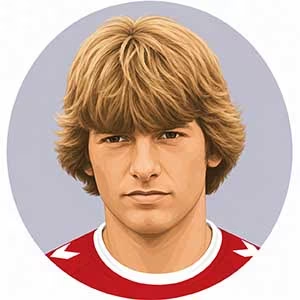
Denmark - Left WingerOlsen, Jesper
A diminutive, elusive phantom on the left wing whose game was woven entirely from balance, trickery, and sudden changes of rhythm, Jesper Olsen stood as one of the purest, most electrifying wide dribblers of the 1980s. Rising through Næstved before becoming an idol at Ajax, Manchester United, Bordeaux, and Caen, The Flea (Loppen) operated with an impossibly low center of gravity and featherweight agility that left towering, flat-footed full-backs grasping at empty air. His technical artistry was quintessential Dutch school with a Danish twist: sharp inside-out body feints, sudden bursts along the touchline, and delicate, pinpoint crossing off his natural left foot. Famously, it was Olsen who executed the audacious, revolutionary "passed penalty" alongside Johan Cruyff against Helmond Sport in 1982, immortalizing his tactical wit. Across his spell under Ron Atkinson and Sir Alex Ferguson at Old Trafford—lifting the 1985 FA Cup—and as a key weapon in Sepp Piontek’s vibrant Danish Dynamite squad at Euro 1984 and the 1986 World Cup, Olsen turned wide play into pure theater. Psychologically, Olsen was a sensitive, deeply modest artist who carried the playful innocence of street football into the ruthless gladiatorial arenas of Europe. He had zero interest in athletic intimidation or theatrical self-aggrandizement; his joy came purely from the ball at his feet and the thrill of a clean, technical duel. Inside the locker room, he was a quiet, polite, and universally cherished figure—unassuming, well-liked across multiple cultures, and completely devoid of ego. The defining crucible of his mental resilience came at the 1986 World Cup in Mexico: after dazzling the tournament, his ill-fated backpass against Spain in the Round of 16 led directly to Emilio Butragueño's equalizer and an eventual 5-1 collapse, spawning the famous Danish phrase en rigtig Jesper Olsen (a real Jesper Olsen). Yet, rather than crumbling under the weight of national heartbreak, Olsen absorbed the trauma with profound dignity and quiet stoicism, refusing to deflect blame, continuing his career in the demanding English and French top flights with head held high. Toward referees and ruthless defenders who routinely tried to kick him out of matches, Olsen remained an immaculate sportsman, never diving, complaining, or retaliating, letting his fleet-footed poetry float above the brutal physical challenges of his era.


 All Time DenmarkNT