We use Google Analytics to understand how visitors use this site. Analytics cookies are only activated with your consent. For details, read our Privacy Policy.
Profile lensThe same player, read from a different angle.
Athletic79
Acceleration
91
Pace
84
Agility
92
Strength
69
Balance
72
Jumping
72
Stamina
77
Fitness
77
Technical84
Dribbling
92
Short Passing
82
Long Passing
86
Finishing
82
Shot Accuracy
82
Shot Power
77
Shooting Technique
85
Heading
66
Tackling
33
Crossing
82
Free Kick
75
Penalties
74
First Touch
88
Mental75
Composure
79
Aggression
76
Consistency
74
Creativity
90
Leadership
70
Work Rate
72
Tactical77
Vision
82
Off the Ball
84
Defensive Positioning
39
Teamwork
76
Anticipation
75
Marking
38
Player Traits
Attacking79
Crossing
82
Finishing
82
Heading Accuracy
66
Shot Accuracy
82
Off the Ball
84
Technique85
Dribbling
92
Free Kick
75
Short Passing
82
Long Passing
86
First Touch
88
Shot Technique
85
Movement85
Acceleration
91
Pace
84
Agility
92
Balance
72
Physicality74
Shot Power
77
Jumping
72
Stamina
77
Strength
69
Fitness
77
Defending37
Marking
38
Tackling
33
Def. Positioning
39
Mentality & Game Reading77
Aggression
76
Composure
79
Penalties
74
Vision
82
Leadership
70
Work Rate
72
Teamwork
76
Anticipation
75
Consistency
74
Creativity
90
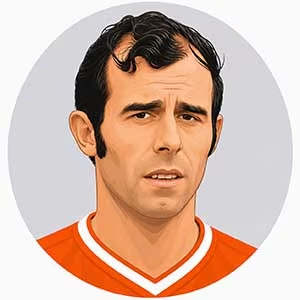
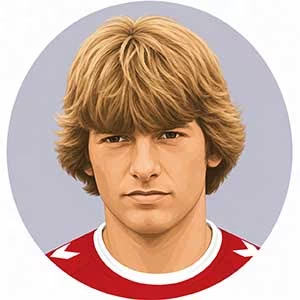
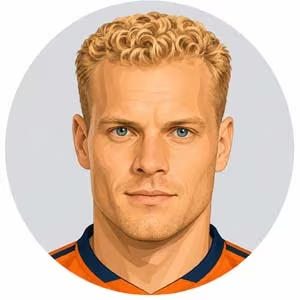
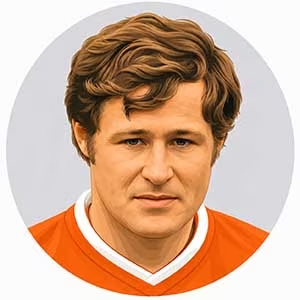
Netherlands - Left WingerMoulijn, Coen
A sudden, sharp burst down the left touchline followed by a trademark shimmy that left opposing defenders tackling shadows turned a working-class hero from the Oude Noorden neighborhood into the eternal soul of Rotterdam's footballing identity. Coenraad "Coen" Moulijn was the quintessential classical outside-left: an untouchable dribbling virtuoso whose delicate balance, pinpoint crossing, and effortless one-on-one mastery provided the attacking ammunition for Feyenoord’s historic rise to domestic and European supremacy.
Gliding down the left wing with his socks around his calves, Moulijn operated with immaculate technical finesse. He was virtually impossible to push off the ball because he avoided physical contact altogether, using subtle hip drops and lightning-fast inside-out touches to breeze past full-backs before delivering razor-sharp cutbacks onto the boots of Ove Kindvall or Henk Schouten. A loyal one-club titan, he made 487 league appearances and scored 84 goals for Feyenoord between 1955 and 1972, sweeping five Eredivisie championships, two KNVB Cups, the 1969–70 European Cup against Celtic in Milan, and the 1970 Intercontinental Cup against Estudiantes. For the Netherlands, across 38 caps and four goals, he stood as the country's undisputed marquee attraction during the pre-Totaalvoetbal era, captaining the national team with distinction.
Moulijn’s specialized, line-hugging game, however, belonged to the classical era of wing play. He was not a physical, modern athlete who tracked back sixty yards to perform defensive duties inside his own penalty box, nor did he possess a thumping long-range shot with his weaker right foot. When confronted by ultra-cynical, destructive defenders who kicked him relentlessly from the opening whistle on waterlogged, muddy pitches, his flowing rhythm could be disrupted if the referee failed to provide adequate protection.
Modest, authentic, and forever rooted in his community—continuing to run his local haberdashery and ladies' clothing shop in Rotterdam throughout and after his playing career—Moulijn was an adored folk hero who represented the unpretentious working-class ethos of his city. He had no ego, rejecting massive financial overtures from Spanish and Italian giants because he simply could not imagine leaving his beloved Rotterdam. On the pitch, his body language was fluid, alert, and thoroughly graceful: dancing down the touchline with a mischievous glint in his eye and celebrating victories with modest, warm smiles. Inside De Kuip, where a bronze statue now permanently honors his memory, he was a revered patriarch whose loyalty, breathtaking dribbling skill, and spotless sporting conduct made him an immortal monument of Dutch football history.