We use Google Analytics to understand how visitors use this site. Analytics cookies are only activated with your consent. For details, read our Privacy Policy.
Profile lensThe same player, read from a different angle.
Athletic81
Acceleration
83
Pace
81
Agility
81
Strength
71
Balance
78
Jumping
83
Stamina
91
Fitness
78
Technical79
Dribbling
79
Short Passing
82
Long Passing
81
Finishing
75
Shot Accuracy
71
Shot Power
84
Shooting Technique
73
Heading
73
Tackling
79
Crossing
77
Free Kick
67
Penalties
68
First Touch
78
Mental81
Composure
84
Aggression
90
Consistency
78
Creativity
74
Leadership
82
Work Rate
83
Tactical82
Vision
83
Off the Ball
73
Defensive Positioning
75
Teamwork
87
Anticipation
84
Marking
79
Player Traits
Attacking74
Crossing
77
Finishing
75
Heading Accuracy
73
Shot Accuracy
71
Off the Ball
73
Technique77
Dribbling
79
Free Kick
67
Short Passing
82
Long Passing
81
First Touch
78
Shot Technique
73
Movement81
Acceleration
83
Pace
81
Agility
81
Balance
78
Physicality81
Shot Power
84
Jumping
83
Stamina
91
Strength
71
Fitness
78
Defending78
Marking
79
Tackling
79
Def. Positioning
75
Mentality & Game Reading81
Aggression
90
Composure
84
Penalties
68
Vision
83
Leadership
82
Work Rate
83
Teamwork
87
Anticipation
84
Consistency
78
Creativity
74
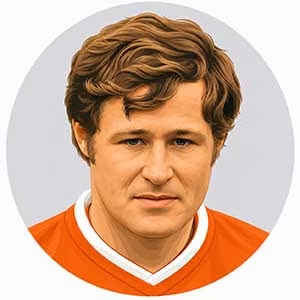
Netherlands - Centre MidfielderJansen, Wim
Rotterdam pragmatism found its absolute tactical brain in Wilhelmus Marinus Antonius Jansen, the quiet polymath whose spatial literacy anchored both Ernst Happel’s Feyenoord and the revolutionary Dutch national sides of the 1970s. Naturally suited to the holding midfield slot but equally imperious when dropping into the sweeper role or sliding out to full-back, Jansen was the quintessential low-friction connector. Standing five-foot-nine with a compact center of gravity, he never wasted a touch: his game was an exercise in clean half-turns, sharp horizontal recycling, and an uncanny knack for intercepting forward passes without ever needing to lunge or hit the turf. As the tactical metronome of Feyenoord, he captained the club through their historic 1969–70 European Cup and Intercontinental Cup double, along with four Eredivisie titles and the 1974 UEFA Cup, before later lifting another league title during a brief, controversial stint with Ajax. Earning 65 caps for the Netherlands, he was one of only four players—alongside Ruud Krol, Wim Suurbier, and Johan Neeskens—to start both the 1974 and 1978 World Cup finals, serving as the essential defensive brain that allowed the expansive, fluid mechanisms around him to function without structural collapse.
Understated, intellectually driven, and completely allergic to the cult of personality, Jansen carried an almost clinical detachment that made him Johan Cruyff’s favorite tactical interlocutor. He possessed no desire for personal headlines or individual accolades; his satisfaction came entirely from seeing the team’s collective geometry operate with mathematical efficiency. On the pitch, his communication was unobtrusive and precise—directing pressing triggers with subtle hand gestures and positioning adjustments rather than theatrical shouting. Inside the locker room, he was a peaceful, highly respected mediator who bridged fierce club rivalries between the Amsterdam and Rotterdam contingents, commanding universal authority through his flawless tactical diagnosis. When facing the agonizing heartbreak of back-to-back World Cup final defeats against host nations, his mental baseline remained dignified and analytical, absorbing defeat without public tantrums or finger-pointing. Toward match officials and aggressive adversaries, Jansen operated with pristine Northern European sportsmanship: never simulating contact, avoiding retaliatory cynicism, and leaving an indelible legacy as one of the most intelligent, versatile, and unheralded cornerstones of Dutch Total Football.